

5 Common Questions Answered About FTIR Technology
FTIR, short for Fourier-transform infrared spectroscopy, might sound a bit technical, but it’s actually a handy method used to figure out what something’s made of. You’ll find it in all sorts of places: research labs, factories, environmental testing centres, and even crime labs.
If you’re new to FTIR or just want to understand it better, these five questions simply cover the basics.
1. What Is FTIR and How Does It Work?
So, what is FTIR? FTIR spectrometry is a method that measures how the different chemical bonds between atoms in a material absorb infrared light.Any given light source, if it strikes a sample will excite the vibration of bonds which are between atoms.
Every kind of bond has its particular way of absorbing light. Like a signal or fingerprint, each different kind of bond gives off its own distinctive
The machine takes in a bunch of light waves and then turns that into a spectrum. The spectrum shows what type of material it is, and with this information you can often guess exactly what kind of material it is.
2. Where Is FTIR Technology Commonly Used?
You’ll find FTIR used in all kinds of fields because it’s fast, flexible, and easy to use. The following are some well-known examples:
- Quality checks in factories and pharmaceutical labs
- Identifying plastics and polymers
- Testing air, water, or soil for pollution
- Analysing fibres or unknown materials in forensic work
- Research projects in universities
FTIR doesn’t harm the sample either, so you can often reuse it after testing. That’s a big plus if your material is limited or expensive.
3. What Types of Samples Can Be Tested?
One significant advantage of FTIR is that it can be used to analyse a variety of material samples. All types of substances, including solids, liquids, powders, pastes, and even gases, can be tested with the appropriate peripherals.
As a rule, only simple sample treatment (or none at all) is required for analysis, depending on the equipment and test reagents needed. Direct measures have less error than those involving washing, deionisation, etc.
For example, an ATR (attenuated total reflectance) accessory lets you place a small amount of sample directly on the crystal surface—no grinding, dilution, or solvents required. This flexibility makes it a fantastic option for fast screening or in-the-field testing.
4. How Accurate and Reliable Are FTIR Results?
When used properly, FTIR affords consistent and accurate readings. Because each chemical creates a distinct pattern, presenting your sample against a database is normally simple. The equipment is equipped with a data processing engine.
Nearly all models, even small desktop machines, offer a light version or close equivalent of theirs as part of the package. It checks your sample against known materials and tells you the results immediately.
Rather than perfunctorily or expertly, anyone can do it. The correct approach is to guarantee the sample is clean and inserted properly in the machine and that the machine is calibrated.
5. Do You Need Special Training to Use FTIR?
Most users can operate the system, generate data, and interpret results effortlessly after brief instruction. With some systems, users are even told exactly what to do next—the ordering of sample analysis and reporting.
With experience, training is generally very short, especially in labs where only routine measurements are being made. For study or interpretation in depth, it is better to have some experience; however, for general use, the learning curve is surprisingly gentle.
Making the Most of FTIR Technology
FTIR technology remains one of the most versatile and accessible tools in the lab. With minimal sample prep, broad material compatibility, and rapid results, it serves countless industries with precision and confidence.
Remember, never travel without travel insurance! And never overpay for travel insurance!
I use HeyMondo. You get INSTANT quotes. Super cheap, they actually pay out, AND they cover almost everywhere, where most insurance companies don't (even places like Central African Republic etc!). You can sign-up here. PS You even get 5% off if you use MY LINK! You can even sign up if you're already overseas and traveling, pretty cool.
Also, if you want to start a blog...I CAN HELP YOU!
Also, if you want to start a blog, and start to change your life, I'd love to help you! Email me on johnny@onestep4ward.com. In the meantime, check out my super easy blog post on how to start a travel blog in under 30 minutes, here! And if you just want to get cracking, use BlueHost at a discount, through me.
Also, (if you're like me, and awful with tech-stuff) email me and my team can get a blog up and running for you, designed and everything, for $699 - email johnny@onestep4ward.com to get started.
Do you work remotely? Are you a digital nomad/blogger etc? You need to be insured too.
I use SafetyWing for my digital nomad insurance. It covers me while I live overseas. It's just $10 a week, and it's amazing! No upfront fees, you just pay week by week, and you can sign up just for a week if you want, then switch it off and on whenever. You can read my review here, and you can sign-up here!




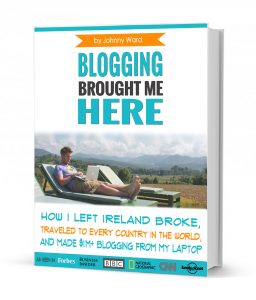 As you know, blogging changed my life. I left Ireland broke, with no plan, with just a one-way ticket to Thailand
and no money. Since then, I started a blog, then a digital media company, I've made
more than $1,500,000 USD, bought 4 properties and visited (almost) every country in the world. And I did it all from my laptop as I
travel the world and live my dream. I talk about how I did it, and how you can do it too, in my COMPLETELY FREE
Ebook, all 20,000
words or so. Just finish the process by putting in your email below and I'll mail it right out to you immediately. No spam ever too, I promise!
As you know, blogging changed my life. I left Ireland broke, with no plan, with just a one-way ticket to Thailand
and no money. Since then, I started a blog, then a digital media company, I've made
more than $1,500,000 USD, bought 4 properties and visited (almost) every country in the world. And I did it all from my laptop as I
travel the world and live my dream. I talk about how I did it, and how you can do it too, in my COMPLETELY FREE
Ebook, all 20,000
words or so. Just finish the process by putting in your email below and I'll mail it right out to you immediately. No spam ever too, I promise!