

How to Finance a Life Abroad When You Have Zero Savings and Zero Safety Net
Moving abroad with nothing in the bank sounds like a fantasy — or a disaster waiting to happen. But the truth is, thousands of people do it every year. They leave with little more than a passport, a plan, and a willingness to figure things out along the way. The money side of living overseas can feel like the biggest wall standing between you and the life you want. It does not have to be. With the right financial strategy, it is entirely possible to fund a life abroad even when you are starting from zero.
Table of contents
- How to Finance a Life Abroad When You Have Zero Savings and Zero Safety Net
- Start With an Honest Look at What You Actually Need
- Funding Option 1: Income You Can Generate Before You Leave
- Funding Option 2: Employer-Sponsored Relocation and Remote Roles
- Funding Option 3: Teaching English or Skilled Trade Work Overseas
- Funding Option 4: Student Loans for Your International Move
- Funding Option 5: Government Programs, Grants, and Scholarships
- Managing Risk When You Have No Safety Net
- The Mindset That Makes It Work
- Final Thoughts
Start With an Honest Look at What You Actually Need
Before you can solve a financial problem, you need to understand its size.
Most people overestimate what it costs to live abroad and underestimate how many options exist to fund it. Your first step is not to save — it is to research. Look at the real cost of living in your target destination. Rent, food, transport, health insurance, visa fees, and emergency reserves. Write it all down.
The Numbers That Actually Matter
Break your budget into three categories:
- Setup costs — flights, deposits, first month’s rent, admin fees
- Monthly running costs — the recurring expenses to keep you alive and legal
- Emergency buffer — a minimum of one to three months of living costs
Once you have those numbers, you know what you are working toward. You also know which funding options are realistic for your situation.
Funding Option 1: Income You Can Generate Before You Leave
The fastest way to fund a move abroad is to generate income before you go.
This does not mean landing a six-figure remote job overnight. It means identifying skills you already have and finding people willing to pay for them online. Writing, design, translation, customer support, bookkeeping, tutoring — these are all viable starting points. Platforms like Upwork and Fiverr let you start earning with no upfront investment.
Even part-time freelance income of a few hundred dollars a month changes your options significantly. Start small. Build your client base while you are still at home. By the time you move, you will have at least a portion of your income sorted.
Funding Option 2: Employer-Sponsored Relocation and Remote Roles
More companies now hire internationally and some cover relocation costs.
If you are currently employed, ask. Many people never do. Your employer may offer a relocation allowance, a remote working arrangement, or a transfer to an overseas office. The worst they can say is no. And if they do say no, that conversation might still prompt you to look for roles at companies that do support international employees.
Remote-first companies are a strong target. Look for job boards that list “remote, worldwide” positions. Getting hired before you move removes most of the financial risk from the equation.
Funding Option 3: Teaching English or Skilled Trade Work Overseas
It is not glamorous. It works.
Teaching English abroad remains one of the most accessible ways to fund a life overseas, particularly across Asia, the Middle East, and Latin America. Many programs provide free or subsidised housing, a monthly salary, and visa sponsorship. You arrive with a job, a place to live, and a paycheck lined up. The financial pressure drops immediately.
Beyond teaching, skilled tradespeople — electricians, plumbers, construction workers — are often in high demand in growing economies. If you have a trade qualification, research whether it transfers to your destination country. The pay can be surprisingly competitive.
Funding Option 4: Student Loans for Your International Move
If you are relocating abroad for education, student loans may be one of the most structured and accessible funding options available to you.
Many people moving overseas are simultaneously enrolling in foreign universities, and the combination of tuition fees and living costs creates a significant funding gap. This is exactly where international student loans come into play. Unlike general personal loans, these are designed with students in mind — often featuring deferred repayment options, lower interest rates, and terms that account for the reality that you will not be earning a full income while you study.
International student loans can cover more than just tuition. Depending on the lender and program, funds may extend to housing, travel, course materials, and other setup costs associated with building a life in a new country. That flexibility makes them a practical tool for bridging the gap between what scholarships or savings cover and what the move actually costs.
It is worth noting that eligibility and terms vary considerably depending on your nationality, your destination country, and the institution you are attending. Some loans require a co-signer based in your home country; others are tied to specific university partnerships. Researching your options early — before you have committed to a program — gives you the most leverage.
One principle applies regardless of which loan product you choose: borrow what you need, not what you qualify for. Income uncertainty is a reality when you are starting over in a new country, and keeping your debt manageable from the outset will give you far more flexibility once you graduate and begin building your life abroad.
Funding Option 5: Government Programs, Grants, and Scholarships
Free money exists. Most people never apply for it.
Governments, universities, and private foundations offer grants and scholarships for people relocating abroad to study, work, or start businesses. Programs like the Fulbright Scholarship, the Chevening Awards, and the DAAD program in Germany provide not just tuition coverage but living stipends too. The Fulbright Program alone funds thousands of international exchanges every year across more than 160 countries.
The application process takes effort. That is exactly why most people do not bother — which means less competition than you think. If you are serious about moving abroad for education or professional development, spend a week researching what you qualify for before ruling it out.
Managing Risk When You Have No Safety Net
Zero savings means zero margin for error. That is not a reason not to go — it is a reason to plan differently.
Build a Micro-Emergency Fund First
Even $500 to $1,000 set aside before you leave changes your risk profile. It covers a missed payment, a medical co-pay, or a last-minute flight if something goes wrong. If you cannot save that before leaving, delay your departure by a few weeks. It is worth it.
Choose Your Destination Strategically
Not all countries are created equal for someone arriving with limited funds. Lower cost-of-living destinations give you more runway. Countries with strong expat job markets reduce your time to income. Countries with reciprocal healthcare agreements reduce your insurance burden. These factors matter enormously when your buffer is thin.
Keep Your Fixed Costs as Low as Possible Early On
Your first months abroad are not the time to lock in a long lease or buy furniture. Stay flexible. Short-term accommodation, shared housing, and furnished rooms are more expensive per night but far cheaper as a mistake if your plans change. Give yourself room to adjust.
The Mindset That Makes It Work
Here is what separates people who successfully finance a move abroad from those who do not: they treat the financial problem as solvable, not permanent.
A lack of savings is a starting position. It is not a life sentence. Every option listed above — freelancing, remote work, teaching, equity loans, scholarships — is accessible to someone starting from zero. Some take longer. Some require applications. Some require you to make the first move in a conversation with your employer.
None of them require a windfall or a rich relative.
Final Thoughts
Financing a life abroad from nothing is uncomfortable. It demands creativity, discipline, and a willingness to explore options that feel unfamiliar. But it is not impossible — not even close. The people who make it work are not the ones with the most money. They are the ones who treat funding as a problem to solve rather than a wall to be stopped by. Start with what you have, build toward what you need, and give yourself permission to move before everything is perfect. It rarely is. That is not the point.
Remember, never travel without travel insurance! And never overpay for travel insurance!
I use HeyMondo. You get INSTANT quotes. Super cheap, they actually pay out, AND they cover almost everywhere, where most insurance companies don't (even places like Central African Republic etc!). You can sign-up here. PS You even get 5% off if you use MY LINK! You can even sign up if you're already overseas and traveling, pretty cool.
Also, if you want to start a blog...I CAN HELP YOU!
Also, if you want to start a blog, and start to change your life, I'd love to help you! Email me on johnny@onestep4ward.com. In the meantime, check out my super easy blog post on how to start a travel blog in under 30 minutes, here! And if you just want to get cracking, use BlueHost at a discount, through me.
Also, (if you're like me, and awful with tech-stuff) email me and my team can get a blog up and running for you, designed and everything, for $699 - email johnny@onestep4ward.com to get started.
Do you work remotely? Are you a digital nomad/blogger etc? You need to be insured too.
I use SafetyWing for my digital nomad insurance. It covers me while I live overseas. It's just $10 a week, and it's amazing! No upfront fees, you just pay week by week, and you can sign up just for a week if you want, then switch it off and on whenever. You can read my review here, and you can sign-up here!









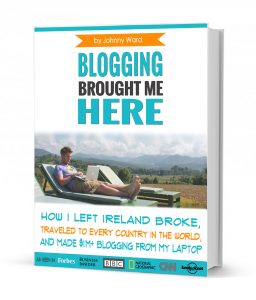 As you know, blogging changed my life. I left Ireland broke, with no plan, with just a one-way ticket to Thailand
and no money. Since then, I started a blog, then a digital media company, I've made
more than $1,500,000 USD, bought 4 properties and visited (almost) every country in the world. And I did it all from my laptop as I
travel the world and live my dream. I talk about how I did it, and how you can do it too, in my COMPLETELY FREE
Ebook, all 20,000
words or so. Just finish the process by putting in your email below and I'll mail it right out to you immediately. No spam ever too, I promise!
As you know, blogging changed my life. I left Ireland broke, with no plan, with just a one-way ticket to Thailand
and no money. Since then, I started a blog, then a digital media company, I've made
more than $1,500,000 USD, bought 4 properties and visited (almost) every country in the world. And I did it all from my laptop as I
travel the world and live my dream. I talk about how I did it, and how you can do it too, in my COMPLETELY FREE
Ebook, all 20,000
words or so. Just finish the process by putting in your email below and I'll mail it right out to you immediately. No spam ever too, I promise!