

Adventure Proofing Your Body: Why Joint Longevity is the Key to a Lifetime of Travel
We talk a lot about the bucket list. We talk about the flights, the gear, and the currency exchange rates. But we rarely talk about the hardware that actually gets us there. I’m talking about your knees. Your hips. Your ankles. The stuff that actually carries you up that trail in Madeira or through the cobblestone alleys of Prague.
Travel is physical. Even the “relaxing” kind involves more miles on your feet than a standard week at the office. If you want to keep doing this when you’re sixty, seventy, or eighty, you have to treat your body like a long-term asset rather than a rental car you’re planning to crash.
Table of contents
The Reality of the “Adventure Tax”
Every trek comes with a price. Not just the cost of the boots, but the tax on your cartilage. Most people think about fitness in terms of cardio or lung capacity. Can I breathe at this altitude? Can I walk five miles? Those are good questions. However, the more pressing issue for longevity is the structural integrity of your frame.
Muscle recovers in days. Lungs adjust in a week. Cartilage, however; that’s a finite resource. Once you wear it down to the bone, the adventure stops. Or at least, it becomes a lot less fun. You start looking at stairs as enemies rather than pathways. You skip the hidden beach because the climb back up feels like a punishment.
Why We Ignore the Creaks
We have a habit of pushing through. We take an ibuprofen and keep moving. It works in your twenties. It might even work in your thirties. But eventually, the bill comes due.
- Micro-trauma accumulation: Small stumbles on a trail might not cause an injury today, but they add up over a decade.
- Inflammation cycles: Constant travel often means poor sleep and high-sodium food; both are fuel for joint pain.
- Sedentary gaps: We go from sitting at a desk for three months to hiking twenty miles in a weekend. That’s a recipe for a blowout.
Investing in the Internal Infrastructure
If you want to stay mobile, you have to move away from the “workout” mindset and into the “maintenance” mindset. This isn’t about looking good in a swimsuit on a beach in Bali. It’s about ensuring your hinges don’t rust shut before you’ve seen the rest of the world.
The best way to handle this is through targeted support. Sometimes, the body needs a little extra help to manage the wear and tear of a high-mileage lifestyle. When the knees start to feel a bit “thin” or the hips lose that fluid range of motion, professional-grade interventions can make a massive difference. Finding a reliable Doctor Medica online shop allows travelers to access the kind of high-quality products often used in clinical settings to support tissue health. It’s about being proactive. You wouldn’t take a car on a cross-country road trip with a leaking radiator; you shouldn’t take your body into the wilderness without ensuring the “fluids” and “padding” are up to the task.
The Mechanics of Movement
It’s not just about what you put into your body. It’s about how you use it. Most of us walk wrong. We hike with a heavy pack and lean too far forward. We put all the pressure on our patellas.
Think about your body as a series of shock absorbers. If your ankles are stiff, your knees have to take the hit. If your hips are tight, your lower back pays the price. To keep traveling, you need to keep those joints “loose” but “stable.” It’s a delicate balance.
Breaking the “Tough It Out” Habit
There is this weird pride in the travel community about suffering. “I did the Inca Trail with a bum ankle.” Cool. But can you do it again in ten years? Probably not.
Instead of pride in pain, we should take pride in preparation. This means doing the boring stuff. It means the eccentric lunges. It means the mobility work. It means recognizing that a day of rest isn’t a “waste” of a vacation day; it’s an investment in the next five trips.
The Hidden Cost of Modern Travel
Budget airlines are a nightmare for joint health. I’m serious. Cramming a six-foot frame into a seat designed for a child for ten hours causes real physiological stress. Your joints crave movement. They need synovial fluid to circulate. When you’re locked in a 17-inch wide seat, that fluid stagnates.
Then, we land and immediately grab a thirty-pound suitcase and start walking. Our bodies are stiff, cold, and poorly lubricated. That’s when the “tweak” happens. The sudden pull in the lower back. The sharp snap in the knee.
We need to start treating the transit portion of travel as an athletic event. Hydrate. Move in the aisles. Stretch the moment you hit the terminal. It sounds “extra,” but it’s the difference between hitting the ground running and hitting the ground limping.
Changing the Narrative on Aging
We’ve been sold a lie that getting older means stopping. That travel eventually becomes “scenic bus tours” and nothing else. That only happens if you let your physical foundation crumble.
I’ve seen eighty-year-olds in the Himalayas. They weren’t the fastest, but they were there. The common thread among them wasn’t elite genetics. It was a lifelong commitment to joint maintenance. They didn’t ignore the aches. They addressed them. They used the right supports. They kept their weight in check to reduce the load on their frames.
The Longevity Mindset
Travel is a privilege of the mobile. We take it for granted until the first time we can’t comfortably get out of a low chair or a boat.
Think about the places you still want to see. The Dolomites. The Great Wall. The streets of Tokyo. All of those places require a body that can pivot, climb, and endure. Your joints are the gatekeepers to those experiences.
Stop thinking about “getting fit” for a trip. Start thinking about “proofing” your body for a lifetime. It’s a shift from short-term goals to long-term capability. It’s less about the peak of the mountain and more about the ability to keep walking toward the next one.
Remember, never travel without travel insurance! And never overpay for travel insurance!
I use HeyMondo. You get INSTANT quotes. Super cheap, they actually pay out, AND they cover almost everywhere, where most insurance companies don't (even places like Central African Republic etc!). You can sign-up here. PS You even get 5% off if you use MY LINK! You can even sign up if you're already overseas and traveling, pretty cool.
Also, if you want to start a blog...I CAN HELP YOU!
Also, if you want to start a blog, and start to change your life, I'd love to help you! Email me on johnny@onestep4ward.com. In the meantime, check out my super easy blog post on how to start a travel blog in under 30 minutes, here! And if you just want to get cracking, use BlueHost at a discount, through me.
Also, (if you're like me, and awful with tech-stuff) email me and my team can get a blog up and running for you, designed and everything, for $699 - email johnny@onestep4ward.com to get started.
Do you work remotely? Are you a digital nomad/blogger etc? You need to be insured too.
I use SafetyWing for my digital nomad insurance. It covers me while I live overseas. It's just $10 a week, and it's amazing! No upfront fees, you just pay week by week, and you can sign up just for a week if you want, then switch it off and on whenever. You can read my review here, and you can sign-up here!



 As you know, blogging changed my life. I left Ireland broke, with no plan, with just a one-way ticket to Thailand
and no money. Since then, I started a blog, then a digital media company, I've made
more than $1,500,000 USD, bought 4 properties and visited (almost) every country in the world. And I did it all from my laptop as I
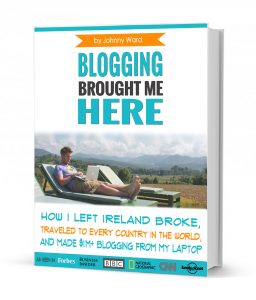
travel the world and live my dream. I talk about how I did it, and how you can do it too, in my COMPLETELY FREE
Ebook, all 20,000
words or so. Just finish the process by putting in your email below and I'll mail it right out to you immediately. No spam ever too, I promise!
As you know, blogging changed my life. I left Ireland broke, with no plan, with just a one-way ticket to Thailand
and no money. Since then, I started a blog, then a digital media company, I've made
more than $1,500,000 USD, bought 4 properties and visited (almost) every country in the world. And I did it all from my laptop as I
travel the world and live my dream. I talk about how I did it, and how you can do it too, in my COMPLETELY FREE
Ebook, all 20,000
words or so. Just finish the process by putting in your email below and I'll mail it right out to you immediately. No spam ever too, I promise!