


Entertainment in Your Pocket: From Arcades to Gaming-Style Apps
Airport Minutes Become Playable Time
Travel used to contain empty pockets of time. A gate delay meant staring at boards. A train ride meant folded papers. A hotel lobby meant small talk, bad coffee, or silence. Now the phone fills those gaps with quick play, music, chat, maps, video, and tiny contests of skill. This shift did not arrive overnight. Tetris appeared on the Hagenuk MT-2000 in 1994. Snake reached the Nokia 6110 in 1997. Those early titles were spare, yet deeply sticky. They proved one neat point. A small screen could change waiting. Today, that idea feels ordinary. People move through airports with chargers, earbuds, and saved apps. They use games during boarding calls, taxi queues, and late check-ins. Sessions can last two minutes. They can also run through a full delay. The appeal lies in fit. Arcade games suit a coffee queue. Puzzle apps suit a quiet carriage. Idle games tick along during baggage claim. Social play works well from hotel Wi-Fi. Travel time has become broken time. Mobile games suit broken time almost perfectly. They ask little space. They need little ceremony. They rarely demand a desk, console, or sofa. They sit beside tickets, passports, and camera rolls. In that sense, the phone has become a pocket arcade. It also acts as a private pause button. Movement still rules the day. Yet waiting now feels less passive, and more chosen.

Table of contents
The Small Catalogue Inside Every Trip
Travellers rarely stick to one format. They pick according to noise, battery, mood, signal, and time. Many start with a simple question: what types of games are there for short gaps? The answer keeps shifting, but the broad map is clear. Arcade and hyper-casual titles suit tiny sessions. They use taps, swipes, loops, and instant restarts. Puzzle and logic apps need more focus. They fit flights, ferry rides, and long station stops. Strategy and idle titles suit longer waits. They let progress build while attention drifts. Social and multiplayer apps work when Wi-Fi feels stable. They turn a dull hotel room into a chatty contest. Casino-style apps also sit inside this larger mobile mix. They borrow the pace, symbols, and reward loops of older rooms, then resize them for touchscreens. The key point is context. A person checking departure boards may choose a puzzle. Someone parked in a lounge may prefer cards. In this broad group, an online casino can appear as one category among many, not as the whole story. Age rules, local law, and payment caution still matter. The wider point concerns choice. Different types of games answer different travel moods. That is why phones contain so many small rituals. A train delay can mean chess. A taxi queue can mean pinball. A hotel lift can mean one last tap.
Why Phones Make Play Fit the Road
Mobile play works because its design respects interruption. Travel is full of it. Gates change. Bags arrive. Food turns up. A seat number gets called. Good mobile titles accept that chaos. They save often. They load fast. They pause cleanly. Many also run offline, or with weak signal. That matters on planes, rural trains, ferries, and crowded terminals. Cloud saves add another layer. A player can start on a phone, then return later from a tablet. Cross-device sync turns spare minutes into part of a longer pattern. Interface design matters too. Buttons must sit near thumbs. Text must remain readable outdoors. Menus must be clear under stress. A station bench is not a quiet study. It is loud, bright, and often cramped. The best mobile design knows this. The GSMA’s Mobile Economy research shows how mobile connectivity now underpins much daily media use. Games are part of that shift. Behaviour has changed with the tools. People switch apps often. They scan, tap, reply, pause, and return. Attention breaks into slices. So games built for travel avoid heavy setup. They offer fast feedback and quick closure. Some types of video games still ask for deep focus. Mobile travel play usually does not. It is closer to a snack than a banquet. Small rewards, clear goals, and fast exits matter most.
Travel Now Has Its Own Screen Rhythm
The modern trip is no longer only movement. It is also a chain of screen moments. A boarding pass appears. A map updates. A message lands. A game fills the pause between those acts. This pattern has changed how people think about delay. Waiting can still annoy. Bad Wi-Fi still tests patience. Batteries still fail at cruel times. Yet mobile games give structure to time that once felt wasted. They create small markers during movement. One puzzle before boarding. One race before the train. One idle check before sleep. From arcade apps to card tables, the phone now carries a private menu of play. It moves with the user, not the room. That is the main cultural turn. Entertainment used to wait at a place. Now it travels inside a pocket. The device turns queues, lounges, cabins, and rented rooms into small media spaces. It also makes choice more personal. Some want speed. Some want thought. Some want social play. Some want luck-based formats. The best answer to “types of games” is therefore not a fixed list. It is a travel habit. People reach for the format that fits the minute. The road still has its frictions. Yet the pause between places has changed. It has become playable, portable, and quietly central to modern movement.
Remember, never travel without travel insurance! And never overpay for travel insurance!
I use HeyMondo. You get INSTANT quotes. Super cheap, they actually pay out, AND they cover almost everywhere, where most insurance companies don't (even places like Central African Republic etc!). You can sign-up here. PS You even get 5% off if you use MY LINK! You can even sign up if you're already overseas and traveling, pretty cool.
Also, if you want to start a blog...I CAN HELP YOU!
Also, if you want to start a blog, and start to change your life, I'd love to help you! Email me on johnny@onestep4ward.com. In the meantime, check out my super easy blog post on how to start a travel blog in under 30 minutes, here! And if you just want to get cracking, use BlueHost at a discount, through me.
Also, (if you're like me, and awful with tech-stuff) email me and my team can get a blog up and running for you, designed and everything, for $699 - email johnny@onestep4ward.com to get started.
Do you work remotely? Are you a digital nomad/blogger etc? You need to be insured too.
I use SafetyWing for my digital nomad insurance. It covers me while I live overseas. It's just $10 a week, and it's amazing! No upfront fees, you just pay week by week, and you can sign up just for a week if you want, then switch it off and on whenever. You can read my review here, and you can sign-up here!









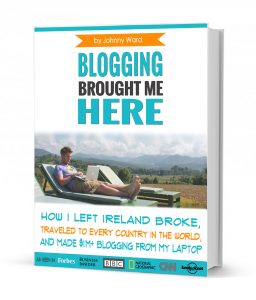 As you know, blogging changed my life. I left Ireland broke, with no plan, with just a one-way ticket to Thailand
and no money. Since then, I started a blog, then a digital media company, I've made
more than $1,500,000 USD, bought 4 properties and visited (almost) every country in the world. And I did it all from my laptop as I
travel the world and live my dream. I talk about how I did it, and how you can do it too, in my COMPLETELY FREE
Ebook, all 20,000
words or so. Just finish the process by putting in your email below and I'll mail it right out to you immediately. No spam ever too, I promise!
As you know, blogging changed my life. I left Ireland broke, with no plan, with just a one-way ticket to Thailand
and no money. Since then, I started a blog, then a digital media company, I've made
more than $1,500,000 USD, bought 4 properties and visited (almost) every country in the world. And I did it all from my laptop as I
travel the world and live my dream. I talk about how I did it, and how you can do it too, in my COMPLETELY FREE
Ebook, all 20,000
words or so. Just finish the process by putting in your email below and I'll mail it right out to you immediately. No spam ever too, I promise!