


Lesser-known Villages of Manaslu: Hidden Beauty of the Himalayas
While most of the trekkers in Nepal travel for stunning panoramic views, diverse landscapes, and rich wildlife, traditional remote villages secretly capture trekkers’ attention.
Usually, Everest Base Camp (EBC) or the Annapurna Circuit attracts most of the travellers globally. However, tucked away from these commercial trails, the Manaslu Circuit Trek has been gaining popularity for its glaciers, rivers, monasteries, and some of the most authentic villages in Nepal.
Unlike the heavily commercialized trails, the Manaslu Circuit Trek introduces trekkers to some of the most remote and culturally rich villages en route. These villages, untouched by modern tourism, aren’t just a stop point; they’re a living museum of culture, tradition, and Himalayan hospitality.
If you’re planning your trek with companies like Himalayan Masters, you’ll come to realize that the Manaslu journey isn’t just about mountains, but the Tibetan communities that you meet along the route.
Table of contents
- Lesser-known Villages of Manaslu: Hidden Beauty of the Himalayas
- Machha Khola: The first Overnight Place of the Trek
- Jagat: A Village of Stone and Tradition
- Deng: First Encounter with Tibetan Culture
- Namrung: A Cultural and Scenic Delight
- Lho: The Village with a View
- Samagaon: The heart of Manaslu
- Samdo: Life at the Edge
- Dharmashala: The Last Outpost
- Why These Villages Matter
Machha Khola: The first Overnight Place of the Trek
After a tiring day of riding from Kathmandu to Machha Khola, about 7-8 hours of driving, Machha Khola serves as the first overnight stay location for many trekkers.
This village might seem ordinary at first glance, but it offers the first experience of rural life. As you move forward, the villages will get more remote and basic.
Situated along the Budi Gandaki River, the village sits in the middle of lush forests and terraced fields.
Spend a few moments preparing yourself for the trail ahead and immerse yourself in the beauty of Machha Khola, a remote yet comfortable village.
Jagat: A Village of Stone and Tradition
Designated as a UNESCO World Heritage, entry point to Manaslu Conservation Area, Jagat is one of the most unique villages en route.
Built with traditional stone houses and narrow lanes, Jagat reflects the authentic tradition of Tibetan-influenced culture.
The people here are as friendly and welcoming as you can imagine. Trekkers can get a glimpse of the traditional lifestyle and an insight into local farming lifestyles.
Watching locals weave baskets, dry maize or grains in the sun, cattle returning after grazing for the whole day, or the children chase each other, these things are what make the trek worthwhile.
Here, you feel like a step back in time.
Deng: First Encounter with Tibetan Culture
As the trail ascends, the air gets thinner and the landscapes pristine.
Deng is one of the first villages where Tibetan-influenced culture becomes more significant. The prayer flags fluttering in the gust of Himalayan winds, locals rotating prayer wheels, mani walls stretching throughout the village, and hymns of Buddhist mantras coming from monasteries, the entire atmosphere feels spiritual.
You get to interact with the locals, and might even be invited for a cup of butter tea, made from yak milk. Additionally, during festivals, you can not only observe ancient Tibetan Buddhist traditions, but also participate.
Namrung: A Cultural and Scenic Delight
Namrung is often paralleled for its stunning mountain views. From the village, you can get the first sight of Manaslu itself, glowing with morning sun.
Apart from its cinematic scenery, Namrung is a cultural hub where Tibetan-style houses, mani walls, prayer flags, and monasteries are found. It creates a different kind of serene peace.
Villagers are often seen in their traditional dress, always welcoming trekkers with a gentle smile and a “Namaste”.
Lho: The Village with a View
Among all the villages in the Manaslu Circuit Trek route, Lho is probably the most picturesque village. Lho is known for the most spectacular view of Manaslu.
There is a monastery on top of the hill that you can visit. This village is more than just a one-night place; it radiates a serene, spiritual aura. If you’re lucky, you might have the chance to observe evening prayers at the monastery, where young monks chant under flickering butter lamps.
It’s moments like this that make your trek meaningful and spiritual.
Samagaon: The heart of Manaslu
Probably the most popular village in the entire region, Samagaon is a famous Buddhist village. Trekkers can get some of the best views of Manaslu above the village and vast yak pastures.
The village also serves as an acclimatization place, offering various side trip options such as Manaslu Base Camp, Birendra Lake, or a hike to Pungyen Gompa.
Walking through Samagaon provides an experience of raw, remote, and authentic Tibetan culture, featuring chortens, stupas, monasteries, and prayer wheels.
Samdo: Life at the Edge
Situated near the Tibetan border, Samdo is one of the last settlements before trekkers head towards the Larkya La Pass.
Due to freezing winds, elevation, and limited farming possibilities, life here is quite challenging. However, the food and accommodation provided here are comfortable enough.
Moreover, trekking through some of the most remote villages in Manaslu is more about cultural immersion and experiencing village life.
For trekkers, Samdo is both a resting point and a lesson in survival at high altitude.
Dharmashala: The Last Outpost
Dharmashala is one of the highest permanent settlement villages in the Manaslu region and on the planet. It is more of a seasonal settlement than a permanent village.
Nearly at 4,500 meters, Dharmashala is the final mountain stop before crossing Larkya La Pass. The teahouses are basic, but the views of staggering peaks are just magical. It’s a peaceful and serene village, where you can reflect on yourself.
Though a harsh and challenging village, trekkers are rewarded with the experience of remote, Himalayan life.
Why These Villages Matter
The Manaslu Circuit Trek isn’t about snow-capped peaks or crossing high-altitude passes. But it’s more about cultural experience. It’s more about human interaction and exploring the Himalayan lifestyle in its purest form.
Each village en route holds its own charm, story, significance, and culture. Some villages offer a place to rest, some awe-inspiring views, and some offer the authentic taste of the Himalayas.
You tend to forget your busy life schedule and begin to get habituated to village life. One thing you must keep in mind is that, if you are expecting modern facilities or comfort, then this route is not for you.
Remember, never travel without travel insurance! And never overpay for travel insurance!
I use HeyMondo. You get INSTANT quotes. Super cheap, they actually pay out, AND they cover almost everywhere, where most insurance companies don't (even places like Central African Republic etc!). You can sign-up here. PS You even get 5% off if you use MY LINK! You can even sign up if you're already overseas and traveling, pretty cool.
Also, if you want to start a blog...I CAN HELP YOU!
Also, if you want to start a blog, and start to change your life, I'd love to help you! Email me on johnny@onestep4ward.com. In the meantime, check out my super easy blog post on how to start a travel blog in under 30 minutes, here! And if you just want to get cracking, use BlueHost at a discount, through me.
Also, (if you're like me, and awful with tech-stuff) email me and my team can get a blog up and running for you, designed and everything, for $699 - email johnny@onestep4ward.com to get started.
Do you work remotely? Are you a digital nomad/blogger etc? You need to be insured too.
I use SafetyWing for my digital nomad insurance. It covers me while I live overseas. It's just $10 a week, and it's amazing! No upfront fees, you just pay week by week, and you can sign up just for a week if you want, then switch it off and on whenever. You can read my review here, and you can sign-up here!


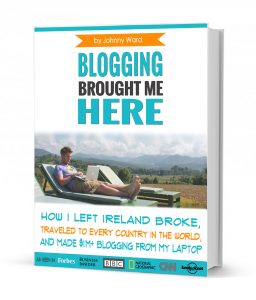 As you know, blogging changed my life. I left Ireland broke, with no plan, with just a one-way ticket to Thailand
and no money. Since then, I started a blog, then a digital media company, I've made
more than $1,500,000 USD, bought 4 properties and visited (almost) every country in the world. And I did it all from my laptop as I
travel the world and live my dream. I talk about how I did it, and how you can do it too, in my COMPLETELY FREE
Ebook, all 20,000
words or so. Just finish the process by putting in your email below and I'll mail it right out to you immediately. No spam ever too, I promise!
As you know, blogging changed my life. I left Ireland broke, with no plan, with just a one-way ticket to Thailand
and no money. Since then, I started a blog, then a digital media company, I've made
more than $1,500,000 USD, bought 4 properties and visited (almost) every country in the world. And I did it all from my laptop as I
travel the world and live my dream. I talk about how I did it, and how you can do it too, in my COMPLETELY FREE
Ebook, all 20,000
words or so. Just finish the process by putting in your email below and I'll mail it right out to you immediately. No spam ever too, I promise!