

Post-Expedition Skin Repair: Professional Treatments for Extreme Weather Damage
So, you’re back. You conquered the peak, or maybe you just spent three weeks getting blasted by salt spray and relentless UV on a high-altitude trek. You feel like a champion, but your face? Your face looks like a topographical map of the very terrain you just crossed. It’s tight. It’s red. It might even be peeling in ways that make you want to hide under a rock.
Expeditions do that. They strip away the fluff. Unfortunately, they also strip away your lipid barrier and leave your skin cells screaming for help. We spend so much time planning the gear, the calories, and the route; yet we usually treat skin care as an afterthought. A bit of sunscreen here, a splash of water there. Then the damage hits. It’s not just a tan. It’s deep-seated inflammation and structural breakdown from extreme environmental stress.
Fixing this isn’t about a fancy drugstore moisturizer. Not this time. When the weather has truly done a number on you, it’s time to look at the professional side of things. We need to talk about clinical intervention.
Table of contents
- Post-Expedition Skin Repair: Professional Treatments for Extreme Weather Damage
- The Reality of Environmental Trauma
- Clinical Hydration and Barrier Rescue
- Dealing with the UV Aftermath
- The Role of Bio-Stimulators
- Why “At-Home” Often Fails
- Rebuilding the Texture
- The Importance of the “Down Period”
- Final Thoughts on the Long Game
The Reality of Environmental Trauma
Extreme weather isn’t just “uncomfortable” for your skin. It’s a physical assault. High altitudes mean thinner air and significantly less protection from UV rays. You’re getting hit with radiation that’s far more intense than anything at sea level. Then there’s the wind. Constant, high-velocity wind acts like sandpaper. It creates micro-fissures in the stratum corneum.
By the time you get home, your skin is likely in a state of chronic “fight or flight.” It’s reactive. It’s dehydrated. The texture feels more like parchment than silk. To fix this, we have to move past the surface. We have to look at how to rebuild the foundation.
Clinical Hydration and Barrier Rescue
When you’ve spent weeks in sub-zero temperatures or arid deserts, your internal hydration levels are trashed. Drinking water helps, sure; but it rarely reaches the surface layers of the skin in the concentration needed to repair real damage. This is where professional-grade solutions come into play.
The goal here is to reintroduce essential building blocks directly into the dermal layers. We’re talking about high-concentration hyaluronic acid and bio-stimulators that jumpstart the repair process. Practitioners often turn to specialized Medical Spa RX aesthetic products to source the heavy hitters needed for this level of recovery. These aren’t your typical over-the-counter serums: they are formulated to penetrate deeper and stay there longer. Using professional-grade injectables or topicals can bridge the gap between “looking tired” and actually restoring the skin’s biological function. It’s about putting back exactly what the elements stole.
Key Focus Areas for Professional Repair
- Dermal Volumization: Replacing the plumpness lost to extreme dehydration and fat-pad depletion during high-exertion trips.
- Pigment Correction: Addressing the “mountain mask” or irregular brown spots caused by intense UV exposure.
- Vascular Calming: Reducing the persistent redness and broken capillaries that often result from extreme cold and windburn.
Dealing with the UV Aftermath
Sun damage from an expedition is a different beast. It’s cumulative and intense. You might notice new fine lines appearing almost overnight once the initial swelling of the trip subsides. That’s the collagen fibers breaking down under the weight of oxidative stress.
Chemical peels are a solid choice here, but you have to be careful. You can’t just go in with a high-strength acid while the skin is still compromised. A staged approach is better. First, calm the inflammation. Then, use professional-grade peels to lift away the damaged, hyper-pigmented cells. It’s a slow process. It requires patience. But it’s the only way to get back that clarity.
Lasers are another heavy hitter. Fractional CO2 or IPL can do wonders for the mottled texture that follows a long stint outdoors. They work by creating controlled micro-injuries: these force the body to produce fresh, healthy tissue. It’s essentially a reset button for your face.
The Role of Bio-Stimulators
Sometimes, the skin needs more than just a “refill.” It needs a wake-up call. Long-term exposure to harsh environments can make the skin sluggish. The natural turnover rate slows down. This is where bio-stimulators come in. These treatments don’t just fill a wrinkle; they encourage your own body to produce more collagen and elastin over several months.
Think of it as long-term insurance. You’re building up the skin’s resilience for the next time you decide to head into the wild. It’s a proactive way to handle the aging process that gets accelerated by an outdoor lifestyle. You aren’t just fixing the damage from the last trip: you are fortifying the skin for the one after that.
Why “At-Home” Often Fails
We all love a good face mask. But after a true expedition, a sheet mask from the local pharmacy is like bringing a squirt gun to a house fire. The concentration of active ingredients in consumer products is strictly regulated for safety; which means it’s often too low to effect real change in severely damaged skin.
Professional treatments involve higher potencies. They involve delivery systems that can actually get past the dead skin cells sitting on the surface. Plus, a professional can see what you can’t. They can tell the difference between simple dryness and a compromised skin barrier that needs specific lipids. They can identify the difference between a sunspot and something more concerning.
Rebuilding the Texture
Roughness is the most common complaint post-adventure. That “leathery” feel is the skin’s way of trying to protect itself. It thickens up in response to the wind and sun. To get back to a normal texture, you need professional exfoliation.
Dermabrasion or specialized hydra-dermabrasion treatments can strip away those layers of “armor” without causing further trauma. It’s a delicate balance. You want to remove the debris but you don’t want to leave the skin vulnerable. When done correctly, the result is an immediate shift in how light reflects off the face. You go from looking dull and gray to having a healthy, reflected glow.
The Importance of the “Down Period”
Recovery doesn’t happen while you’re still checking your gear. It happens in the weeks following your return. This is the time to be incredibly gentle with yourself. Avoid harsh scrubs. Avoid cheap products with high fragrance content.
Focus on professional consultations. Let a pro look at the damage under a magnifying lamp. They can create a roadmap. Maybe it starts with a series of deep-hydration sessions. Maybe it moves into laser work once the redness has settled. It’s a strategic play. You wouldn’t rush back into heavy training after a marathon; so don’t rush your skin back into a “normal” routine without giving it the specialized care it deserves.
Final Thoughts on the Long Game
Adventure leaves its mark. Some of those marks are great: memories, photos, a sense of accomplishment. But the marks on your face don’t have to be permanent. We live in an era where the science of skin recovery is incredibly advanced. You can push your limits in the mountains or on the ocean, and then you can come back and let technology fix the fallout.
It’s about balance. You take care of the soul by going out there; you take care of the vessel by seeking professional help when you get back. Your skin is your largest organ and your primary shield. It’s worth the investment. Treat the repair process with the same level of respect you gave the expedition itself. The results will speak for themselves when you look in the mirror and see yourself again; not just a weathered version of who you used to be.
Remember, never travel without travel insurance! And never overpay for travel insurance!
I use HeyMondo. You get INSTANT quotes. Super cheap, they actually pay out, AND they cover almost everywhere, where most insurance companies don't (even places like Central African Republic etc!). You can sign-up here. PS You even get 5% off if you use MY LINK! You can even sign up if you're already overseas and traveling, pretty cool.
Also, if you want to start a blog...I CAN HELP YOU!
Also, if you want to start a blog, and start to change your life, I'd love to help you! Email me on johnny@onestep4ward.com. In the meantime, check out my super easy blog post on how to start a travel blog in under 30 minutes, here! And if you just want to get cracking, use BlueHost at a discount, through me.
Also, (if you're like me, and awful with tech-stuff) email me and my team can get a blog up and running for you, designed and everything, for $699 - email johnny@onestep4ward.com to get started.
Do you work remotely? Are you a digital nomad/blogger etc? You need to be insured too.
I use SafetyWing for my digital nomad insurance. It covers me while I live overseas. It's just $10 a week, and it's amazing! No upfront fees, you just pay week by week, and you can sign up just for a week if you want, then switch it off and on whenever. You can read my review here, and you can sign-up here!




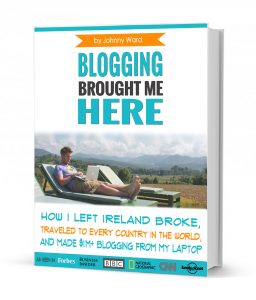 As you know, blogging changed my life. I left Ireland broke, with no plan, with just a one-way ticket to Thailand
and no money. Since then, I started a blog, then a digital media company, I've made
more than $1,500,000 USD, bought 4 properties and visited (almost) every country in the world. And I did it all from my laptop as I
travel the world and live my dream. I talk about how I did it, and how you can do it too, in my COMPLETELY FREE
Ebook, all 20,000
words or so. Just finish the process by putting in your email below and I'll mail it right out to you immediately. No spam ever too, I promise!
As you know, blogging changed my life. I left Ireland broke, with no plan, with just a one-way ticket to Thailand
and no money. Since then, I started a blog, then a digital media company, I've made
more than $1,500,000 USD, bought 4 properties and visited (almost) every country in the world. And I did it all from my laptop as I
travel the world and live my dream. I talk about how I did it, and how you can do it too, in my COMPLETELY FREE
Ebook, all 20,000
words or so. Just finish the process by putting in your email below and I'll mail it right out to you immediately. No spam ever too, I promise!