

Solo Workations and the Art of Creative Isolation
More freelancers gave up co-working desks this year for quiet rented rooms instead. Rents softened, visas stretched longer, and working alone somewhere unfamiliar stopped being a gimmick. Why does it work? Because real isolation sharpens focus instead of dulling it. Here’s where, how, and why solo workations actually hold up.
Table of contents
Why Solitude Beats the Shared Desk
Open-plan coworking spaces sell energy. Fair enough. But energy and focus aren’t the same thing, and after a few weeks most solo workers notice the difference. A shared desk gives you noise, small talk, someone’s Zoom call bleeding through your headphones. A private space gives you three uninterrupted hours before lunch — which, if you’ve ever tried to finish a first draft, is worth more than any networking event.
Take a one-bedroom villa in Bali as an example. No shared walls, no scheduled “collaboration hours,” just a desk, a pool you can see from it, and silence you control. That’s the whole pitch, really. Not luxury for its own sake — space that lets your brain do one thing at a time.
The Bali Calculation
Bali still wins the long game, and not by accident. The island solved the infrastructure problem years ago — decent fiber in Canggu and Uluwatu, backup generators most villas already have wired in, laundry and groceries a five-minute scooter ride away. None of that is glamorous. It’s just what makes six weeks of work actually possible instead of theoretical.
The 2026 Visa Reality
Here’s what people get wrong. The B211A social-cultural visa still works for shorter stretches, but it’s not built for remote income — technically you’re not supposed to earn from Indonesian soil on it, even if enforcement is loose. The E33G remote worker KITAS, introduced a couple of years back, is the cleaner route for anyone staying past two months: proof of foreign employer or clients, minimum income threshold, and it’s renewable without the visa-run theater that used to define Bali life. Slower paperwork, sure. But no more scooter trips to Singapore just to reset a stamp.
Uluwatu, Off the Postcard
If the villa sits near Uluwatu, know this before you plan your schedule around it: the good breaks — Padang Padang, Bingin — run best on a mid to low tide with a solid swell, usually April through October. Outside that window, the water’s flatter and the cliffs are quieter, which actually suits people who came to work, not surf. Locals plan their afternoons around the tide chart, not the clock. Worth doing the same, even if you don’t paddle out.
Building a Routine That Doesn’t Collapse
Novelty burns off fast. By week two, the palm trees stop registering as scenery and start registering as background. That’s the moment most solo workations either settle into something sustainable or quietly fall apart. A few things separate the two:
- Fix your start time before you leave home — don’t decide it on arrival, jet lag will decide it for you
- Cook or order the same breakfast for the first week; one less decision means one more hour of actual work
- Pick a hard stop, not a soft one — “I’ll wrap up around six” never works, “the sun sets, I close the laptop” does
The Four O’Clock Wall
Ask anyone who’s done this more than once: the afternoon slump hits harder abroad than it does at home. Heat, a heavier lunch, the temptation of a pool twenty feet away — it adds up. The fix isn’t caffeine, it’s structure. Move your hardest task to the morning, before nine, and let the afternoon absorb the lighter stuff. Sounds obvious. Almost nobody does it until the third week forces the issue.
What to Pack, What to Skip
Packing for a workation isn’t packing for a holiday, and treating it that way is the most common mistake first-timers make.
- A proper laptop stand — your neck will thank you after week one
- A universal adapter with surge protection, not the flimsy travel kind
- One noise-isolating headset, even if the villa is quiet; construction next door happens everywhere
- Skip the extra shoes, skip the “just in case” formalwear — nobody’s dressing up for a client call from a pool deck
Choosing the Right Kind of Quiet
Not every silence works the same way, and this is where people overspend or undershoot. A studio in a busy tourist strip gives you convenience (food, gyms, other remote workers to grab a coffee with) but also motorbike traffic at 7am and karaoke bars that don’t care about your deadline. A villa further inland or up toward Ubud gives you actual quiet, at the cost of a longer scooter ride for groceries.
There’s no universally right answer, only the right trade for the work you’re doing. Deep writing, design, anything that needs four unbroken hours? Go quieter, go further out. Calls with clients across time zones, quick turnarounds, constant Slack pings? Stay closer to reliable wifi and backup power, even if it costs more per night.
A Short List for Picking Location
- Check the actual fiber provider, not just “wifi available” in the listing — IndiHome and Biznet run differently across the island
- Ask about backup power specifically; brownouts happen more in rainy season, November through March
- Walk the route to the nearest warung and grocery stall before booking anything longer than two weeks — Google Maps lies about walking time here more than anywhere else
The Art of Working Alone, Well
So does it work — sitting alone with a laptop, an ocean nearby, and no one checking if you’re at your desk? For the people who plan it properly, yes. Not because the setting does the work for you, but because it removes everything that usually gets in the way. Quiet isn’t a backdrop here. It’s the whole point.
Remember, never travel without travel insurance! And never overpay for travel insurance!
I use HeyMondo. You get INSTANT quotes. Super cheap, they actually pay out, AND they cover almost everywhere, where most insurance companies don't (even places like Central African Republic etc!). You can sign-up here. PS You even get 5% off if you use MY LINK! You can even sign up if you're already overseas and traveling, pretty cool.
Also, if you want to start a blog...I CAN HELP YOU!
Also, if you want to start a blog, and start to change your life, I'd love to help you! Email me on johnny@onestep4ward.com. In the meantime, check out my super easy blog post on how to start a travel blog in under 30 minutes, here! And if you just want to get cracking, use BlueHost at a discount, through me.
Also, (if you're like me, and awful with tech-stuff) email me and my team can get a blog up and running for you, designed and everything, for $699 - email johnny@onestep4ward.com to get started.
Do you work remotely? Are you a digital nomad/blogger etc? You need to be insured too.
I use SafetyWing for my digital nomad insurance. It covers me while I live overseas. It's just $10 a week, and it's amazing! No upfront fees, you just pay week by week, and you can sign up just for a week if you want, then switch it off and on whenever. You can read my review here, and you can sign-up here!



 As you know, blogging changed my life. I left Ireland broke, with no plan, with just a one-way ticket to Thailand
and no money. Since then, I started a blog, then a digital media company, I've made
more than $1,500,000 USD, bought 4 properties and visited (almost) every country in the world. And I did it all from my laptop as I
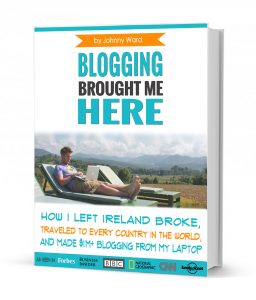
travel the world and live my dream. I talk about how I did it, and how you can do it too, in my COMPLETELY FREE
Ebook, all 20,000
words or so. Just finish the process by putting in your email below and I'll mail it right out to you immediately. No spam ever too, I promise!
As you know, blogging changed my life. I left Ireland broke, with no plan, with just a one-way ticket to Thailand
and no money. Since then, I started a blog, then a digital media company, I've made
more than $1,500,000 USD, bought 4 properties and visited (almost) every country in the world. And I did it all from my laptop as I
travel the world and live my dream. I talk about how I did it, and how you can do it too, in my COMPLETELY FREE
Ebook, all 20,000
words or so. Just finish the process by putting in your email below and I'll mail it right out to you immediately. No spam ever too, I promise!