

Top Residency Destinations for Medical Students and How to Afford the Move
Residency is one of the biggest transitions in a medical career. After years of coursework, clinical rotations, exams, and interviews, medical students finally move into a period of supervised practice where they begin working much more directly within their chosen specialties.
The location of that residency matters. Some students prioritize access to major academic medical centers, while others focus on cost of living, quality of life, specialty opportunities, or proximity to family. At the same time, moving for residency can be expensive. Travel, housing deposits, transportation, licensing costs, and basic household expenses can all arrive before a resident has received a full paycheck.
For that reason, choosing where to train is often both a career decision and a financial one.
Table of contents
- Top Residency Destinations for Medical Students and How to Afford the Move
- What Makes a Residency Destination Desirable?
- Boston: A Major Center for Academic Medicine
- New York City: Variety, Volume, and Specialized Training
- Houston: Major Medical Opportunities With a Different Cost Structure
- Chicago: Large Healthcare Systems and Broad Clinical Exposure
- How to Prepare for the Cost of Residency Travel and Relocation
- Look for Assistance Through the Residency Program
- Keep the First-Year Lifestyle Flexible
- Choose the Residency Program and the City Together
What Makes a Residency Destination Desirable?
There is no single best city for every medical resident. A destination that works well for someone pursuing cardiology may not offer the same advantages to a student interested in family medicine, pediatrics, psychiatry, or surgery.
Program reputation is one factor, but it is only part of the decision. Medical students may also consider the size of the hospital system, exposure to different patient populations, opportunities for research, faculty mentorship, fellowship placement, and the overall training environment.
Location can influence everyday life as well. Long commutes, expensive housing, or limited transportation options can add stress to an already demanding schedule. A slightly less expensive city with reliable public transportation or housing near the hospital may therefore be more practical than a famous destination with much higher living costs.
Students can use resources from the Association of American Medical Colleges (AAMC) to research residency preparation, application requirements, and broader information about the transition from medical school into graduate medical education.
Boston: A Major Center for Academic Medicine
Boston remains one of the most recognizable medical training destinations in the United States. The region is home to large teaching hospitals, research institutions, universities, and specialty programs that attract medical graduates from across the country.
For students interested in academic medicine or medical research, the concentration of institutions can be especially appealing. Residents may have opportunities to work alongside specialists involved in clinical trials, new treatment methods, and complex patient care.
The challenge is cost. Housing in and around Boston can take up a significant part of a resident’s income. Students moving there may need to consider roommates, hospital-affiliated housing, or neighborhoods farther from the center but connected by public transportation.
Planning these decisions before Match Day expenses begin to accumulate can make the transition easier.
New York City: Variety, Volume, and Specialized Training
New York offers something few medical markets can match: an enormous and diverse patient population. Residents may encounter a wide range of medical conditions, socioeconomic circumstances, languages, and healthcare settings.
The city also contains numerous academic hospitals, community hospitals, specialty centers, and public health institutions. That variety gives students many possible training environments.
However, New York can also be expensive. Rent, moving fees, transportation, and everyday purchases can quickly add up, particularly when a student is relocating from another state.
Residents considering New York should therefore look beyond base rent. Transportation costs, proximity to the hospital, utility expenses, and the possibility of sharing an apartment can all affect the true monthly cost of living.
Houston: Major Medical Opportunities With a Different Cost Structure
Houston attracts medical students in part because of the scale of its healthcare community. The city includes major hospitals, research organizations, and specialized treatment centers serving patients from across the region and beyond.
Compared with some coastal medical hubs, Houston may also offer more housing choices at different price levels. Still, affordability depends heavily on location and transportation.
Houston is geographically spread out, which means residents need to think carefully about commuting. Living farther from the hospital may reduce rent, but owning a car introduces fuel, insurance, parking, and maintenance costs.
Students comparing cities should therefore examine their entire budget rather than simply searching for the lowest apartment price.
Chicago: Large Healthcare Systems and Broad Clinical Exposure
Chicago offers another combination of major teaching hospitals and diverse patient populations. Medical residents can train in large academic centers, public hospitals, community systems, and specialty facilities.
The city also gives residents a wide range of neighborhood choices. Some areas are relatively close to medical campuses, while others offer lower housing costs in exchange for longer commutes.
Public transportation can make certain neighborhoods more practical for residents who would rather avoid owning a vehicle. That can matter financially, especially during the first months of residency when moving expenses and other one-time costs are still being absorbed.
Chicago’s mix of medical institutions, neighborhoods, and transportation options makes it worth considering for students who want a large-city training experience without relying on the same financial assumptions that come with cities such as New York or San Francisco.
How to Prepare for the Cost of Residency Travel and Relocation
The financial transition into residency often begins well before the first day of work. Students may need to travel for housing searches, pay professional fees, move belongings across the country, purchase work-related items, or place deposits on an apartment.
A useful first step is separating recurring expenses from one-time relocation costs. Rent and groceries will continue each month. A moving truck, security deposit, plane ticket, or licensing fee may happen only once, but several of these expenses can arrive within the same short period.
Students should create a relocation budget before committing to housing. It can include transportation, deposits, utility setup, furniture, licensing expenses, professional clothing, insurance, and a small emergency reserve.
For some medical graduates, savings or family support may cover much of this transition. Others may explore financing options such as a medical residency loan when there is a gap between the expenses required to start residency and the income available before the first paycheck arrives. Any borrowing decision should be considered carefully, with attention to interest rates, repayment terms, existing student debt, and how the new obligation will fit into a resident’s monthly budget.
Look for Assistance Through the Residency Program
Before paying every relocation expense independently, students should ask their residency program what support may be available.
Some hospitals or institutions provide relocation assistance, temporary housing information, transportation benefits, meal allowances, parking discounts, or other resources for incoming residents. Even when direct financial assistance is unavailable, program coordinators may know which neighborhoods are popular with residents or which housing options provide a reasonable commute.
Current residents can also be a valuable source of practical information. They often know where residents actually live, how long commutes take during early-morning shifts, and which expenses surprised them after moving.
That type of information can be more useful than relying only on general cost-of-living estimates.
Keep the First-Year Lifestyle Flexible
Residency may not be the ideal time to build a permanent lifestyle around a new city.
A one-year lease, modest furniture, and limited major purchases can provide flexibility while a new resident learns the demands of the program. It may take several months to understand commuting patterns, scheduling expectations, call responsibilities, and which neighborhoods fit daily life best.
Residents should also be cautious about increasing their spending simply because they are earning a salary after years of medical school. Income has changed, but financial pressure may remain significant, especially for physicians carrying educational debt.
Maintaining a manageable lifestyle during the first year can provide more room for emergency savings, debt payments, and unexpected professional expenses.
Choose the Residency Program and the City Together
Residency decisions should not be based entirely on geography, but location should not be ignored either. A strong program in a city that creates constant financial or logistical stress may ultimately be less attractive than it first appears.
Medical students can compare programs by looking at training quality, specialty opportunities, work environment, housing, transportation, and total living costs together. Doing so provides a more realistic picture of what residency life will actually involve.
The most desirable destination is not necessarily the city with the most famous hospitals or the lowest rent. It is the place where professional development, practical living arrangements, and financial sustainability work together.
Preparing for those costs early can make the move into residency less disruptive and allow new physicians to focus more of their attention on the training they worked so hard to reach.
Remember, never travel without travel insurance! And never overpay for travel insurance!
I use HeyMondo. You get INSTANT quotes. Super cheap, they actually pay out, AND they cover almost everywhere, where most insurance companies don't (even places like Central African Republic etc!). You can sign-up here. PS You even get 5% off if you use MY LINK! You can even sign up if you're already overseas and traveling, pretty cool.
Also, if you want to start a blog...I CAN HELP YOU!
Also, if you want to start a blog, and start to change your life, I'd love to help you! Email me on johnny@onestep4ward.com. In the meantime, check out my super easy blog post on how to start a travel blog in under 30 minutes, here! And if you just want to get cracking, use BlueHost at a discount, through me.
Also, (if you're like me, and awful with tech-stuff) email me and my team can get a blog up and running for you, designed and everything, for $699 - email johnny@onestep4ward.com to get started.
Do you work remotely? Are you a digital nomad/blogger etc? You need to be insured too.
I use SafetyWing for my digital nomad insurance. It covers me while I live overseas. It's just $10 a week, and it's amazing! No upfront fees, you just pay week by week, and you can sign up just for a week if you want, then switch it off and on whenever. You can read my review here, and you can sign-up here!







 As you know, blogging changed my life. I left Ireland broke, with no plan, with just a one-way ticket to Thailand
and no money. Since then, I started a blog, then a digital media company, I've made
more than $1,500,000 USD, bought 4 properties and visited (almost) every country in the world. And I did it all from my laptop as I
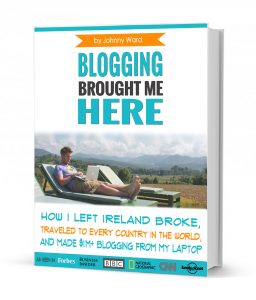
travel the world and live my dream. I talk about how I did it, and how you can do it too, in my COMPLETELY FREE
Ebook, all 20,000
words or so. Just finish the process by putting in your email below and I'll mail it right out to you immediately. No spam ever too, I promise!
As you know, blogging changed my life. I left Ireland broke, with no plan, with just a one-way ticket to Thailand
and no money. Since then, I started a blog, then a digital media company, I've made
more than $1,500,000 USD, bought 4 properties and visited (almost) every country in the world. And I did it all from my laptop as I
travel the world and live my dream. I talk about how I did it, and how you can do it too, in my COMPLETELY FREE
Ebook, all 20,000
words or so. Just finish the process by putting in your email below and I'll mail it right out to you immediately. No spam ever too, I promise!