

The Role of Randomness in Games
Randomness sits at the heart of every casino game, and yet it’s probably the most misunderstood part of the whole industry. Players talk about hot slots, cold tables, and dealers who are “due.” Mathematicians talk about independent events and probability distributions. Both are looking at the same spin of the same wheel, but only one description matches what’s actually happening. Getting the difference clear doesn’t make anyone a better gambler, but it does change what the experience feels like — and what kind of expectations are realistic to bring to it.
Table of contents
What “Random” Really Means Here
In everyday speech, random often means unusual or unexpected. In a casino, it has a stricter meaning: each event is independent of the previous one, and the long-run frequencies match the underlying probabilities. A fair coin lands heads with probability one-half regardless of what happened on the previous twenty flips. A roulette ball doesn’t remember that the last three spins were red. This independence is the engine that makes the house edge work.
RNGs Versus Physical Randomness
Online and physical casinos arrive at randomness through different routes. A roulette wheel uses physics: friction, the bounce of the ball, the croupier’s release. A slot machine in a brick-and-mortar venue used to use mechanical reels but now relies on the same technology online games do — a pseudo-random number generator, or RNG.
A modern RNG is a deterministic algorithm seeded with unpredictable inputs (system time, hardware noise, user interactions). The output is a stream of numbers that passes statistical tests for randomness so thoroughly that no practical method can distinguish it from true randomness. Each spin’s result is locked in the instant the player taps the button — nothing that happens afterwards on screen can change it.
How Different Games Handle It
Randomness shows up differently depending on the game. The table below sets out where the unpredictability comes from and whether the player has any meaningful influence on the outcome.
| Game | Source of randomness | Player decisions affect outcome? |
| Online slots | RNG generates result the moment the spin starts | No — only bet size and which game to play |
| Roulette (live) | Physical wheel, ball, croupier | No — bet choice doesn’t change the wheel |
| Blackjack | Shuffled deck (live) or RNG-shuffled deck (online) | Yes — hit, stand, split, double all shift the math |
| Video poker | RNG deals initial hand and replacement cards | Yes — which cards to hold meaningfully changes return |
| Live game shows | Physical wheel or props, recorded on camera | Mostly no — multipliers and side bets are the main choice |
The games where decisions matter — blackjack, video poker, certain poker variants — are also the games with the lowest house edge when played well. The math rewards engagement. Slots, by contrast, are pure chance dressed up in elaborate themes, which is part of why they appeal to a much wider audience.
Streaks, Patterns, and the Mind’s Insistence on Stories
The human brain is built to find patterns even where none exist. Five reds in a row at roulette feel like the start of something, or the prelude to a correction. Neither is true. The wheel is just doing what wheels do, and the streak is a normal artefact of independent events repeated many times. Streaks of five, eight, even twelve are statistically expected over a long evening of play — they just feel significant because the human mind tags them as meaningful.
A few things to keep in mind when a streak appears:
- A run of identical outcomes doesn’t shift the probabilities of the next one
- Gambler’s fallacy and hot-hand belief are mirror images of the same mistake
- Volatility (how wildly results swing around the average) is not the same as bias
Certified Fairness and Audits
Regulated jurisdictions require RNGs to be tested by independent labs. The names that show up most often are eCOGRA, iTech Labs, GLI, and BMM. These auditors examine the algorithm, run massive simulated samples, and confirm that the published return-to-player figures hold up in practice. A licensed operator publishes the certificates; an unlicensed one usually doesn’t.
Players who care about fairness can usually find the relevant audit information on a casino’s site — a footer link to eCOGRA, iTech Labs, or GLI is the most common signal. Newer operators often publish certificates more prominently than long-established ones, partly because they have something to prove. A New Runa Casino account, for example, gives access to slots and table games from licensed studios whose RNGs have already passed third-party testing before the games reach the casino floor. That layered approach — studio testing plus operator certification — is what makes online randomness verifiable in a way a physical roulette wheel really isn’t.
Living With the Numbers
Randomness isn’t a glitch in the system — it is the system. Every promotional banner, loyalty programme, and game design choice is built around the fact that nobody can predict the next spin. Understanding this doesn’t make the games less fun, but it does change what “winning” realistically looks like over time: shorter sessions, smaller bets, and the recognition that the casino’s edge is mathematical, not magical. Anyone who plays with that picture in mind is harder to surprise and easier to stop on time.
Remember, never travel without travel insurance! And never overpay for travel insurance!
I use HeyMondo. You get INSTANT quotes. Super cheap, they actually pay out, AND they cover almost everywhere, where most insurance companies don't (even places like Central African Republic etc!). You can sign-up here. PS You even get 5% off if you use MY LINK! You can even sign up if you're already overseas and traveling, pretty cool.
Also, if you want to start a blog...I CAN HELP YOU!
Also, if you want to start a blog, and start to change your life, I'd love to help you! Email me on johnny@onestep4ward.com. In the meantime, check out my super easy blog post on how to start a travel blog in under 30 minutes, here! And if you just want to get cracking, use BlueHost at a discount, through me.
Also, (if you're like me, and awful with tech-stuff) email me and my team can get a blog up and running for you, designed and everything, for $699 - email johnny@onestep4ward.com to get started.
Do you work remotely? Are you a digital nomad/blogger etc? You need to be insured too.
I use SafetyWing for my digital nomad insurance. It covers me while I live overseas. It's just $10 a week, and it's amazing! No upfront fees, you just pay week by week, and you can sign up just for a week if you want, then switch it off and on whenever. You can read my review here, and you can sign-up here!









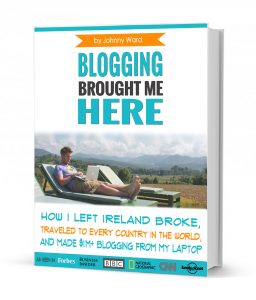 As you know, blogging changed my life. I left Ireland broke, with no plan, with just a one-way ticket to Thailand
and no money. Since then, I started a blog, then a digital media company, I've made
more than $1,500,000 USD, bought 4 properties and visited (almost) every country in the world. And I did it all from my laptop as I
travel the world and live my dream. I talk about how I did it, and how you can do it too, in my COMPLETELY FREE
Ebook, all 20,000
words or so. Just finish the process by putting in your email below and I'll mail it right out to you immediately. No spam ever too, I promise!
As you know, blogging changed my life. I left Ireland broke, with no plan, with just a one-way ticket to Thailand
and no money. Since then, I started a blog, then a digital media company, I've made
more than $1,500,000 USD, bought 4 properties and visited (almost) every country in the world. And I did it all from my laptop as I
travel the world and live my dream. I talk about how I did it, and how you can do it too, in my COMPLETELY FREE
Ebook, all 20,000
words or so. Just finish the process by putting in your email below and I'll mail it right out to you immediately. No spam ever too, I promise!