

How New Creators Can Give YouTube Shorts a Stronger First Push
A new creator does not need a huge audience to learn from YouTube Shorts, but the first round of attention matters. Shorts move quickly because viewers can choose to watch or swipe away in seconds, and YouTube Studio has a Shorts metric that shows how often viewers chose to view instead of swiping away.
That early activity does not guarantee a breakout video. YouTube says recommendations consider what viewers watch, what they do not watch, what they search for, likes, dislikes, and “Not interested” feedback. It also says overall performance depends on a mix of factors, including whether viewers choose to watch and how much they watch.
Table of contents
Why the First Push Feels Different on Shorts
Shorts are judged in a faster setting than long form videos. A viewer may give a long tutorial several minutes because the title answers a specific problem. A Short usually gets a smaller chance. The opening second has to tell the viewer why staying is worth it.
That is why starting views matter for beginners. A view is not proof that the video is good, but it is the first sign that the Short reached someone and got at least some attention. YouTube’s Shorts analytics includes views, likes, subscribers, “shown in feed,” and the percentage of people who viewed instead of swiped away.
A creator should not treat the first push as luck. The work starts before publishing. The title, opening frame, caption, sound choice, and first sentence all help a new viewer decide whether to stay. If the Short opens with a slow setup, the viewer may leave before the useful part appears.
For creators who want a paid visibility boost, GoreAd presents a YouTube Shorts Views page with package based ordering, fast delivery, no password required, 24/7 support, and a process that uses the Short URL and email address.
A creator can review buy YouTube shorts views as one option while still building the Short around strong content, clear timing, and real viewer interest.
Start With the Reason to Watch
A beginner often starts a Short with context. That can work in a long video, but it usually wastes the most valuable moment in a Short. The viewer should understand the point before the second or third beat.
A useful opening can be a mistake, a result, a question, or a clear promise. “Three editing habits that make Shorts feel slow” is easier to process than “I wanted to talk about something I noticed recently.” The first line should help the viewer sort the clip quickly.
Build the Short So Early Views Have Somewhere to Go
A stronger first push is not only about getting more eyes on the clip. It is about making sure those eyes have a reason to keep watching. YouTube says relative watch time is broadly more important for short videos, while absolute watch time is more important for longer videos.
This matters because a Short can get views and still fail to hold attention. If people open it and leave almost immediately, the first push does not say much. A better goal is a clean watch path. The viewer should know what the clip is about, feel a reason to stay, and reach the ending without confusion.
New creators can use a simple pre publish check:
- Does the first second show the topic clearly?
- Is the caption readable without blocking the subject?
- Does the Short answer one idea instead of three?
- Is the ending worth reaching?
- Does the CTA match what the viewer received?
The CTA should not feel pasted on. A creator can ask viewers to watch the next Short, comment with a question, save the idea, or follow for a related part two. Asking for a reaction works better when the viewer has already received something useful or entertaining.
Use Timing Without Overthinking It
Publishing time can help the first wave of viewers find the Short sooner, but it should not be treated as a secret formula. YouTube says publish time is not known to affect long term performance, although publishing when the audience is most active can help early viewership.
For beginners, this means timing should support the content plan. A fitness Short may do better when the target audience checks workout ideas. A creator education Short may perform better during work breaks or evening planning hours. The right answer comes from testing, not copying another channel’s schedule.
Read the First Signals Without Panicking
Early numbers can be useful, but they can also mislead new creators. A Short with fewer first day views may still teach a useful lesson if the viewed versus swiped away rate is strong. A Short with many first views may still need work if people leave too early.
The better habit is to compare Shorts by topic, opening style, length, and CTA. One weak upload should not cause a full strategy change. YouTube says one underperforming video does not hurt the whole channel by itself, and its systems rely more on video and audience level signals.
A practical review after publishing can include three questions:
- Did people choose to view or swipe away?
- Did the Short hold attention until the point was delivered?
- Did the topic attract the kind of viewer the creator wants again?
Creators also need to respect YouTube’s rules while planning promotion. YouTube says it does not allow anything that artificially increases views, likes, comments, or other metrics through automatic systems or by serving videos to unsuspecting viewers. It also says artificial traffic may not be counted and can lead to account strikes.
The main lesson is not that beginners should chase views at any cost. The smarter lesson is that the first push works best when the Short is ready for it. A clear opening, useful subject, readable structure, honest CTA, and careful review give early attention a real job. For new creators, that is the difference between buying motion and building momentum.
Remember, never travel without travel insurance! And never overpay for travel insurance!
I use HeyMondo. You get INSTANT quotes. Super cheap, they actually pay out, AND they cover almost everywhere, where most insurance companies don't (even places like Central African Republic etc!). You can sign-up here. PS You even get 5% off if you use MY LINK! You can even sign up if you're already overseas and traveling, pretty cool.
Also, if you want to start a blog...I CAN HELP YOU!
Also, if you want to start a blog, and start to change your life, I'd love to help you! Email me on johnny@onestep4ward.com. In the meantime, check out my super easy blog post on how to start a travel blog in under 30 minutes, here! And if you just want to get cracking, use BlueHost at a discount, through me.
Also, (if you're like me, and awful with tech-stuff) email me and my team can get a blog up and running for you, designed and everything, for $699 - email johnny@onestep4ward.com to get started.
Do you work remotely? Are you a digital nomad/blogger etc? You need to be insured too.
I use SafetyWing for my digital nomad insurance. It covers me while I live overseas. It's just $10 a week, and it's amazing! No upfront fees, you just pay week by week, and you can sign up just for a week if you want, then switch it off and on whenever. You can read my review here, and you can sign-up here!






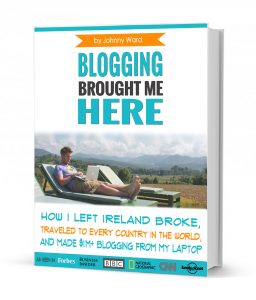 As you know, blogging changed my life. I left Ireland broke, with no plan, with just a one-way ticket to Thailand
and no money. Since then, I started a blog, then a digital media company, I've made
more than $1,500,000 USD, bought 4 properties and visited (almost) every country in the world. And I did it all from my laptop as I
travel the world and live my dream. I talk about how I did it, and how you can do it too, in my COMPLETELY FREE
Ebook, all 20,000
words or so. Just finish the process by putting in your email below and I'll mail it right out to you immediately. No spam ever too, I promise!
As you know, blogging changed my life. I left Ireland broke, with no plan, with just a one-way ticket to Thailand
and no money. Since then, I started a blog, then a digital media company, I've made
more than $1,500,000 USD, bought 4 properties and visited (almost) every country in the world. And I did it all from my laptop as I
travel the world and live my dream. I talk about how I did it, and how you can do it too, in my COMPLETELY FREE
Ebook, all 20,000
words or so. Just finish the process by putting in your email below and I'll mail it right out to you immediately. No spam ever too, I promise!