

How to Build an Ecommerce Side Hustle That Lets You Travel More
I have always liked the idea of travelling without having to wait for my annual vacation. Spending a month in another country, taking a spontaneous trip or working from somewhere new sounds much better to me than being tied to the same desk every day.
The problem is that most side hustles do not actually create much freedom. If I have to be in a particular place to deliver a service, pack orders or complete the work, I have simply created another job for myself.
That is why I would approach an ecommerce side hustle differently.
Table of contents
- How to Build an Ecommerce Side Hustle That Lets You Travel More
- What Makes an Ecommerce Side Hustle Travel-Friendly?
- Why Does Ecommerce Make Sense as a Side Hustle?
- Can Private Label Make a Physical Product Business Easier to Run?
- What Are the Advantages of Private-Label Ecommerce?
- Why Would I Consider Cosmetics?
- What Should I Look for in a Private-Label Cosmetics Manufacturer?
- Is Selfnamed an Option for a Private-Label Beauty Business?
- How Would I Start Without Creating Another Full-Time Job?
- What Can I Actually Automate?
- What Could Still Go Wrong?
- Can an Ecommerce Side Hustle Really Give Me More Freedom?
- The Goal Is More Freedom, Not Just Another Side Hustle
If travelling more is the real goal, I would build a business that can be managed remotely and outsource as much of the physical operation as possible. Private-label ecommerce is one model that can fit this approach because a manufacturer can handle production while fulfillment can be handled separately, leaving me to focus on the brand, store, marketing and customers.
It is not passive income, and there is no guarantee that a product will sell. But it can create something a traditional side hustle often cannot: more control over where I work.
What Makes an Ecommerce Side Hustle Travel-Friendly?
A travel-friendly business does not necessarily have to be passive. It simply needs to avoid making my physical location a requirement for every important task.
I would look for four things:
- I can manage the store from a laptop.
- Someone else can manufacture the products.
- Orders can be fulfilled without me packing boxes.
- Marketing, customer service and reporting can be handled online.
That changes the question I would ask before starting.
Instead of asking, “How much money can this side hustle make?”, I would ask:
“Could I run this business for a month from another country without physically touching the products?”
If the answer is yes, I have at least created the foundation for a location-independent business.
For example, I could wake up in Spain, check overnight orders, answer customer emails, review yesterday’s sales, adjust an advertising campaign and work on new product content. The customer does not need to know whether I am sitting at home or in a hotel.
That is very different from a side hustle that requires me to be physically present.
Why Does Ecommerce Make Sense as a Side Hustle?
The main reason I find ecommerce interesting is that I am building around a product rather than selling every hour of my time.
As a freelancer, my income is closely connected to the amount of work I can personally complete. If I stop working, the revenue usually stops too.
An ecommerce business gives me other assets to build.
I can spend time creating a useful website, developing a brand, improving product pages, collecting customer reviews, building an email list and attracting organic search traffic. Those assets can continue working after I close my laptop.
That does not mean ecommerce is easy.
There is still customer service, product research, advertising, returns, payments, taxes and supplier management. A new store can also take considerable time before it generates consistent sales.
The difference is that many of those activities can be performed from almost anywhere.
Can Private Label Make a Physical Product Business Easier to Run?
This is where private label becomes interesting.
Private label means that a manufacturer produces an existing or developed product while I sell it under my own brand. I am not building a factory or manufacturing every product myself. Instead, I am concentrating on the parts of the business that customers actually see: the product selection, branding, positioning, store and marketing.
That can remove a major operational burden.
Imagine starting a skincare business from scratch. I could try to develop formulations, find production equipment, source ingredients, manage packaging and arrange storage myself.
Or I could work with a private-label manufacturer that already has the production infrastructure.
For a side hustle, I prefer the second model because it lets me spend more time testing whether customers actually want the product.
Private label does not eliminate the work. It changes where the work happens.
What Are the Advantages of Private-Label Ecommerce?
The biggest advantage is not simply that I can put my logo on a product.
It is that I can test a business concept without first building the entire manufacturing operation behind it.
If a supplier allows small orders, I can start with a narrow product range, order samples, test the products and build the brand around what I learn.
There is another advantage.
If I simply resell an established brand, I am competing with other stores selling exactly the same product. There may be very little reason for a customer to buy from me rather than someone else.
A private-label product gives me more control over the customer-facing proposition.
I can decide who the product is for, how it is presented, what the brand represents and how the products fit together.
The product is still important, but the brand becomes part of the offer.
Why Would I Consider Cosmetics?
If I were looking for a private-label category, cosmetics would be one of the areas I would investigate.
Beauty products are particularly suited to branding. Packaging, product presentation, positioning and visual identity can all play a significant role in how a customer perceives the product.
I also would not try to create a beauty store that sells everything.
I would start with a specific customer.
For example:
- skincare for frequent travellers
- minimalist skincare for people who want a small routine
- men’s grooming products
- focused body-care products
- a small collection designed around sensitive skin
A narrow concept makes it easier to answer a basic question:
Who exactly am I trying to sell this to?
There is also a potential repeat-purchase advantage. Many beauty products are consumed and replaced, which means a successful product can generate another purchase instead of relying entirely on constantly finding new customers.
That is an opportunity, not a guarantee. Cosmetics are competitive, and product quality, customer trust, branding and compliance all matter.
What Should I Look for in a Private-Label Cosmetics Manufacturer?
I would not choose a manufacturer simply because it has a large catalog.
For a travel-friendly side business, I would evaluate the supplier against the following criteria.
| Factor | Why I would care |
| Minimum order quantity | Determines how much money I need to commit upfront |
| Samples | Lets me test the actual product before selling it |
| Product quality | Directly affects customer satisfaction and repeat purchases |
| Compliance | Particularly important when selling cosmetics |
| Branding options | Determines how much control I have over the finished product |
| Fulfillment | Determines whether I need to handle inventory myself |
| Ecommerce integrations | Can reduce manual order management |
| Shipping | Affects customer experience and margins |
| Returns | Important when I am operating from another country |
| Scalability | Prevents me from having to replace the supplier too quickly |
I would also ask questions before launching rather than after receiving the first customer order.
Where is the product manufactured? Who is responsible for regulatory compliance? How are orders fulfilled? Where are they shipped from? What happens if a product is discontinued? Can I order samples? How quickly are orders processed?
For cosmetics sold in the EU, compliance deserves particular attention. EU rules include requirements around a designated Responsible Person, safety assessment, a Product Information File and notification through the Cosmetic Products Notification Portal before products are placed on the EU market.
I would therefore treat regulatory support as a supplier-selection criterion, not an afterthought.
Is Selfnamed an Option for a Private-Label Beauty Business?
One company I would put on my shortlist is Selfnamed.
Selfnamed currently advertises more than 200 ready-to-brand beauty products and says it has around 20 years of cosmetics experience. It also advertises no minimum order requirements, which can make the model more suitable for testing a small product idea before committing to larger inventory.
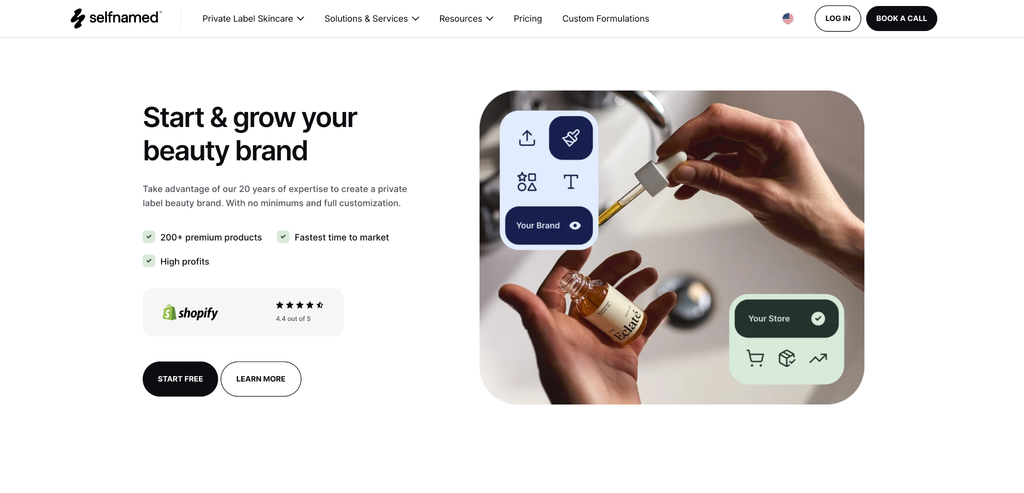
The operational side is particularly relevant to someone who wants to travel.
Selfnamed currently offers integrations with Shopify, WooCommerce, Squarespace and Wix, as well as automatic order fulfillment. It operates fulfillment centers in Europe and the United States.
Its current manufacturing information says that most products are made in the EU, primarily in Latvia, while some products are made in Italy and France. Selfnamed also states that its US facility is a fulfillment center rather than a manufacturing location.
That combination is interesting from a location-independence perspective.
I could potentially build the storefront, manage the brand and acquire customers without turning my home into a warehouse.
That does not mean Selfnamed is automatically the right supplier for every beauty business. I would still compare product quality, pricing, shipping costs, margins, packaging and compliance requirements before committing.
How Would I Start Without Creating Another Full-Time Job?
I would start much smaller than most people imagine.
1. Pick the customer before picking 50 products
I would first decide who I want to sell to.
“People who like skincare” is too broad.
“Frequent travellers who want a five-product skincare routine that fits in carry-on luggage” gives me something much more specific to build around.
2. Start with a small product range
I would not launch with dozens of products.
I would choose perhaps a few products that make sense together and order samples.
The goal would be to answer practical questions:
- Do I actually like the product?
- Does the packaging look good?
- Does it fit the brand?
- Would I be comfortable recommending it?
- Is the expected selling price realistic?
3. Build the brand around a clear idea
The first version does not need to look like a multinational cosmetics company.
I need a credible name, visual identity, positioning and store.
More importantly, I need a reason for the customer to care.
A product with a generic label is easy to compare on price. A focused brand gives me more room to compete on positioning and customer experience.
4. Test customer acquisition
This is where the business either starts becoming real or remains an interesting idea.
I would test several channels rather than immediately putting a large budget into advertising.
Depending on the product, that could include:
- Google Search and Shopping
- SEO content
- social media
- creator partnerships
- email marketing
- targeted paid advertising
- referral programs
I would measure sales rather than followers.
Which products get attention? Which pages convert? How much does it cost to acquire a customer? Which products are reordered? Where are customers coming from?
Those numbers tell me much more than the size of my social media audience.
5. Watch the unit economics
I would also calculate the economics of every product.
A simple starting point is:
Selling price − product cost − fulfillment − payment fees − customer acquisition cost − returns = contribution margin
If that number does not work, more sales will not necessarily fix the business.
I would rather discover that after selling 20 products than after ordering 2,000.
What Can I Actually Automate?
This is one of the most important questions for anyone who wants to travel.
The goal is not to automate the entire business. The goal is to remove repetitive tasks that do not require my personal involvement.
For example, an ecommerce setup can potentially automate:
- order transmission
- payment processing
- inventory updates
- shipping notifications
- basic customer emails
- abandoned-cart emails
- analytics reporting
- some customer support
- fulfillment
That still leaves important work for me.
I would expect to spend time on product decisions, marketing, customer feedback, content, partnerships, financial decisions and anything unexpected.
That is why I would describe this model as location-independent, not passive.
What Could Still Go Wrong?
There are several things I would take seriously before assuming an ecommerce business will make travel easier.
Advertising can become expensive.
A product that looks promising may not sell.
A supplier can have delays or quality problems.
Customers can request refunds.
A payment provider can create problems.
Regulatory requirements can change.
And if I am the only person who knows how the business works, I may discover that I have simply created a remote job for myself.
The solution is not to eliminate every problem.
It is to design the operation so that one problem does not require me to physically return home.
That means documenting processes, choosing reliable suppliers, using automation where it makes sense and keeping the product range manageable.
Can an Ecommerce Side Hustle Really Give Me More Freedom?
I think the better question is not whether ecommerce gives me freedom automatically.
It doesn’t.
The business has to be designed for it.
If I keep all the inventory in my apartment, pack every order myself and answer every customer message manually, I haven’t built a travel-friendly business.
I have built a business that happens to have a website.
The model becomes much more interesting when manufacturing and fulfillment are handled by other companies while I focus on the parts that actually require my input.
That is why private-label ecommerce is worth considering for someone whose bigger goal is location independence.
The Goal Is More Freedom, Not Just Another Side Hustle
If I were starting from scratch today, I would not choose a side hustle based only on its revenue potential.
I would also look at the lifestyle it creates.
If I want to travel more, I need a business that does not make my physical location part of the operating model.
Ecommerce can fit that requirement. Private-label manufacturing can make a physical product business easier to start without building manufacturing infrastructure yourself. Cosmetics are one category I would investigate because they combine strong branding opportunities with products that customers may purchase repeatedly.
A supplier such as Selfnamed can remove some of the operational work by offering ready-to-brand products, no minimum order requirements and fulfillment integrations, although I would still compare its economics and capabilities with other suppliers before choosing one.
I would start with a small product range, test samples, validate the customer and watch the numbers carefully.
The objective would not be to build a huge ecommerce company immediately.
It would be to build a business that can eventually travel with me.
Because if travelling more is the real goal, that matters just as much as the revenue.
Remember, never travel without travel insurance! And never overpay for travel insurance!
I use HeyMondo. You get INSTANT quotes. Super cheap, they actually pay out, AND they cover almost everywhere, where most insurance companies don't (even places like Central African Republic etc!). You can sign-up here. PS You even get 5% off if you use MY LINK! You can even sign up if you're already overseas and traveling, pretty cool.
Also, if you want to start a blog...I CAN HELP YOU!
Also, if you want to start a blog, and start to change your life, I'd love to help you! Email me on johnny@onestep4ward.com. In the meantime, check out my super easy blog post on how to start a travel blog in under 30 minutes, here! And if you just want to get cracking, use BlueHost at a discount, through me.
Also, (if you're like me, and awful with tech-stuff) email me and my team can get a blog up and running for you, designed and everything, for $699 - email johnny@onestep4ward.com to get started.
Do you work remotely? Are you a digital nomad/blogger etc? You need to be insured too.
I use SafetyWing for my digital nomad insurance. It covers me while I live overseas. It's just $10 a week, and it's amazing! No upfront fees, you just pay week by week, and you can sign up just for a week if you want, then switch it off and on whenever. You can read my review here, and you can sign-up here!

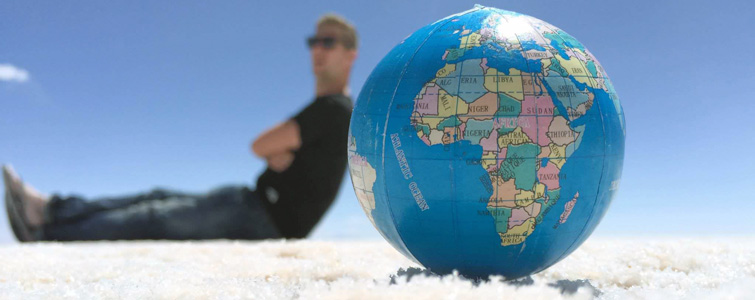







 As you know, blogging changed my life. I left Ireland broke, with no plan, with just a one-way ticket to Thailand
and no money. Since then, I started a blog, then a digital media company, I've made
more than $1,500,000 USD, bought 4 properties and visited (almost) every country in the world. And I did it all from my laptop as I
travel the world and live my dream. I talk about how I did it, and how you can do it too, in my COMPLETELY FREE
Ebook, all 20,000
words or so. Just finish the process by putting in your email below and I'll mail it right out to you immediately. No spam ever too, I promise!