


AI Audit Agents and the Next Generation of Financial Infrastructure
The investable shift is not another dashboard. It is a control layer that can inspect transactions continuously, assemble evidence and route recoverable exceptions into action.
Table of contents
- AI Audit Agents and the Next Generation of Financial Infrastructure
- The investable signal is moving from insight to controlled action
- Four market signals worth separating
- A new control layer is forming
- Follow the dollar, not the demo
- Why the infrastructure thesis is credible
- Five layers make the system more than a model
- The moat is evidence, not the model
- What investors should test
- The outcome ledger an investor should request
- Diligence questions that expose a thin product
- A portfolio view of the market
- The next generation will be governed
- Unit economics should be visible at case level
- Where defensibility may actually come from
- Sources and editorial notes

The investable signal is moving from insight to controlled action
Finance software has already made reporting faster. The emerging investment question is whether a new layer can investigate an exception, assemble evidence and move the case towards a governed outcome without becoming another opaque decision-maker. That is a narrower and more defensible thesis than the idea of a fully autonomous finance department.
The timing is credible. KPMG’s 2026 global AI-in-finance research surveyed 1,013 senior finance leaders across 20 countries and 13 sectors. The report describes a market moving beyond isolated tools towards orchestration, but it also shows why assurance capability matters: adoption can scale faster than the controls used to explain it. For investors, the gap between deployment and assurance is both the opportunity and the diligence risk.
In brief: Investment lens: value accrues to the evidence and workflow layer, not automatically to the company using the largest model.
Four market signals worth separating
Published figures below come from KPMG’s 2026 study; they describe surveyed organisations, not Dash.fi customers.
| Signal | Published finding | Investor implication |
|---|---|---|
| Sample | 1,013 senior finance leaders | Large enough to show enterprise direction, but weighted towards organisations with at least US$250m revenue. |
| US adoption | 93% deploying or scaling in the next 18 months | Implementation demand is becoming current-budget infrastructure rather than distant experimentation. |
| Assurance readiness | 42% strongly assurance-ready; 60% among agentic-AI leaders | Audit evidence may become a product capability and a buying criterion. |
| Failure tracking | 29% formally track AI-adoption failures | A large measurement gap remains between activity and controlled outcomes. |
A new control layer is forming
Financial software has spent two decades making activity easier to see. The next layer is being built to decide what deserves attention and move an exception toward resolution. That distinction matters. A dashboard can show that parcel spend rose; an audit agent can compare invoices with contract terms, identify a questionable accessorial charge, attach the relevant evidence and send the item to an owner.
The label “AI audit agent” is still emerging, and investors should be wary of treating it as a settled category. The durable idea underneath it is continuous, evidence-backed control. Instead of asking analysts to sample transactions after the month closes, software can inspect a much larger share of activity as it occurs, while reserving judgment and approval for people.
Follow the dollar, not the demo
The most useful way to understand an audit agent is to follow one disputed dollar. A transaction first has to be normalized with the correct supplier, entity, currency and service period. The system then needs a reason to question it: a contract rate, policy rule, duplicate pattern or operational record. That finding is only potential exposure. It becomes a finance case when the relevant documents, calculation and uncertainty are assembled for review.
The next steps are operational rather than analytical. Someone must decide whether to contact a supplier, post a correction, change a control or close the case as valid. A product that automates detection but leaves evidence gathering and ownership in email has improved only the top of the funnel. Infrastructure value appears when the same case can move through these states without losing the source trail or confusing estimated exposure with money returned.
Why the infrastructure thesis is credible
Three existing markets are beginning to overlap: spend management, recovery audit and workflow automation. Spend platforms hold transaction data. Recovery-audit specialists know where contractual leakage hides. Agentic software can coordinate multi-step work across those systems. The opportunity is not to replace the ledger or the payment rail, but to add an intelligence and evidence layer above them.
This is especially visible in complex operating categories. A finance team may have a total-spend view yet lack a reliable explanation for carrier adjustments, duplicate fees or contract drift. Purpose-built shipping-spend analytics illustrates the difference between reporting a number and interrogating the transactions beneath it. The investment case depends on whether that interrogation consistently produces verifiable exceptions—not on how conversational the interface appears.
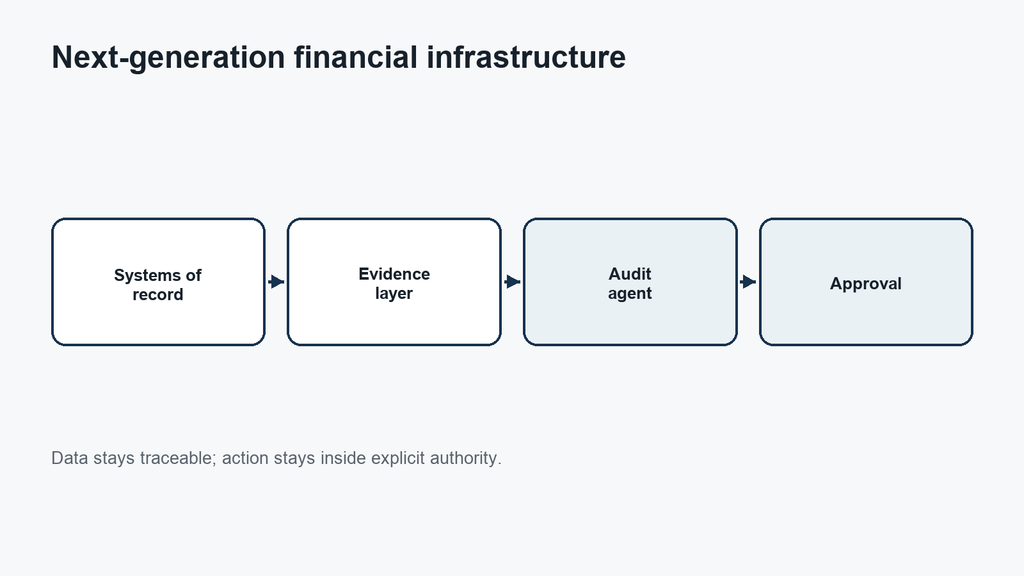
Figure: A governed audit-agent architecture.
Five layers make the system more than a model
The first layer is ingestion: ledgers, invoices, contracts, usage records and payment data. The second is a financial evidence model that resolves dates, units, entities and terms. The third is detection, where rules, statistical methods and language models can work together. The fourth is case orchestration—prioritisation, routing, deadlines, permissions and human review. The fifth is the system of outcome, where credits, corrections, prevented recurrence and rejected findings are recorded.
Model providers can participate in the third layer, but the surrounding layers determine whether an answer is reproducible and actionable. That is why PwC’s discussion of AI agents in finance and reporting emphasizes controls, oversight and traceability alongside automation. The architecture should preserve those controls even when the underlying model changes.
The moat is evidence, not the model
Foundation models will continue to improve and commoditise. A defensible audit product therefore needs more than a prompt wrapped around invoice data. It needs normalized inputs, contract-aware rules, durable audit trails, integrations into systems of record, and feedback from resolved cases. Every recommended action should point back to source evidence.
This is consistent with the risk-management direction outlined by NIST’s AI Risk Management Framework, which treats governance as a continuous function across an AI system’s lifecycle. In financial services, the Bank for International Settlements has likewise highlighted governance, model risk, data governance and third-party providers as continuing areas of attention.
What investors should test
A useful diligence process starts with five questions. Can the system explain each exception at line-item level? Does it distinguish a likely error from a certain error? Which actions require human approval? How is recovery measured after an alert is raised? And can the customer export the evidence if the vendor disappears?
The strongest businesses should improve as more outcomes are verified without becoming opaque. They will also be sold on measurable recovered value or avoided loss, not merely on hours saved. That creates attractive economics, but it raises the standard of proof: a flagged dollar is not the same as a recovered dollar.
The outcome ledger an investor should request
Each state needs an amount, timestamp, owner and reason code; stages should never be collapsed into one savings figure.
| Case state | Required evidence | Economic measure |
|---|---|---|
| Flagged | Rule or model output linked to source records | Potential exposure |
| Verified | Reviewer-supported calculation and relevant term | Verified amount and precision |
| Submitted | Complete claim or correction sent before deadline | Submitted amount and ageing |
| Resolved | Credit, refund, correction or documented rejection | Gross outcome by resolution type |
| Prevented | Upstream rule, contract or process changed | Recurrence and avoided-cost estimate |
Diligence questions that expose a thin product
A polished interface can conceal weak operating infrastructure. Investors should ask for evidence at the case level:
- Can a reviewer reproduce the source data, rule, model version and approval history behind a finding?
- Does the vendor report identified, verified, submitted and recovered value separately?
- Which actions are read-only, reversible or money-moving, and who can change those permissions?
- What happens when a contract term is ambiguous, a source record changes or the model is unavailable?
- Can the customer export its rules, evidence and resolved-case history without the vendor?
A portfolio view of the market
The category can be mapped by the financial object each company audits and the authority it receives. Some products inspect employee and card spend; others focus on accounts payable, logistics invoices, cloud usage or advertising. Some stop at an alert, while others prepare claims or enforce policy. These differences affect sales cycles, data requirements and gross-margin potential.
Investors should also examine who owns the budget. A controller may buy transaction assurance, procurement may buy contract compliance, and an operations team may own carrier or cloud spend. Products that prove value across two functions can expand more naturally, but they also need a clear implementation owner.
Finally, test whether the vendor’s economics depend on a one-time historical recovery. A strong recurring product should keep finding new issues, prevent known leakage and make continuous control valuable after the obvious backlog is cleared. Retention will reveal whether the software is infrastructure or merely a successful first audit.
The next generation will be governed
The financial-infrastructure winners will not be the agents that act most freely. They will be the systems that operate inside explicit authority: read-only access by default, bounded actions, independent approval for money movement, and a clear record of what the agent saw and why it made a recommendation.
That is less cinematic than the autonomous-finance pitch. It is also more investable. Finance departments buy reliability, evidence and controlled outcomes. AI audit agents become infrastructure when they can deliver all three repeatedly.
Unit economics should be visible at case level
Revenue growth alone cannot show whether the category works. Investors need cohort measures that start with spend reviewed and end with verified outcomes. Useful ratios include verified value per thousand transactions, reviewer minutes per accepted finding, submission rate before deadline, gross recovery rate, net recovery after fees and labour, and recurrence after remediation.
Those measures also expose services intensity. If every new customer or spend category requires a large analyst team to rebuild rules and evidence packets, reported software margins may be misleading. Human expertise can be a sensible part of the product, especially early in a category, but the company should show which work becomes reusable and which remains bespoke.
Where defensibility may actually come from
Foundation-model access is unlikely to be the lasting moat. Durable value is more likely to sit in normalized transaction data, contract-aware rules, outcome labels, integration depth and the operational knowledge required to turn a finding into a resolved case. Those assets improve only when the product records disagreement and resolution rather than hiding them.
The strongest businesses may look less like chat products and more like control infrastructure: narrow permissions, explicit escalation, case-level unit economics and evidence that survives scrutiny. A company that cannot explain why a flagged dollar became a recovered dollar has not yet proved the category thesis.
Sources and editorial notes
Editorial handling note (not part of the publishable article): this placement has a commercial relationship with Dash.fi and must be disclosed. Recommended label: “Sponsored content produced in partnership with Dash.fi.” Confirm wording and link attributes with the publisher. External evidence links appear beside the claims they support and below for editorial review. Hypothetical calculations and decision weights are labelled illustrative. Product-specific statements and commercial terms should be rechecked immediately before publication.
Remember, never travel without travel insurance! And never overpay for travel insurance!
I use HeyMondo. You get INSTANT quotes. Super cheap, they actually pay out, AND they cover almost everywhere, where most insurance companies don't (even places like Central African Republic etc!). You can sign-up here. PS You even get 5% off if you use MY LINK! You can even sign up if you're already overseas and traveling, pretty cool.
Also, if you want to start a blog...I CAN HELP YOU!
Also, if you want to start a blog, and start to change your life, I'd love to help you! Email me on johnny@onestep4ward.com. In the meantime, check out my super easy blog post on how to start a travel blog in under 30 minutes, here! And if you just want to get cracking, use BlueHost at a discount, through me.
Also, (if you're like me, and awful with tech-stuff) email me and my team can get a blog up and running for you, designed and everything, for $699 - email johnny@onestep4ward.com to get started.
Do you work remotely? Are you a digital nomad/blogger etc? You need to be insured too.
I use SafetyWing for my digital nomad insurance. It covers me while I live overseas. It's just $10 a week, and it's amazing! No upfront fees, you just pay week by week, and you can sign up just for a week if you want, then switch it off and on whenever. You can read my review here, and you can sign-up here!









 As you know, blogging changed my life. I left Ireland broke, with no plan, with just a one-way ticket to Thailand
and no money. Since then, I started a blog, then a digital media company, I've made
more than $1,500,000 USD, bought 4 properties and visited (almost) every country in the world. And I did it all from my laptop as I
travel the world and live my dream. I talk about how I did it, and how you can do it too, in my COMPLETELY FREE
Ebook, all 20,000
words or so. Just finish the process by putting in your email below and I'll mail it right out to you immediately. No spam ever too, I promise!