

Digital Creators Are Using AI Transcription to Turn Audio and Video Into Content
Scroll through any platform and it’s clear: most creators are speaking, not typing. Long interviews. Live sessions. Tutorials recorded in one take. Conversations that feel natural in the moment.
The problem isn’t production. It’s what happens after the recording ends. Files get saved, maybe uploaded, and then left alone. Much useful material stays buried because turning it into something else feels like extra work.
AI transcription shifts that. When speech is converted into text quickly, recordings stop being single-use pieces. They become source material — something that can be shaped, trimmed, expanded, and redistributed without starting over.
It doesn’t replace the original content. It unlocks it.
One Recording, Many Outcomes
Think about how much is said in a 40-minute conversation. Explanations. Examples. Off-the-cuff clarifications. Strong lines that could stand on their own.
Once that material exists as text, new possibilities open up. A detailed section can become a standalone article. A sharp explanation can anchor a newsletter. A short exchange can turn into a social post. Even a list mentioned verbally can be reformatted into a guide.
Without a transcript, repurposing depends on memory. That’s unreliable. Even with notes, small points get overlooked. Having the full conversation in writing changes the equation. Everything is visible. Nothing relies on recall.
Text also invites restructuring. Ideas can be grouped logically. Repetition can be reduced. Casual explanations can be tightened. This happens faster on a page than on a timeline bar.
Many creators also use transcripts as a starting point when learning how to add subtitles to a video, making their content easier to follow and more accessible across different platforms.OHW
Turning Speech Into Searchable Content
Audio files don’t rank in search results on their own. They need context.
When creators publish transcripts alongside recordings, they give search engines something to index. The phrasing often mirrors how real people search. Questions, comparisons, specific wording — it’s already there.
After light editing, a transcript can function as a resource page. Instead of writing a separate article, creators refine what they’ve already said.
Speed Changes the Workflow
Anyone who has tried to transcribe manually knows how draining it is. Pause. Type. Rewind. Repeat. A 30-minute episode can take hours.
Automated transcription removes that bottleneck. Record first. Upload. Receive text.
Services such as transcribetotext.ai streamline this, delivering readable drafts creators can immediately work with. The first version isn’t perfect, and it doesn’t need to be. Spoken language includes detours, half-finished thoughts, and filler phrases. Cleaning that up is straightforward. Compared to building an article line by line, refining an existing transcript is lighter work.
The time saved isn’t just technical. It changes how creators plan their week.
Accessibility Is Becoming Standard
Text versions of audio content serve a clear purpose. Not everyone consumes information through headphones.
Some rely on captions. Others prefer reading quietly. Many watch videos where sound isn’t practical. A transcript covers all those situations.
It also adds clarity. Names, terms, and references are easier to catch. Readers can scan for the section that matters instead of committing to the full runtime.
Offering both formats signals care. It shows content is meant to be usable, not just published.
A Better Editing Perspective
There’s something revealing about seeing your own spoken words on a screen.
In conversation, a long explanation can feel smooth. In writing, it may look scattered. Certain phrases appear repeatedly. Points that seemed minor suddenly stand out.
That distance is useful. A transcript acts almost like a rough draft. Structure can be introduced deliberately. Subheadings can break up dense sections. Strong statements can be highlighted. Tangents can be shortened or removed entirely.
Some creators record with this in mind. They speak freely, knowing they’ll reorganize later. It allows natural delivery upfront and clearer structure in the final piece.
Text makes experimentation easier. Moving a paragraph takes seconds. Reordering audio does not.
Building a Sustainable Content Engine
Consistency often breaks down not because of ideas, but because of workload. Producing material for every channel can become overwhelming.
Transcription supports a different model. One substantial recording becomes the foundation. From that foundation, multiple pieces are shaped: an article, several shorter posts, a condensed email version, or a checklist.
Instead of generating fresh material every day, creators work from a central source. Messaging stays aligned because everything originates from the same conversation. Energy goes into refinement rather than reinvention.
Over time, this builds depth. Topics are explored thoroughly and then distributed thoughtfully. The result feels connected rather than scattered.
Supporting Different Consumption Styles
Audiences aren’t uniform. Some listen while driving. Some read during breaks. Some skim first and decide later whether to invest more time.
Providing both spoken and written versions accommodates those differences without doubling effort. A transcript allows quick scanning. It also provides a reference point for specific ideas mentioned in passing.
In practice, the formats reinforce each other. A reader who finds an article through search may choose to play the full episode afterward.
Reducing Creative Resistance
Starting from an empty document can stall momentum. Recording thoughts out loud often feels easier and more immediate.
With transcription in place, creators don’t have to choose between speaking and writing. They can do both — just not at the same time. First, talk through the ideas. Later, refine them in text.
That separation lowers pressure. It encourages clearer thinking without the demand to phrase everything perfectly. Editing becomes a distinct phase, focused and intentional.
The transcript functions as a bridge between spontaneous conversation and structured content.
Why This Shift Matters
AI transcription doesn’t replace creative thinking. It amplifies it.
It transforms recordings into adaptable assets. It increases visibility through searchable text. It supports accessibility. It simplifies editing. And it enables consistent publishing without multiplying workload.
For digital creators juggling platforms and deadlines, that efficiency is practical, not theoretical.
Spoken ideas no longer stay locked inside audio files. Once converted into text, they become flexible. Editable. Repurposable.
In a content environment where attention is scattered and time is limited, flexibility is more valuable than ever.
Remember, never travel without travel insurance! And never overpay for travel insurance!
I use HeyMondo. You get INSTANT quotes. Super cheap, they actually pay out, AND they cover almost everywhere, where most insurance companies don't (even places like Central African Republic etc!). You can sign-up here. PS You even get 5% off if you use MY LINK! You can even sign up if you're already overseas and traveling, pretty cool.
Also, if you want to start a blog...I CAN HELP YOU!
Also, if you want to start a blog, and start to change your life, I'd love to help you! Email me on johnny@onestep4ward.com. In the meantime, check out my super easy blog post on how to start a travel blog in under 30 minutes, here! And if you just want to get cracking, use BlueHost at a discount, through me.
Also, (if you're like me, and awful with tech-stuff) email me and my team can get a blog up and running for you, designed and everything, for $699 - email johnny@onestep4ward.com to get started.
Do you work remotely? Are you a digital nomad/blogger etc? You need to be insured too.
I use SafetyWing for my digital nomad insurance. It covers me while I live overseas. It's just $10 a week, and it's amazing! No upfront fees, you just pay week by week, and you can sign up just for a week if you want, then switch it off and on whenever. You can read my review here, and you can sign-up here!









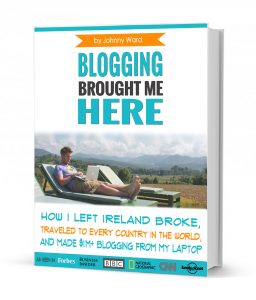 As you know, blogging changed my life. I left Ireland broke, with no plan, with just a one-way ticket to Thailand
and no money. Since then, I started a blog, then a digital media company, I've made
more than $1,500,000 USD, bought 4 properties and visited (almost) every country in the world. And I did it all from my laptop as I
travel the world and live my dream. I talk about how I did it, and how you can do it too, in my COMPLETELY FREE
Ebook, all 20,000
words or so. Just finish the process by putting in your email below and I'll mail it right out to you immediately. No spam ever too, I promise!
As you know, blogging changed my life. I left Ireland broke, with no plan, with just a one-way ticket to Thailand
and no money. Since then, I started a blog, then a digital media company, I've made
more than $1,500,000 USD, bought 4 properties and visited (almost) every country in the world. And I did it all from my laptop as I
travel the world and live my dream. I talk about how I did it, and how you can do it too, in my COMPLETELY FREE
Ebook, all 20,000
words or so. Just finish the process by putting in your email below and I'll mail it right out to you immediately. No spam ever too, I promise!