

Explore Brussels on Foot: A Slow Travel Guide for First-Time Visitors
Brussels is often treated as a city of quick stops: a photo at the Grand Place, a waffle on the go, a glance at the European Quarter, and then off to Paris or Amsterdam. But this approach misses what makes the Belgian capital quietly special. Brussels is not a city that reveals itself through highlights alone – it unfolds through streets, neighborhoods, cafés, and small, human moments. To truly understand it, you need to slow down, linger, and walk.
Table of contents
- Explore Brussels on Foot: A Slow Travel Guide for First-Time Visitors
- Why Brussels Is Perfect for Walking
- Starting Point: Grand Place and the Historic Core
- Neighborhood Hopping at a Human Pace
- Parks as Part of the Journey
- Eating and Drinking the Slow Way
- Art, Architecture, and Unexpected Details
- Practical Tips for Walking in Brussels
- The Bottom Line
For first-time visitors, choosing to explore Brussels on foot is the best way to experience the city’s layered identity: medieval and modern, elegant and scruffy, local and international. Walking allows you to move at the same pace as the city itself – unhurried, conversational, and full of surprises just around the corner.
Why Brussels Is Perfect for Walking
Brussels is compact but complex. Many of its most interesting areas are close enough to walk between, yet distinct enough to feel like different worlds. Unlike cities built around grand axes and monumental vistas, Brussels is irregular and slightly chaotic, making walking especially rewarding.
The city’s topography helps too. While there are some gentle hills, most routes are manageable, and frequent parks, benches, and cafés make breaks feel natural rather than necessary. Public transport is excellent, but walking fills in the emotional gaps between destinations – the moments that turn a trip into a memory.
Starting Point: Grand Place and the Historic Core
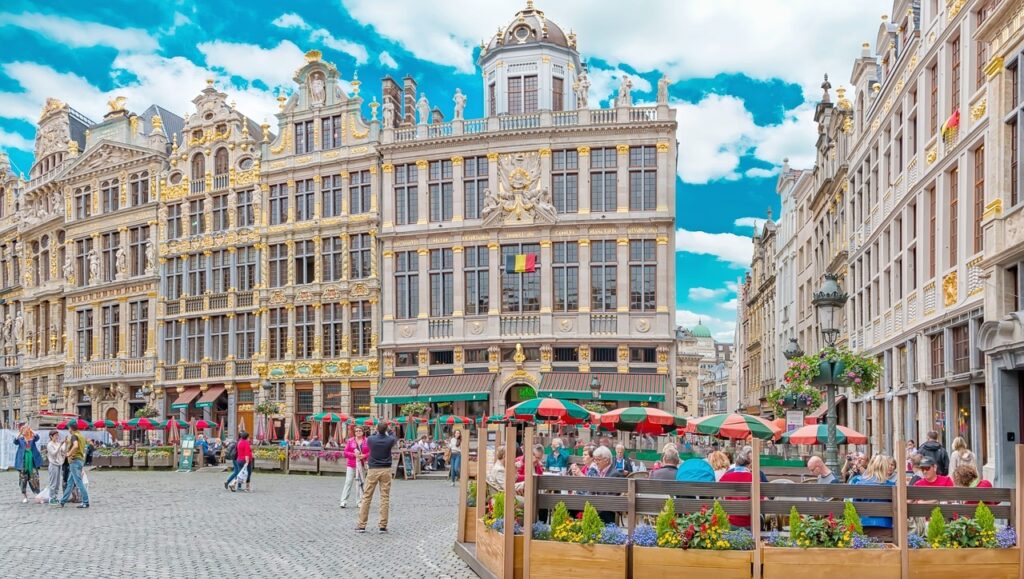
Most walking journeys in Brussels begin at the Grand Place, and rightly so. Few squares in Europe feel as alive or as richly decorated. Guildhalls with gilded facades surround you, and no matter how many times you see it, the square still feels theatrical.
From here, let yourself get a little lost. Walk toward Galeries Royales Saint-Hubert, where glass-roofed elegance meets everyday life. Wander through narrow streets lined with chocolate shops, bookstores, and cafés that feel less like attractions and more like long-standing habits.
This is where walking matters most. A straight route will get you somewhere faster, but detours reveal comic book murals, quiet courtyards, and bakeries where locals stop without thinking twice.
Neighborhood Hopping at a Human Pace
One of Brussels’ greatest strengths is its neighborhoods, each with a distinct personality.
- Sablon feels refined and artistic, known for antique shops, chocolate boutiques, and the beautiful Church of Our Blessed Lady of the Sablon. It’s an ideal area for a slow afternoon stroll.
- Marolles, just downhill, offers a completely different energy. Gritty, authentic, and deeply local, it’s home to flea markets, vintage shops, and street art that feels earned rather than curated.
- Saint-Géry blends nightlife with history, where medieval foundations sit beneath buzzing bars and cafés.
Walking between these areas helps you understand Brussels not as a single narrative, but as a collection of overlapping stories.
Parks as Part of the Journey
Brussels is greener than many visitors expect, and its parks are not just places to rest – they’re part of the walking experience. Parc de Bruxelles, near the Royal Palace, feels formal and symmetrical, perfect for a calm morning walk. Further out, Parc du Cinquantenaire opens up dramatically, with wide paths, museums, and arches that invite slow wandering.
If you continue toward Bois de la Cambre, the city begins to dissolve into forested paths and lakes, showing how seamlessly Brussels blends urban life with nature. Walking here feels less like sightseeing and more like living.
Eating and Drinking the Slow Way
Brussels rewards walkers with food that fits the city’s pace. This is not a place for rushed meals. Stop for frites from a local stand and eat them standing, like everyone else. Sit down for a long lunch featuring mussels or carbonnade flamande. Duck into a neighborhood café for a Belgian beer you’ve never heard of, served in a glass designed specifically for it.
Walking permits you to stop when something smells good, looks inviting, or simply feels right. Some of the best meals happen without planning.
Art, Architecture, and Unexpected Details
As you explore Brussels on foot, art appears where you least expect it. Comic strip murals brighten entire streets. Art Nouveau townhouses by Victor Horta emerge between ordinary buildings. Small galleries and studios hide behind unassuming doors.
Unlike cities where cultural landmarks dominate the skyline, Brussels scatters its beauty at eye level. Walking allows you to notice door handles, tilework, balconies, and shop windows that would disappear if you moved too fast.
Practical Tips for Walking in Brussels
- Wear comfortable shoes: Cobblestones are charming but unforgiving.
- Plan loosely: Choose a general direction, not a strict route.
- Embrace detours: Some of the best moments are unplanned.
- Walk at different times of day: Morning Brussels feels calm and local; evenings are warm, social, and lively.
The Bottom Line
Brussels is not a city that demands your attention – it earns it slowly. Its beauty lies in transitions: from one neighborhood to another, from busy streets to quiet squares, from history to everyday life. For first-time visitors, the decision to explore Brussels on foot transforms the city from a checklist of attractions into a lived experience.
By walking, you don’t just see Brussels – you feel its rhythm, hear its languages blend, and understand its contradictions. Slow travel here isn’t a trend; it’s the natural way the city invites you to discover it. And once you’ve walked through Brussels, you’ll realize that the moments you remember most weren’t the famous sights, but the steps between them.
Remember, never travel without travel insurance! And never overpay for travel insurance!
I use HeyMondo. You get INSTANT quotes. Super cheap, they actually pay out, AND they cover almost everywhere, where most insurance companies don't (even places like Central African Republic etc!). You can sign-up here. PS You even get 5% off if you use MY LINK! You can even sign up if you're already overseas and traveling, pretty cool.
Also, if you want to start a blog...I CAN HELP YOU!
Also, if you want to start a blog, and start to change your life, I'd love to help you! Email me on johnny@onestep4ward.com. In the meantime, check out my super easy blog post on how to start a travel blog in under 30 minutes, here! And if you just want to get cracking, use BlueHost at a discount, through me.
Also, (if you're like me, and awful with tech-stuff) email me and my team can get a blog up and running for you, designed and everything, for $699 - email johnny@onestep4ward.com to get started.
Do you work remotely? Are you a digital nomad/blogger etc? You need to be insured too.
I use SafetyWing for my digital nomad insurance. It covers me while I live overseas. It's just $10 a week, and it's amazing! No upfront fees, you just pay week by week, and you can sign up just for a week if you want, then switch it off and on whenever. You can read my review here, and you can sign-up here!


 As you know, blogging changed my life. I left Ireland broke, with no plan, with just a one-way ticket to Thailand
and no money. Since then, I started a blog, then a digital media company, I've made
more than $1,500,000 USD, bought 4 properties and visited (almost) every country in the world. And I did it all from my laptop as I
travel the world and live my dream. I talk about how I did it, and how you can do it too, in my COMPLETELY FREE
Ebook, all 20,000
words or so. Just finish the process by putting in your email below and I'll mail it right out to you immediately. No spam ever too, I promise!
As you know, blogging changed my life. I left Ireland broke, with no plan, with just a one-way ticket to Thailand
and no money. Since then, I started a blog, then a digital media company, I've made
more than $1,500,000 USD, bought 4 properties and visited (almost) every country in the world. And I did it all from my laptop as I
travel the world and live my dream. I talk about how I did it, and how you can do it too, in my COMPLETELY FREE
Ebook, all 20,000
words or so. Just finish the process by putting in your email below and I'll mail it right out to you immediately. No spam ever too, I promise!