

Getting a Local Number for Any Country: How the Choice Works and What It Unlocks
A phone number is never just a string of digits. The country code at the front tells apps, banks, delivery services, and other people something about where you appear to be based. That single detail decides whether a verification code arrives, whether a marketplace lets you list an item, and whether a customer feels comfortable calling you back. Choosing a virtual number therefore starts with one honest question: which country do you actually need to look like you’re in?
Once you know that, the rest is straightforward. Providers publish virtual numbers by country so you can pick a code that matches the place your presence needs to sit, whether that’s where you live, where your customers are, or where a specific platform expects its users to be. This article walks through how that choice works and what a well-matched local number actually gives you.
Table of contents
Why the country code carries so much weight
Behind the scenes, many services run a lookup on any number you enter. They check the country prefix and the number range to decide how to treat you. A few things hinge on the result:
- Delivery of SMS codes. Some platforms only send verification texts to numbers registered in the countries where they operate.
- Feature access. A local number can unlock region-specific catalogues, payment methods, or pricing that a foreign number would hide.
- Trust signals. People are simply more likely to answer a call or reply to a message from a familiar local code than from an unfamiliar international one.
The lesson is that the “right” number is the one whose country matches the job. A number that looks foreign to the service you’re using creates friction; a matched one removes it.
Matching the country to the goal
Think of the decision in terms of what you’re trying to do, not where you happen to be sitting right now.
- Reaching customers in a market. If you sell to buyers in a particular country, a local number there makes you reachable at local rates and reads as a local business.
- Registering with a region-locked service. Some apps and marketplaces refuse sign-ups from outside their footprint. The number’s country has to sit inside that footprint.
- Keeping a presence after you move. People who relocate often want to stay reachable on a number from the country they left, so old contacts and accounts still work.
- Testing or operating across borders. Teams that support several regions keep a number in each one, so local users always see a familiar code.
A concrete example: a Western European market
Say you’re a freelancer picking up clients in the Benelux region, or you’re setting up a small storefront that ships across mainland Europe. Your clients expect to reach a local contact, and one of the payment or logistics tools you rely on only completes sign-up when the phone number sits inside the country. In that situation a local Netherlands number does two jobs at once: it satisfies the platform’s country check during registration, and it gives your clients a familiar code to call. You don’t need to physically be there, and you don’t need a second SIM card sitting in a drawer.
The same pattern repeats for any market. Selling into Spain, supporting users in Poland, or onboarding clients in Portugal each calls for a number whose country code matches that place. The mechanism is identical; only the flag changes.
One-time versus ongoing use
Not every country number needs to be permanent. It helps to separate two situations:
- Just passing a check. If all you need is a single SMS code to confirm an account, a short-lived number in the right country does the job and can be discarded afterwards.
- Staying reachable. If people will call you back, or you’ll receive codes on that number for months, you want a number you rent and keep, so it stays stable and tied to your accounts.
Deciding which of these you’re in saves money and avoids the frustration of losing a number you actually needed to hold on to.
FAQ
Do I have to live in a country to use its number?
No. A virtual number is tied to the country’s code and routing, not to your physical location. You can receive calls and messages on it from anywhere with an internet connection.
Will a local number always receive verification codes?
Usually, when the country matches the service’s supported regions. Some platforms apply extra filtering, so the safest choice is a number in a country the service explicitly serves.
Can I keep more than one country’s number at the same time?
Yes. Many people hold several — one for each market or personal tie they need to maintain — and manage them from a single account.
What if I picked the wrong country?
Then codes may not arrive or features stay locked. Check which country the service expects its users to be in, and choose a number whose code matches that.
Takeaway
A local number’s value comes almost entirely from getting the country right. Match the code to the market you serve, the service you’re registering with, or the place you want to stay connected to, and the number quietly does its work — codes arrive, features unlock, and people pick up. Start from the goal, choose the country that fits it, and the rest follows.
Remember, never travel without travel insurance! And never overpay for travel insurance!
I use HeyMondo. You get INSTANT quotes. Super cheap, they actually pay out, AND they cover almost everywhere, where most insurance companies don't (even places like Central African Republic etc!). You can sign-up here. PS You even get 5% off if you use MY LINK! You can even sign up if you're already overseas and traveling, pretty cool.
Also, if you want to start a blog...I CAN HELP YOU!
Also, if you want to start a blog, and start to change your life, I'd love to help you! Email me on johnny@onestep4ward.com. In the meantime, check out my super easy blog post on how to start a travel blog in under 30 minutes, here! And if you just want to get cracking, use BlueHost at a discount, through me.
Also, (if you're like me, and awful with tech-stuff) email me and my team can get a blog up and running for you, designed and everything, for $699 - email johnny@onestep4ward.com to get started.
Do you work remotely? Are you a digital nomad/blogger etc? You need to be insured too.
I use SafetyWing for my digital nomad insurance. It covers me while I live overseas. It's just $10 a week, and it's amazing! No upfront fees, you just pay week by week, and you can sign up just for a week if you want, then switch it off and on whenever. You can read my review here, and you can sign-up here!









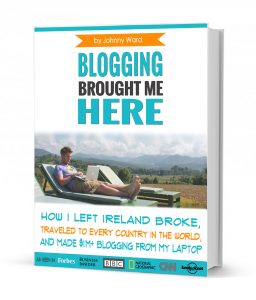 As you know, blogging changed my life. I left Ireland broke, with no plan, with just a one-way ticket to Thailand
and no money. Since then, I started a blog, then a digital media company, I've made
more than $1,500,000 USD, bought 4 properties and visited (almost) every country in the world. And I did it all from my laptop as I
travel the world and live my dream. I talk about how I did it, and how you can do it too, in my COMPLETELY FREE
Ebook, all 20,000
words or so. Just finish the process by putting in your email below and I'll mail it right out to you immediately. No spam ever too, I promise!
As you know, blogging changed my life. I left Ireland broke, with no plan, with just a one-way ticket to Thailand
and no money. Since then, I started a blog, then a digital media company, I've made
more than $1,500,000 USD, bought 4 properties and visited (almost) every country in the world. And I did it all from my laptop as I
travel the world and live my dream. I talk about how I did it, and how you can do it too, in my COMPLETELY FREE
Ebook, all 20,000
words or so. Just finish the process by putting in your email below and I'll mail it right out to you immediately. No spam ever too, I promise!