

How Pakistani Travelers Access Sites on the Go
Pakistani travelers who want to access online gambling sites while abroad often rely on smartphones and reliable internet connections to bypass regional restrictions. This mobile-first approach helps them stay connected to their preferred platforms throughout the journey. Next, we’ll explore the tools they use to make the most of these sites while traveling.
A Road Trip Through Restrictions
For many Pakistani travelers, whether business professionals in Dubai or digital nomads exploring Europe, the internet is a constant companion. Yet one activity remains largely hidden from view: online gambling. Yet casino enthusiasts can explore the gambling platforms on this page in Urdu to see how to access them on the go.
In Pakistan, almost all forms of betting and casino gaming are illegal under the Prevention of Gambling Act (1977). The Pakistan Telecommunication Authority (PTA) actively blocks gambling websites, making access difficult from within the country. Despite these restrictions, local travelers continue to reach offshore platforms while abroad.
How Travel Changes the Balance
Inside Pakistan, gambling sites are often blocked, and payment channels are closely monitored. Step across the border, and the digital landscape changes almost instantly.
In countries where betting is legal, local internet filters disappear. Geo-location shifts let users access licensed platforms that would otherwise be off-limits. International payment options also become much easier, especially in places where global banks and fintech services operate smoothly.
For many travelers, just connecting to hotel Wi-Fi in a regulated market can be enough to load gambling sites without any hacks or workarounds. Essentially, traveling creates a short-lived opportunity to access platforms that aren’t available within Pakistan.
Mobile-First Gambling Habits
Pakistani users who gamble mostly stick to smartphones rather than laptops. This fits with the country’s mobile-first internet culture and the rise of app-based sportsbooks and crypto casinos. Smartphones also make it easy to have quick, private betting sessions while on the go.
Airports, taxi rides, and hotel rooms often turn into temporary betting spots. While this behavior follows global iGaming trends, it’s marked by a stronger focus on discretion and portability. For many users, this mobile approach has become a key part of how they engage with gambling while traveling.
The VPN Factor Abroad
Even when abroad, many users still turn to virtual private networks (VPNs) to keep things running smoothly. VPNs let them log into the same offshore accounts, keep their usual settings and interfaces, and hide their location as they move between countries.
VPNs themselves have come under more scrutiny in Pakistan, with new licensing rules and occasional service disruptions in recent years. For this reason, frequent travelers often set up and test their VPNs before leaving, treating a reliable connection as a crucial part of their travel routine.
Alternative Payment Methods While Traveling
Money is often the most complicated part. Pakistani banks tend to flag gambling transactions, and mobile wallets like JazzCash or Easypaisa can run into problems if they are linked to betting sites. This makes moving funds difficult, even when access to a platform is possible.
When traveling, users often switch to international debit or credit cards, multi-currency fintech apps, or cryptocurrencies to make deposits and withdrawals more easily. Crypto is especially popular because it avoids traditional banking channels, but price swings are always possible and have to be kept in mind.
The Legal Grey Zone for Individuals
In Pakistan, enforcement tends to focus on operators, agents, and organized betting networks rather than casual individual users. Even so, gambling remains illegal, and there are no legal protections if funds disappear, winnings are withheld, or an account is suddenly frozen.
For travelers, this creates an ongoing contradiction. They may be physically in a country where betting is legal and regulated, yet they still retain their legal identity in Pakistan, where the rules are much stricter. While the practical risk for individuals is often low, the lack of clear protection means the uncertainty never fully disappears.
Cultural and Religious Context
Beyond legal restrictions, gambling in Pakistan is heavily influenced by cultural and religious norms. These cultural pressures don’t simply disappear when people travel abroad, so even in countries where gambling is fully legal, many users remain cautious and private about their activities.
As a result, Pakistani travelers often approach gambling as a personal, temporary indulgence rather than a social or public pastime. They tend to keep their sessions discreet, avoiding discussion or exposure, and focus on quick, private engagements rather than making it part of their social routines.
The Real Risks on the Road
Accessing gambling platforms abroad doesn’t always mean a smooth experience. Users can face locked accounts if their location suddenly changes, experience delays in international payments, or have problems with unregulated offshore platforms that offer no way to resolve disputes. Sudden site blocks or changes to mirror domains can also cut off access without warning.
For example, a traveler might win while abroad, but then struggle to withdraw the funds once back in Pakistan, where local banks may refuse transactions linked to gambling. These challenges show that even outside the country, users must navigate a tricky mix of access issues, legal uncertainty, and financial barriers.
Final Thoughts
For Pakistani travelers, online gambling is really a story about movement. Crossing borders changes what the internet allows. Mobile devices carry private digital worlds across different destinations. Laws struggle to keep up with technological advancements and changing habits.
As Pakistan tightens controls on VPNs and online payments, and global gambling grows more mobile and crypto-driven, this cat-and-mouse game intensifies. Travelers find ways to access platforms through gambling apps, alternative payments, and foreign networks. Yet every step sits in a legal and cultural grey zone. Travel may open the door, but the risks never fully disappear.
Remember, never travel without travel insurance! And never overpay for travel insurance!
I use HeyMondo. You get INSTANT quotes. Super cheap, they actually pay out, AND they cover almost everywhere, where most insurance companies don't (even places like Central African Republic etc!). You can sign-up here. PS You even get 5% off if you use MY LINK! You can even sign up if you're already overseas and traveling, pretty cool.
Also, if you want to start a blog...I CAN HELP YOU!
Also, if you want to start a blog, and start to change your life, I'd love to help you! Email me on johnny@onestep4ward.com. In the meantime, check out my super easy blog post on how to start a travel blog in under 30 minutes, here! And if you just want to get cracking, use BlueHost at a discount, through me.
Also, (if you're like me, and awful with tech-stuff) email me and my team can get a blog up and running for you, designed and everything, for $699 - email johnny@onestep4ward.com to get started.
Do you work remotely? Are you a digital nomad/blogger etc? You need to be insured too.
I use SafetyWing for my digital nomad insurance. It covers me while I live overseas. It's just $10 a week, and it's amazing! No upfront fees, you just pay week by week, and you can sign up just for a week if you want, then switch it off and on whenever. You can read my review here, and you can sign-up here!





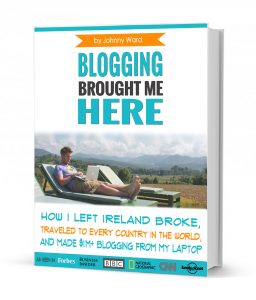 As you know, blogging changed my life. I left Ireland broke, with no plan, with just a one-way ticket to Thailand
and no money. Since then, I started a blog, then a digital media company, I've made
more than $1,500,000 USD, bought 4 properties and visited (almost) every country in the world. And I did it all from my laptop as I
travel the world and live my dream. I talk about how I did it, and how you can do it too, in my COMPLETELY FREE
Ebook, all 20,000
words or so. Just finish the process by putting in your email below and I'll mail it right out to you immediately. No spam ever too, I promise!
As you know, blogging changed my life. I left Ireland broke, with no plan, with just a one-way ticket to Thailand
and no money. Since then, I started a blog, then a digital media company, I've made
more than $1,500,000 USD, bought 4 properties and visited (almost) every country in the world. And I did it all from my laptop as I
travel the world and live my dream. I talk about how I did it, and how you can do it too, in my COMPLETELY FREE
Ebook, all 20,000
words or so. Just finish the process by putting in your email below and I'll mail it right out to you immediately. No spam ever too, I promise!