

How to Fund a Year Abroad Without Draining Your Savings
A year abroad usually gets planned backwards. The destination comes first, then the flights, and then a vague hope that the money will work itself out. By the time the real numbers appear, the plan is already built around a budget nobody checked, and savings end up covering everything that was missed.
That’s an expensive way to do it. Money that took years to save can disappear within months once it starts filling gaps, and you come home with little or nothing left.
Protecting your savings is less about cutting back and more about doing things in the right order. First, work out what the year will actually cost and bring that figure down where you can. Then decide how much will come from income, how much from outside funding, and how much from your own savings, in that order.
Table of contents
Work Out the Real Cost
Every other part of the plan depends on having a realistic total. A rough guess almost always comes in too low, because it only includes the costs you’ve already thought of.
Separate fixed costs from variable ones
Fixed costs include rent, insurance, visa fees, tuition and transport passes. They’re due on schedule no matter how the month is going. Visa and residency fees differ from country to country, so check the official destination information from the U.S. Department of State, along with your destination’s own immigration website, before you settle on those figures.
Variable costs include food, regional travel, going out and equipment. These change from month to month, and they’re where most budgets fall apart. Price your fixed costs precisely, using real listings and quotes from the city you’re moving to rather than national averages. For variable costs, set a firm monthly limit instead of a loose estimate.
Budget for the costs people forget
Moving abroad for a long stay involves costs at the start and at the end: rental deposits, a local phone plan, bank fees, furniture for an unfurnished apartment, medical appointments before you leave, and possibly an unplanned trip home. Include these in your total, then add an emergency reserve equal to about three months of fixed costs.
Bring the Total Down
Once you know the full cost, look for ways to reduce it before deciding how to pay for it.
Housing
Rent is usually the largest single expense and can take up half of your budget. Booking a short-term rental for your first few weeks, then signing a longer lease once you know the city, is usually safer and cheaper than committing to a full year before you arrive. Shared housing, university accommodation, or living a little further from the center can lower the total considerably.
Banking, cards and currency
Foreign transaction fees, poor exchange rates and ATM charges seem small individually, but over a year they add up. A multi-currency account, a card with no foreign transaction fees, and the habit of making fewer, larger transfers can save a meaningful amount. Set these up before you leave, while you still have a home address that banks will accept.
Keep Some Income Coming In
Whether your savings last often depends on whether you’re still earning. Even a modest regular income makes a big difference, because it lets your emergency fund stay untouched instead of becoming your everyday spending money.
Remote work and time differences
Keeping your current job is usually the simplest option, but time differences can be hard to manage. With a ten-hour gap, work meetings can take over your evenings, leaving little time to enjoy where you are. Before you leave, agree on your working hours in writing, including when you’ll be available. Freelance and contract work gives you more flexibility but less security, so it works best if you’ve found your clients before you go.
Working locally
Many student and residence visas allow a limited number of working hours per week, while others don’t allow paid work at all. Common options include teaching, hospitality, seasonal tourism and on-campus jobs. Because these jobs pay in local currency, they also protect part of your budget from exchange-rate changes. Always check what your visa allows before accepting work, as breaking the conditions can lead to losing your visa.
Look for Outside Funding
Grants and similar funding are often overlooked, partly because you usually have to apply many months before you’d receive anything. If you start early, you’ll have more options to choose from.
Grants, scholarships and fellowships
There are funded programs for study, research, teaching and language learning, and many of them cover living costs as well as tuition. Well-known programs such as the Fulbright U.S. Student Program have long application cycles, with deadlines typically falling about a year before the grant period begins. Smaller regional grants, awards from professional associations and university-specific funds tend to receive fewer applications, so they’re well worth researching.
Employers, schools and taxes
Some employers and universities offer sabbaticals, tuition assistance or relocation support, so it’s worth asking what’s available. Taxes are worth checking too. If you’re a U.S. citizen or resident, the foreign earned income exclusion may reduce the tax you owe on money earned abroad, provided you meet the eligibility requirements. A meeting with a tax professional before you leave can help you understand what applies to you.
Give Your Savings a Clear Role
Once income and outside funding cover as much as they can, decide exactly what your savings will be used for, rather than letting them cover whatever is left. That might be your emergency reserve, a one-off expense such as flights or a rental deposit, or a fixed monthly amount. Keeping this money in a separate account makes it easy to see when you’re using it and to notice early if it’s going faster than planned.
Keep Your Budget Up to Date
Over a year abroad, exchange rates shift, income can be irregular, and no two months cost the same. A spreadsheet made before you leave quickly goes out of date, so you’ll need a way to keep your numbers current.
Budgeting apps can track your actual spending, compare different income scenarios, and warn you about months when your money may run short, often before you’d notice yourself. An AI financial advisor tool can also help you test your plan against situations many people don’t consider until they’re already abroad, such as how a fall in the exchange rate would affect your rent, or what would happen if your freelance work stopped for six weeks. The main benefit is spotting problems while there’s still time to deal with them.
What software does well
Apps are good at repetitive work: tracking and sorting your spending, handling two currencies, finding subscriptions you forgot to cancel, and showing how your budget changes under different exchange rates. Seeing the numbers laid out clearly also makes it easier to decide whether you can afford an extra trip without dipping too far into your reserve.
What’s still up to you
Software can’t decide what matters most to you about the year. If your main goal is learning the language, for example, spending more to live with local flatmates or in a particular neighborhood may be worth it. Choices about priorities and how much risk you’re comfortable with are yours to make. Use what the software shows you as information to consider, and speak to a qualified professional about bigger financial decisions.
Putting It All Together
A year abroad usually drains your savings when the money is the last thing you plan. Work out the real cost, reduce it where you can, keep some income coming in, apply for funding early, and decide in advance what your savings are for. None of this means cutting back on the experience itself. It simply means knowing where the money will come from before you go, so the whole year doesn’t rest on a single bank account.
Remember, never travel without travel insurance! And never overpay for travel insurance!
I use HeyMondo. You get INSTANT quotes. Super cheap, they actually pay out, AND they cover almost everywhere, where most insurance companies don't (even places like Central African Republic etc!). You can sign-up here. PS You even get 5% off if you use MY LINK! You can even sign up if you're already overseas and traveling, pretty cool.
Also, if you want to start a blog...I CAN HELP YOU!
Also, if you want to start a blog, and start to change your life, I'd love to help you! Email me on johnny@onestep4ward.com. In the meantime, check out my super easy blog post on how to start a travel blog in under 30 minutes, here! And if you just want to get cracking, use BlueHost at a discount, through me.
Also, (if you're like me, and awful with tech-stuff) email me and my team can get a blog up and running for you, designed and everything, for $699 - email johnny@onestep4ward.com to get started.
Do you work remotely? Are you a digital nomad/blogger etc? You need to be insured too.
I use SafetyWing for my digital nomad insurance. It covers me while I live overseas. It's just $10 a week, and it's amazing! No upfront fees, you just pay week by week, and you can sign up just for a week if you want, then switch it off and on whenever. You can read my review here, and you can sign-up here!









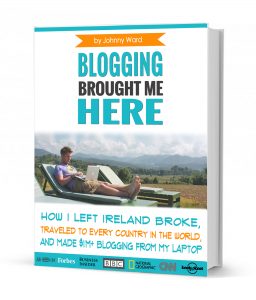 As you know, blogging changed my life. I left Ireland broke, with no plan, with just a one-way ticket to Thailand
and no money. Since then, I started a blog, then a digital media company, I've made
more than $1,500,000 USD, bought 4 properties and visited (almost) every country in the world. And I did it all from my laptop as I
travel the world and live my dream. I talk about how I did it, and how you can do it too, in my COMPLETELY FREE
Ebook, all 20,000
words or so. Just finish the process by putting in your email below and I'll mail it right out to you immediately. No spam ever too, I promise!