

How to Protect Your Finances When You’re Constantly Abroad
Living out of a suitcase creates a particular kind of financial vulnerability, and it isn’t the one most people expect. The risk isn’t pickpockets. It’s distance.
When you’re rarely in one place for long, the ordinary signals that something has gone wrong stop reaching you. A letter sits unopened in a pile at an old address. A card gets blocked while you’re somewhere with no signal. An account opens in your name, and the first notice goes to a mailbox nobody has checked in eight months.
The fixes come down to redundancy and visibility, and neither takes long to arrange.
Table of contents
- How to Protect Your Finances When You’re Constantly Abroad
- Never rely on a single card or a single bank
- Fix the address problem before it becomes one
- Watch your credit file from wherever you happen to be
- Keep your phone number alive
- Assume the networks you’re using aren’t private
- Understand what the payment choices are costing you
- Keep the paperwork current, especially tax
- Have one person at home who can actually act
- Distance is the only real problem
Never rely on a single card or a single bank
One card is a single point of failure, and cards fail abroad all the time. Fraud systems block foreign transactions, a machine swallows one, a hotel places a hold that takes the limit with it.
Carry at least two cards from two different institutions on two different networks, and don’t keep them in the same bag. Add a second account at a separate bank holding enough to cover a few weeks. If one bank freezes everything for a security review, which does happen, the other one still works.
Keep a small amount of local cash, too. There will eventually be a day when nothing electronic cooperates.
Fix the address problem before it becomes one
Mail is where a surprising amount of this goes wrong. Financial institutions still send things by post, and some of them matter, like a card about to expire, a policy about to lapse, or a tax notice with a deadline attached.
Set a permanent address that will stay valid, whether that’s family, a mail forwarding service, or a registered address provider. Then go paperless everywhere it’s offered, since an email arrives no matter which country you’re in.
Update that address with every institution before leaving, not after. Chasing a bank’s address change process from a different time zone, on a phone number that no longer receives their calls, is a genuinely bad afternoon.
Watch your credit file from wherever you happen to be
Identity theft can be much harder to spot when you’re traveling or living abroad. One of the first warning signs may arrive by mail, which is easy to miss when you are not at home.
That makes free credit score monitoring especially useful for people spending time overseas. Many banks and credit card issuers include it at no cost, with alerts sent by email or through an app rather than by post. If a new account appears in your name or another significant change is reported, you can find out quickly instead of discovering it weeks or months later.
Before leaving, make sure your alert settings work internationally, and that notifications are being sent to an email address or app you actually check regularly.
Keep your phone number alive
Two-factor authentication built on text messages becomes a real problem the moment the SIM changes.
Anyone abroad long-term should move to an authenticator app or a hardware key wherever the bank supports it. Where a bank insists on SMS, and plenty still do, keep the home number active on a cheap plan or a forwarding service, and make sure the codes reach the phone you actually carry.
Add a port-out PIN with the carrier too. Whoever takes over that number takes over most of the accounts behind it, and being in a distant time zone makes recovery much slower.
Assume the networks you’re using aren’t private
Airport wifi, hotel wifi, the café downstairs, the coworking space. None of them deserve to be trusted with financial access.
A reputable VPN handles most of the risk. So does simply using mobile data for anything involving money, which is easier than it used to be now that eSIMs are cheap almost everywhere.
Watch the physical side as well. Shoulder surfing at a busy ATM isn’t theoretical, and skimmers show up far more often on standalone machines than on those built into a bank branch.
Understand what the payment choices are costing you
Two things quietly drain money from frequent travelers.
The first is foreign transaction fees, usually around three percent on every purchase. A card without them pays for itself quickly for anyone abroad regularly.
The second is dynamic currency conversion, where the terminal offers to charge you in your home currency instead of the local one. It sounds like a courtesy, and the exchange rate is reliably worse. Always choose the local currency, every time.
Where it’s safe to do so, withdraw larger amounts less often, since flat ATM fees hurt far more on small withdrawals.
Keep the paperwork current, especially tax
Tax residency does not follow anyone’s intuition about where they live. Days counted, ties maintained, and where income is sourced all matter, and the rules differ by country and occasionally contradict each other.
Keep a simple record of where you were and for how long. It takes a few minutes a month, and it’s close to impossible to reconstruct afterward.
Anyone spending serious time in more than one country should get proper advice once rather than guessing for years. This is an area where being wrong compounds quietly and expensively.
Have one person at home who can actually act
Some things cannot be done remotely. A document needs a signature. A bank insists on an in-person visit. Something arrives that needs handling this week.
Pick one trusted person, make sure they know how to reach you quickly, and consider whether a limited power of attorney makes sense for specific situations. That conversation goes much better before you need it than during.
They should also know which institutions you use, so they can tell the difference between something urgent and another marketing piece.
Distance is the only real problem
None of this is about being nervous abroad. It’s about removing the assumption that you’ll be nearby when something needs attention.
Two banks, two cards, an address that stays valid, alerts that actually reach you, two-factor that doesn’t depend on a SIM card, and one person at home who can step in.
Arrange it once, and being four thousand miles away stops being the thing that turns a small problem into a large one.
Remember, never travel without travel insurance! And never overpay for travel insurance!
I use HeyMondo. You get INSTANT quotes. Super cheap, they actually pay out, AND they cover almost everywhere, where most insurance companies don't (even places like Central African Republic etc!). You can sign-up here. PS You even get 5% off if you use MY LINK! You can even sign up if you're already overseas and traveling, pretty cool.
Also, if you want to start a blog...I CAN HELP YOU!
Also, if you want to start a blog, and start to change your life, I'd love to help you! Email me on johnny@onestep4ward.com. In the meantime, check out my super easy blog post on how to start a travel blog in under 30 minutes, here! And if you just want to get cracking, use BlueHost at a discount, through me.
Also, (if you're like me, and awful with tech-stuff) email me and my team can get a blog up and running for you, designed and everything, for $699 - email johnny@onestep4ward.com to get started.
Do you work remotely? Are you a digital nomad/blogger etc? You need to be insured too.
I use SafetyWing for my digital nomad insurance. It covers me while I live overseas. It's just $10 a week, and it's amazing! No upfront fees, you just pay week by week, and you can sign up just for a week if you want, then switch it off and on whenever. You can read my review here, and you can sign-up here!







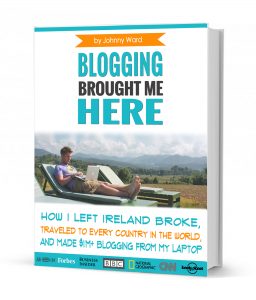 As you know, blogging changed my life. I left Ireland broke, with no plan, with just a one-way ticket to Thailand
and no money. Since then, I started a blog, then a digital media company, I've made
more than $1,500,000 USD, bought 4 properties and visited (almost) every country in the world. And I did it all from my laptop as I
travel the world and live my dream. I talk about how I did it, and how you can do it too, in my COMPLETELY FREE
Ebook, all 20,000
words or so. Just finish the process by putting in your email below and I'll mail it right out to you immediately. No spam ever too, I promise!