

Macroeconomic Factors Influencing Interest Rates: What Borrowers Must Know
When you decide to finance a new home, buy a car, or simply borrow funds to cover an unexpected expense, the interest rate you are offered is rarely arbitrary. Instead, it is the result of a complex, constantly shifting web of macroeconomic factors. In today’s highly connected financial landscape, applying for and securing a loan 24 hours a day is entirely possible thanks to automated digital platforms. However, while the speed and convenience of borrowing have evolved, the actual cost of that money—the interest rate—continues to fluctuate based on the health and trajectory of the global economy. Understanding these underlying economic forces can help you time your borrowing perfectly and potentially save thousands of dollars over the life of a loan.
The evolution of financial technology has completely transformed how we access credit on a global scale. Borrowers everywhere now expect seamless experiences where funds are approved and disbursed almost instantly. For instance, in Southeast Asian markets, the growing popularity of a pinjaman online terus masuk akaun perfectly illustrates this modern consumer demand for lightning-fast, direct-to-account digital lending. Yet, whether you are applying for a quick digital cash advance across the world or securing a traditional thirty-year mortgage at your local neighborhood bank, the interest rates attached to these financial products are heavily dictated by the exact same core macroeconomic principles.
Table of contents
To make sense of how these rates are determined, borrowers must familiarize themselves with a few primary economic drivers.
1. The Heavy Impact of Inflation
One of the most significant drivers of interest rates is inflation. Inflation represents the rate at which the general level of prices for everyday goods and services is rising, which subsequently erodes the purchasing power of a currency.
- The Lender’s Perspective: When inflation is high, lenders demand higher interest rates as compensation for the decrease in the purchasing power of the money they will be repaid in the future.
- The Macro Effect: If a lender issues a loan at a 5% interest rate, but inflation rises to 6%, the lender is effectively losing money in real terms. To prevent this, interest rates rise in tandem with inflation expectations.
2. Central Bank Monetary Policy
You have likely heard news reports about major institutions like the Federal Reserve, the European Central Bank, or the Bank of England adjusting their benchmark rates. These central banks act as the supreme architects of a nation’s monetary policy.
To cool down an overheating economy and fight high inflation, central banks typically raise their base interest rates. By increasing the rate at which commercial banks borrow money from the government, they directly influence the broader market. When it costs banks more to borrow, they pass those increased costs onto everyday consumers. If a central bank hikes its base rate, you can expect the interest on mortgages, credit cards, and personal financing to climb shortly thereafter.
3. Economic Growth and Credit Demand
The overall health of the economy, often measured by Gross Domestic Product (GDP), plays a massive role in dictating borrowing costs through the simple law of supply and demand.
- Booming Economies: When the economy is thriving, businesses are expanding, and consumers are spending confidently. This creates a massive surge in the demand for credit. Increased demand for limited capital naturally pushes interest rates higher.
- Sluggish Economies: Conversely, during a recession or economic downturn, consumer confidence drops and borrowing stalls. To stimulate the economy and encourage spending, central banks and private lenders will lower interest rates, making it significantly cheaper to borrow money.
4. National Debt and Government Borrowing
The amount of money a government borrows also impacts the interest rates available to private citizens. When a country runs a massive national deficit, it must issue more treasury bonds to fund its daily operations.
To attract cautious investors to buy these bonds, the government must offer highly attractive yields. Because government bonds are generally considered the safest possible investment, commercial lenders must raise their own interest rates to remain competitive and attract capital to their private lending pools. This economic phenomenon means that high government debt can indirectly increase the cost of your personal borrowing.
What Borrowers Must Know
Understanding these macroeconomic factors is not just an exercise for professional economists; it is vital, practical knowledge for any everyday borrower. Here is how you can leverage this information to your advantage:
- Lock in Fixed Rates: If macroeconomic indicators show that inflation is trending upward and central banks are signaling future rate hikes, it is generally wise to lock in a fixed-rate mortgage rather than an adjustable-rate one.
- Time Your Applications: If the economy is entering a cooling period and central banks are discussing rate cuts, waiting just a few months before taking out a massive loan could result in a significantly lower interest rate.
- Stay Informed: Keep a close eye on major economic indicators like GDP growth, national inflation reports, and central bank press conferences to anticipate where borrowing costs are heading next.
Ultimately, interest rates are simply the price of money. Like any other price, they rise and fall based on broader market dynamics. By paying attention to inflation, economic growth, monetary policies, and government debt, you can completely demystify the borrowing process. Being economically aware empowers you to make smarter, more cost-effective financial decisions for your future.
Remember, never travel without travel insurance! And never overpay for travel insurance!
I use HeyMondo. You get INSTANT quotes. Super cheap, they actually pay out, AND they cover almost everywhere, where most insurance companies don't (even places like Central African Republic etc!). You can sign-up here. PS You even get 5% off if you use MY LINK! You can even sign up if you're already overseas and traveling, pretty cool.
Also, if you want to start a blog...I CAN HELP YOU!
Also, if you want to start a blog, and start to change your life, I'd love to help you! Email me on johnny@onestep4ward.com. In the meantime, check out my super easy blog post on how to start a travel blog in under 30 minutes, here! And if you just want to get cracking, use BlueHost at a discount, through me.
Also, (if you're like me, and awful with tech-stuff) email me and my team can get a blog up and running for you, designed and everything, for $699 - email johnny@onestep4ward.com to get started.
Do you work remotely? Are you a digital nomad/blogger etc? You need to be insured too.
I use SafetyWing for my digital nomad insurance. It covers me while I live overseas. It's just $10 a week, and it's amazing! No upfront fees, you just pay week by week, and you can sign up just for a week if you want, then switch it off and on whenever. You can read my review here, and you can sign-up here!









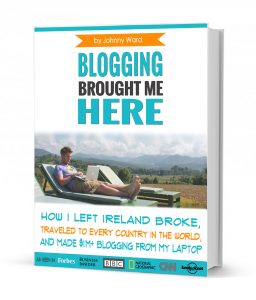 As you know, blogging changed my life. I left Ireland broke, with no plan, with just a one-way ticket to Thailand
and no money. Since then, I started a blog, then a digital media company, I've made
more than $1,500,000 USD, bought 4 properties and visited (almost) every country in the world. And I did it all from my laptop as I
travel the world and live my dream. I talk about how I did it, and how you can do it too, in my COMPLETELY FREE
Ebook, all 20,000
words or so. Just finish the process by putting in your email below and I'll mail it right out to you immediately. No spam ever too, I promise!
As you know, blogging changed my life. I left Ireland broke, with no plan, with just a one-way ticket to Thailand
and no money. Since then, I started a blog, then a digital media company, I've made
more than $1,500,000 USD, bought 4 properties and visited (almost) every country in the world. And I did it all from my laptop as I
travel the world and live my dream. I talk about how I did it, and how you can do it too, in my COMPLETELY FREE
Ebook, all 20,000
words or so. Just finish the process by putting in your email below and I'll mail it right out to you immediately. No spam ever too, I promise!