

Serengeti Christmas & New Year: The Herds Return to the South
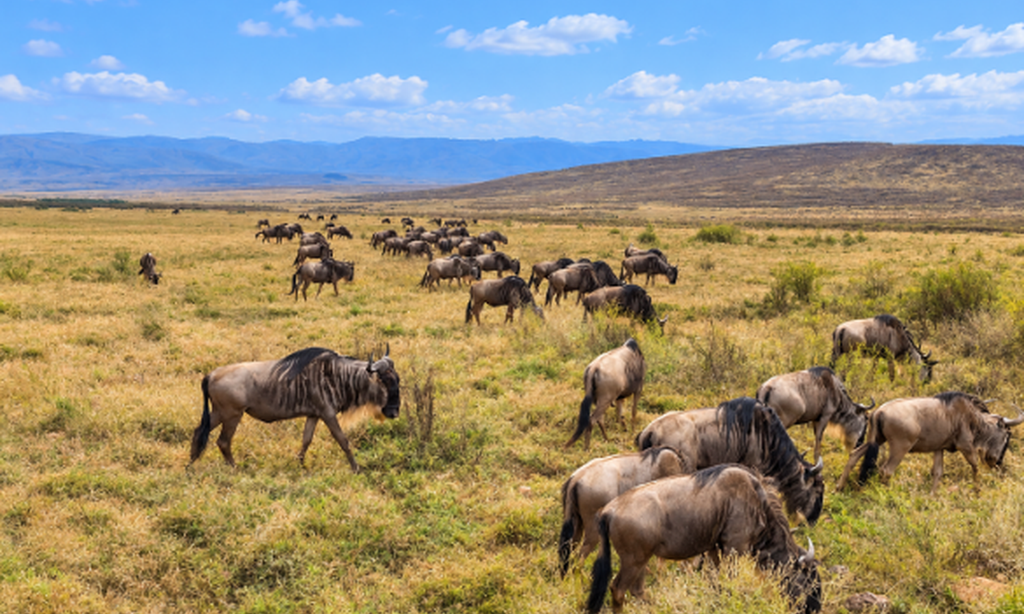
Trade the holiday crowds for a million wildebeest. Here’s what to expect on a Christmas or New Year safari in the southern Serengeti.
Ask most people about the Great Migration Serengeti, and they’ll describe the river crossings, with wildebeest piling into the Mara River while crocodiles wait in the water below. Fewer people realize that most crossings happen between July and October (crossings on the Grumeti River can begin in June), and the migration keeps moving for the rest of the year. Some of its best moments actually fall right around the holidays.
By Christmas, the herds have usually moved back to the southern Serengeti, though the exact timing depends on the rains. The short rains have turned the plains green again, the grass is full of grazing animals, and calving season is only weeks away.
| Quick answerOver Christmas and New Year, the wildebeest herds are usually on the green short-grass plains around Ndutu in the southern Serengeti. Expect warm days with brief afternoon showers. Calving builds through January and peaks in February. A private mid-range safari costs about 400$ – 545$ per person per day, and holiday camps should be booked 9 to 12 months ahead. |
Since we run safaris here every holiday season, we’ve put together what you need to know: where the herds go, what the weather does, which trips make sense, and what you can expect to pay.
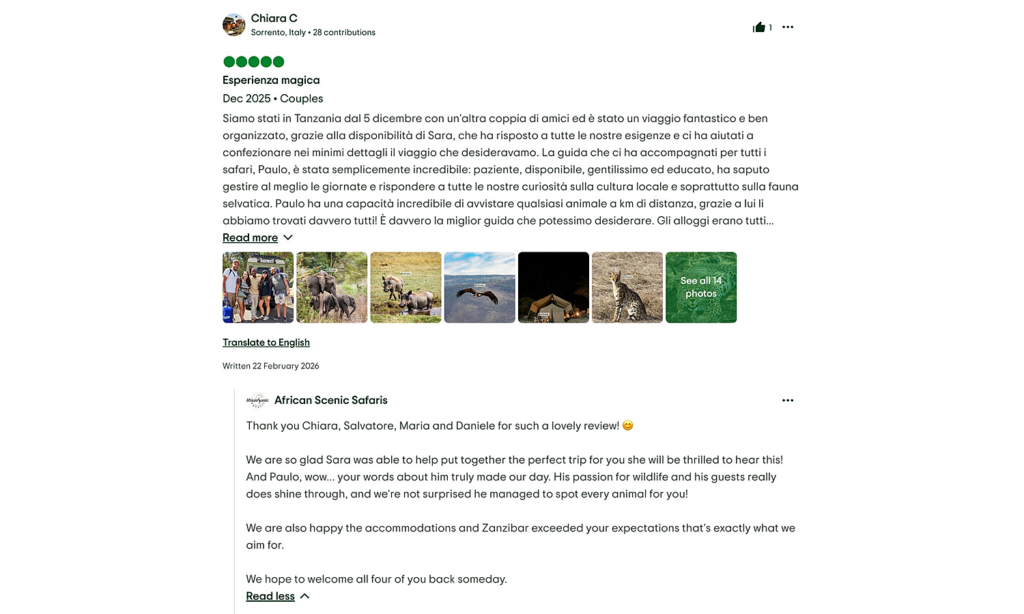
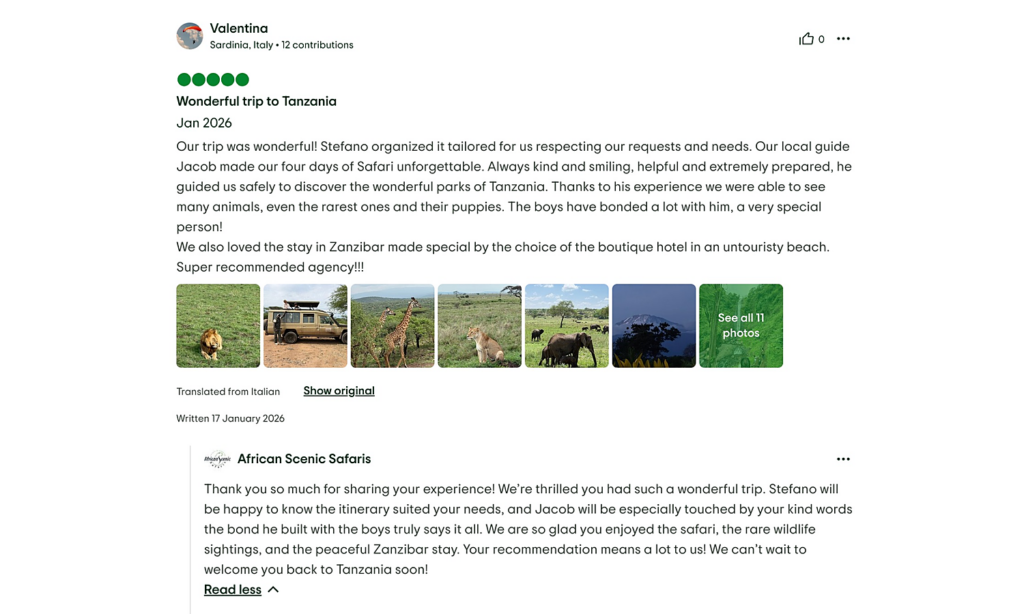
What our holiday guests say
Where Do the Herds Go in December?
In December, the herds usually head to the southern plains around Ndutu, an area on the Serengeti’s edge within the Ngorongoro Conservation Area.
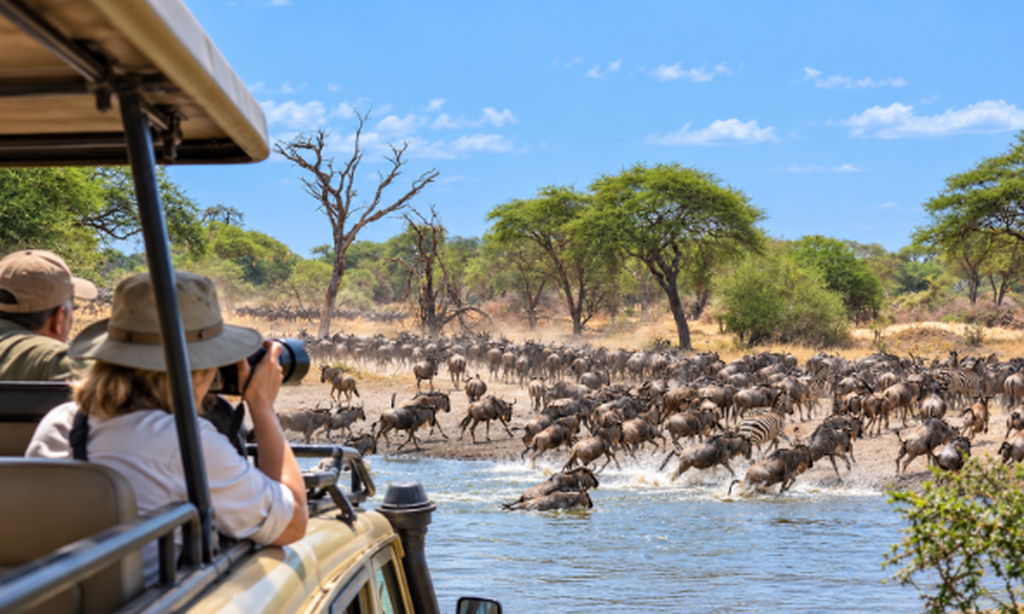
More than a million wildebeest make this journey each year, along with about 200,000 zebra and a few hundred thousand gazelles. They simply go wherever the rain has fallen, and the new grass has come up.
Where Is the Great Migration Each Month?
| Months | Where the herds usually are | What you’ll see |
| December–March | Southern plains around Ndutu | Herds arriving and settling; calving peaks in February |
| April–May | Central Serengeti, starting to move west | Long rains and herds on the move |
| June | Western corridor and the Grumeti River | The first river crossings |
| July–October | Northern Serengeti and the Mara River | The famous Mara River crossings |
| November | Moving back south with the short rains | Herds returning toward the southern plains |
Timing depends on the rains, so treat these months as a guide, not a guarantee.
Why Is Calving Season Such a Big Deal?
Calving doesn’t trickle along slowly. Once it gets going, an estimated half a million calves are born in roughly three weeks. A newborn wildebeest is on its feet within minutes, but it stays wobbly and vulnerable for the first few days, and the predators on the plains are well aware of that.
The result is some of Africa’s most action-packed game viewing. On an ordinary day around Ndutu, you could find yourself watching:
- Herds of wildebeest and zebra that seem to go on forever
- Lions and cheetahs on the hunt in short grass, where there’s nowhere to hide
- Hyenas and jackals hanging around the edges of the herds
- From late January onward, newborn calves taking their first unsteady steps (newborns are still rare at Christmas)
Calving usually peaks in February. A Christmas or New Year visit lets you watch the herds arrive and settle in, and if you can stay a little longer into January, there’s a good chance you’ll see some of the first births.
What Is the Weather Like Over the Holidays?
Late December falls at the tail end of Tanzania’s short rains. That might sound like a drawback, but in practice it usually means a quick afternoon shower followed by clear skies. The plains usually stay green without turning into deep mud, although tracks can get slippery after a heavy downpour.
- Rain: Brief afternoon showers that tend to pass quickly
- Temperatures: In the central Serengeti, around 79–82°F (26–28°C) by day, dropping to about 57–61°F (14–16°C) at night
- Good to know: December is officially shoulder season, but Christmas and New Year’s week are often charged at peak or festive rates
January
- Rain: Mostly dry, with occasional short showers
- Temperatures: Among the warmest weeks of the year, with central Serengeti days reaching about 84°F (29°C).
- Good to know: Peak season begins, and camps near the herds fill up early
The one place that catches people off guard is the Ngorongoro Crater rim. It sits at about 7,500 feet (2,300 meters), and the early mornings up there are surprisingly cold, so a warm fleece is worth the space in your bag.
Christmas Day and New Year’s Eve on Safari
Christmas Day on safari usually follows the normal rhythm of the bush: an early game drive, a break through the heat of the day, and another drive in the late afternoon, when the light is golden and the predators start to stir. Many camps mark the evening with a special festive dinner, and some set up a bush dinner or sundowner drinks out on the plains. New Year’s Eve tends to be a relaxed dinner under the stars rather than a late party, since game drives start early on New Year’s morning.
Where You’ll Stay Around Ndutu
Accommodation near the herds falls into two broad types:
• Seasonal mobile camps: tented camps that move with the migration and set up on the southern plains from about December to March, putting you close to the herds.
• Permanent lodges and tented camps: fixed properties near Lake Ndutu and Lake Masek, with more facilities and the same access to the plains.
Both fill up fast over the holidays. For Christmas and New Year, we recommend booking 9 to 12 months ahead.
Traveling Over the Holidays with Children
The holidays are when many families travel, and a private safari suits them well, since your vehicle runs to your family’s schedule. A few things to know:
• Minimum ages: some camps set a minimum age for children, so check this when choosing where to stay.
• Family tents: many camps offer family tents or interconnecting rooms.
Park fees: children under five enter Serengeti National Park free, and children aged 5 to 15 pay a reduced fee.
Best Safaris for Christmas and New Year
Every trip we run is private, which means your group has its own vehicle and guide from start to finish. Of the itineraries on our tours page, these three suit the holidays best.
1. 8 Days Calving Season Safari
If the herds are the main reason you’re going, this is the trip to look at. Most of your time is spent around Ndutu and in the Serengeti, with a crater descent near the end. You’ll stay in tented camps and lodges, and because off-road driving is allowed in parts of the Ndutu area, your guide can often follow the action within the conservation area’s rules.
2. 8 Days Tarangire Flyout Safari
Holiday vacation time is usually short, and this trip makes the most of it. You drive the shorter legs between Tarangire, the Ngorongoro Crater, Ndutu, and the Serengeti, then fly from the Serengeti back to Arusha on the last day instead of making the long drive out. That means more of your days on game drives and less of them on the road. Scheduled light-aircraft flights cost about $250–$500 per person per flight.
3. 8 Days Tanzania Classic Safari
This popular trip for first-time visitors covers Tarangire, Lake Manyara, the Serengeti, and the Ngorongoro Crater. Over the holidays, we can route it through the southern plains so the migration becomes part of the plan.
Holiday Add-Ons
• Zanzibar beach extension: the most popular holiday pairing. A short flight takes you from the Serengeti or Arusha to Zanzibar’s beaches for a few days of rest after the safari.
• Kilimanjaro New Year summit: for the adventurous, a climb timed to reach the summit around New Year’s Day, before or after your safari.
Like the look of this? Send us your dates and group size, and we’ll put together a free, itemized quote, usually by the next day.
How Much Does a Tanzania Safari Cost?
Holiday pricing is a little unusual because the trip straddles two seasons. As our Tanzania Safari Cost guide explains, December is shoulder season, and January is peak season, so the daily rate goes up partway through your stay:
| Level (per person, per day) | December | January |
| Mid-range | $400–$470 | $470–$545 |
| Luxury | $750–$890 | $890–$1,030 |
Put together, an 8-day trip from December 28 to January 4 (four days at December rates and four at January rates) comes to about $3,480–$4,060 per person at the mid-range level and $6,560–$7,680 at the luxury level, not including international flights.
Those numbers already include park fees, which account for a fair share of the total. Because Ndutu is inside the Ngorongoro Conservation Area, the fee there is $71 per person per day, while the Serengeti charges $83. The $295 per vehicle Ngorongoro Crater descent fee is also included. Because it’s charged per vehicle, each person’s share decreases as your group grows. These are the current published fees, so we’ll confirm the 2026/27 tariff when we send your quote.
Camps and lodges inside Serengeti National Park also charge a concession fee of about $71 per person per night (less for children aged 5 to 15, and free for under-fives). When you compare quotes from different operators, check whether this fee is included.
If you’re going to splurge on one thing, make it a sunrise hot-air balloon flight over the Serengeti, which costs $550-$600 per person.
Festive-Season Extras
Some camps add a festive supplement over Christmas and New Year, typically around $50–$150 per person per night for stays between about December 20 and January 5, and a few ask for a minimum stay of three or four nights. Check for both when you compare quotes.
Practical Tips for a Holiday Safari
• Visa: Most visitors can apply for a Tanzania e-visa online at visa.immigration.go.tz . It costs $50 for most nationalities and $100 for US citizens. Apply at least three to four weeks before you travel.
• Flights: fly into Kilimanjaro International Airport (JRO), the closest international airport to the northern parks.
• Malaria: the Serengeti is in a malaria area. Ask your doctor about antimalarial tablets, and pack insect repellent and long sleeves for the evenings.
• Travel insurance: Tanzania now requires visitors to buy its inbound travel insurance (see the FAQ below).
Holiday packing list
• A warm fleece or light down jacket for the crater rim and early-morning drives
• A light rain jacket for afternoon showers
• Neutral-colored, breathable layers
• Sun hat, sunglasses and sunscreen
• Binoculars and spare camera batteries
• Insect repellent
Final Thoughts: Is a Serengeti Christmas and New Year Safari Worth It?
Yes, for most travelers it is. The river crossings may get most of the attention, but the southern Serengeti over the holidays offers something they can’t. Instead of a line of vehicles waiting at the riverbank, you get wide-open plains, enormous herds, and the steady drama of calving season on the way.
If you’ve been waiting for the right moment to plan a Tanzania safari, this may be it.
Ready to spend the holidays with the herds? Send us your dates and group size, and we’ll put together a free, itemized quote, usually by the next day. Holiday camps around Ndutu often book out 9 to 12 months in advance, so it’s worth reaching out early.
[Get My Free Quote]
About the Author: African Scenic Safaris is a locally owned Tanzania tour operator based in Moshi since 2009. The team runs private safaris and ethical Kilimanjaro climbs, and the company is Travelife-certified for sustainable tourism. Plan your trip at africanscenicsafaris.com.
Get My Free Quote
About the Author: African Scenic Safaris is a locally owned Tanzania tour operator based in Moshi since 2009. The team runs private safaris and ethical Kilimanjaro climbs, and the company is Travelife-certified for sustainable tourism. Plan your trip at africanscenicsafaris.com.
Frequently Asked Questions
Where are the wildebeest herds at Christmas?
At Christmas, the herds are usually on the short-grass plains around Ndutu in the southern Serengeti, which sits inside the Ngorongoro Conservation Area. They tend to stay south until about March, though the exact timing depends on the rains.
Is January a good time to visit Tanzania?
Yes. January is one of the warmest months, with fairly little rain, and central Serengeti days reaching about 84°F (29°C). The herds are in the south, calving is building toward its February peak, and predator sightings are often excellent. It’s peak season, so book early.
How much does a Serengeti safari cost over the holidays?
A private mid-range safari costs about $400–$470 per person per day in December and $470–$545 in January, including park fees. An eight-day trip from December 28 to January 4 costs about $3,480– $4060 per person at mid-range, or $6,560–$7,680 at luxury, before international flights.
Do I need travel insurance for Tanzania?
Yes. Since October 1, 2026, most visitors entering mainland Tanzania must buy the government’s inbound travel insurance from the National Insurance Corporation (NIC), either online before travel or on arrival. It costs $44 per adult, with discounts for children, and covers you for up to 92 days with multiple entries. It covers emergency medical treatment, evacuation, and repatriation. Residents of EAC and SADC countries are exempt. If you’re adding a Zanzibar beach extension, you need only one mandatory policy for the trip: buy the one for wherever you first enter Tanzania. We still recommend full travel insurance, too.
How far ahead should I book a Christmas safari?
For Christmas and New Year in the southern Serengeti, we recommend booking 9 to 12 months ahead. Camps near the herds are small, and the best-placed ones fill up first, especially for families who need several tents.
Remember, never travel without travel insurance! And never overpay for travel insurance!
I use HeyMondo. You get INSTANT quotes. Super cheap, they actually pay out, AND they cover almost everywhere, where most insurance companies don't (even places like Central African Republic etc!). You can sign-up here. PS You even get 5% off if you use MY LINK! You can even sign up if you're already overseas and traveling, pretty cool.
Also, if you want to start a blog...I CAN HELP YOU!
Also, if you want to start a blog, and start to change your life, I'd love to help you! Email me on johnny@onestep4ward.com. In the meantime, check out my super easy blog post on how to start a travel blog in under 30 minutes, here! And if you just want to get cracking, use BlueHost at a discount, through me.
Also, (if you're like me, and awful with tech-stuff) email me and my team can get a blog up and running for you, designed and everything, for $699 - email johnny@onestep4ward.com to get started.
Do you work remotely? Are you a digital nomad/blogger etc? You need to be insured too.
I use SafetyWing for my digital nomad insurance. It covers me while I live overseas. It's just $10 a week, and it's amazing! No upfront fees, you just pay week by week, and you can sign up just for a week if you want, then switch it off and on whenever. You can read my review here, and you can sign-up here!


 As you know, blogging changed my life. I left Ireland broke, with no plan, with just a one-way ticket to Thailand
and no money. Since then, I started a blog, then a digital media company, I've made
more than $1,500,000 USD, bought 4 properties and visited (almost) every country in the world. And I did it all from my laptop as I
travel the world and live my dream. I talk about how I did it, and how you can do it too, in my COMPLETELY FREE
Ebook, all 20,000
words or so. Just finish the process by putting in your email below and I'll mail it right out to you immediately. No spam ever too, I promise!