

Slow Travel, Nomad Visas, and the New Shape of Long-Haul Trips in 2026

Image by Bjorn Castellanos
Long-haul travel has finally caught its breath after a chaotic few years. The frantic two-country-a-week itineraries that dominated post-pandemic feeds have started to look exhausting in 2026, and a quieter wave of travellers is settling into longer stays, smaller daily routines, and trips planned around weather windows rather than flight deals. Hostel boards in Lisbon and Medellin read more like coworking schedules than party calendars. Train stations in Tbilisi and Chiang Mai fill up on Sunday evenings as people rotate between four-week bases. The shift is not loud, but it is everywhere if you spend enough time on the road, and it is reshaping how guidebooks, gear brands, visa offices, and hostel chains pitch themselves to a traveller who wants to actually see somewhere rather than just touch it.
Table of contents
- Slow Travel, Nomad Visas, and the New Shape of Long-Haul Trips in 2026
- The 2026 Slow-Travel Rebound and Why It Finally Stuck
- Travel Gear That Earns Its Place in 2026
- Nomad Visas Have Finally Grown Up
- Why Long-Stay Apartments Are Outcompeting Hostels and Hotels
- Remote Work Routines That Actually Survive a Year on the Road
- Border Hops, Air Networks, and the New Geography of Long Trips
- Health, Insurance, and the Boring Things That Keep You Travelling
- Food, Slow Cooking, and the Stories That Survive a Stay
- What the Next Year of Long-Haul Travel Probably Looks Like
This piece looks at the patterns that have settled in for full-time travellers and serious holiday-takers in 2026, drawn from a year of bouncing between bases in West Africa, the Caucasus, Southeast Asia, and the slower edges of Europe. The themes that keep surfacing are familiar but with sharper edges: nomad visas that finally work as intended, lighter gear that actually survives a year of buses, a cleaner separation between travel hours and downtime hours, and a slower rhythm that rewards curiosity over kilometres. None of this is glamorous in the way travel feeds suggest. Most of it is small choices repeated for weeks at a time, which is exactly why it survives contact with real life on the road.
The 2026 Slow-Travel Rebound and Why It Finally Stuck
Slow travel has been talked about for over a decade, but the practice only really stuck for a critical mass of long-haul travellers from late 2024 onwards. The combination of stickier flight prices, better remote-work norms, and a generation of travellers who have already ticked off the highlight reel created room for a calmer pace. Four weeks in Oaxaca, three weeks in Tirana, six weeks scattered across northern Portugal: these are the trip shapes that get described over hostel breakfasts now, not seven cities in fifteen days. The economics support it too. Monthly apartment rates in mid-sized cities undercut weekly hotel rates almost everywhere outside the major capitals, and the savings free up budget for the things that actually make a stay memorable: longer Spanish classes, a proper bike rental, a guided walk with someone who actually lives there. Slow travel in 2026 is less a lifestyle slogan and more a default choice for anyone planning a trip longer than two weeks.
That shift has a quieter consequence for the people writing about the audience, because the modern slow-travel reader sits inside a wider adult-traveller media-consumption demographic rather than a pure backpacker one. Editors covering this cohort have noticed that the same reader who clicks through a thousand-word piece on Tirana apartment rents also spends a non-trivial slice of an evening on independent reviews of streaming services, podcast roundups, kit comparisons, and downtime entertainment platforms, which means the editorial environment around a 2026 slow-travel piece looks a lot more like adjacent adult-leisure coverage than it did in the 2010s. That is the reason a working editor on this beat now moves across categories that look unrelated to travel on paper, from independent television and streaming rundowns to long-form route reviews and consumer references such as Bonus.com’s game selection for real money slots, simply because those categories share the same evening minutes as a slow-travel feature in the wider adult-reader habit pattern.
Travel Gear That Earns Its Place in 2026
Long-term travellers have become ruthless about what they pack, and the kit list that survives a year on the road in 2026 looks different from anything that came before it. The pragmatic version of the modern carry-on rotates around a single 40-litre bag, a laptop that can handle four-hour client calls in cafe heat, packable rain shells that double as evening layers, and a small electronics pouch that prioritises charging speed over plug compatibility. The wider gear conversation is captured well in a recent remote work gear list from AFAR that walks through what people who actually live on the road keep buying versus what they regret. The pattern is consistent across travellers I have spoken to this year: one good merino base layer, two pairs of trail-capable shoes, noise-cancelling earbuds that last a full transcontinental flight, and a paper notebook that survives airline crew rough handling. Everything else is replaceable on the road, and the discipline of buying less but better has translated into lighter packs and fewer customs interrogations.
Nomad Visas Have Finally Grown Up
The first wave of digital nomad visas, introduced between 2020 and 2023, looked great on paper and frustrated almost everyone who tried to use them. Application portals broke, income thresholds were unrealistic, tax residency rules were ambiguous, and consulates often did not know their own programs existed. By 2026 the situation has matured considerably. Portugal, Spain, Italy, Estonia, Croatia, Mexico, Costa Rica, Colombia, Mauritius, Cape Verde, and Japan all operate programs that, while still imperfect, actually issue decisions in predictable timeframes. The interesting development is how these visas are starting to shape destination choice for long-term travellers. People no longer arrive in Lisbon and hope to figure out residency on the back end; they apply from home, time their entry around appointment slots, and arrive with a clearer picture of what they can and cannot do for the next year. The result is a more honest relationship between traveller and country, and a quieter end to the era of awkward tourist-visa overstays that used to define the long-haul scene.
Why Long-Stay Apartments Are Outcompeting Hostels and Hotels
The accommodation question has shifted in a real way for slow travellers. Hostels remain unbeatable for the first few days in a new city when you want company and a fast read on the place, and boutique hotels still earn their keep for milestone weekends. The middle is now dominated by mid-term apartment rentals booked through long-stay platforms that quietly discount everything past a fourteen-night threshold. A Lisbon studio that lists at 110 euros a night for a weekend often falls to 1,400 euros for the month, which is the kind of arithmetic that ends the debate for anyone working remotely between Tuesdays and Thursdays. The trade-offs are real: less daily contact with other travellers, a quieter social calendar, and the small admin of laundry, groceries, and gas-meter top-ups. But the stability of a real kitchen, a desk that fits a second monitor, and a postman who recognises you by the second week is the foundation on which most of the other slow-travel habits become possible.
Remote Work Routines That Actually Survive a Year on the Road
Most of the people writing about remote work from a beach do not actually work from a beach for more than fifteen minutes. The truth of sustainable remote work on the road is closer to a quiet apartment, a properly-set-up desk, a noise-cancelling pair of headphones, and a schedule that respects time zones even when nobody on your team is asking you to. The practical guide to landing remote jobs while travelling full-time that this blog has put together remains one of the most honest reads on the subject because it strips out the lifestyle gloss and walks through the unglamorous work of finding a role, holding it down, and getting the logistics right. The patterns that work in 2026 are the same patterns that worked in 2019, just better tooled: fixed core hours overlapping with the team’s office, two longer focus blocks rather than seven scattered hours, and a hard cutoff after which the laptop closes and the city outside the window gets a chance. The travellers who treat remote work as a real job rather than a hobby on the side are the ones who manage to keep doing it for years rather than months.
Border Hops, Air Networks, and the New Geography of Long Trips
The map a long-haul traveller actually uses in 2026 is shaped less by where they want to go and more by which airlines have rebuilt their networks after the 2023 to 2025 fuel-cost shake-out. Low-cost European carriers have consolidated around Lisbon, Krakow, and Athens as winter bases for nomads chasing milder weather. Asian budget carriers have re-stitched intra-region routes that briefly disappeared, making Penang, Phuket, and Da Nang viable weekend hops from a Bangkok or Hanoi base again. South America has seen Colombian and Peruvian airlines step into routes that older flag carriers exited, which has revived the Medellin to Cusco circuit for slow travellers who want big distance without crossing oceans. The practical effect is that travellers plan trips in clusters now, picking a regional hub for three months and orbiting nearby cities on weekend loops, rather than zig-zagging across continents on punishing routings. The lower carbon footprint is a side benefit. The lower exhaustion is the real reason it has caught on.
Health, Insurance, and the Boring Things That Keep You Travelling
Nobody wants to write the chapter of a trip that involves a dentist in a country they cannot pronounce, but the boring infrastructure of travel insurance, vaccinations, and routine health admin is what keeps long trips going. The insurance market has matured around nomad-specific products from a handful of providers, with month-to-month billing, cover for prior bases, and inclusion of work equipment that older travel policies excluded. The vaccination calendar has become easier to manage with travel-clinic apps that flag dose timing and recommend regional updates ahead of border crossings. Mental health support, often ignored by the previous generation of travel coverage, now appears as a standard component of the better policies. None of this is exciting, but the travellers who have spent three or more years on the road tend to have one thing in common: they spent an evening every six months reviewing the boring infrastructure, and that review is what makes the next half-year possible.
Food, Slow Cooking, and the Stories That Survive a Stay
Ask any traveller who has spent a month in a city which memories endured, and the food stories almost always lead. Not the showpiece tasting menus, although those have their place, but the small repeating rituals: the corner bakery that knows your order by week three, the Tuesday market stall where the older woman saves the last of the fresh cheese, the bus driver who told you which side street has the better coffee. Slow travel in 2026 has tilted harder toward those repeating rituals because the longer stay makes them possible in a way a four-day trip never could. Travellers are spending more time in markets, taking cooking classes that focus on home dishes rather than tasting-menu showpieces, and bringing home recipe notebooks instead of magnets. The result is a softer kind of travel memory, less photo-driven and more sensory, and a richer relationship with places that for older guidebook readers might have been collapsed into a single afternoon walk.
What the Next Year of Long-Haul Travel Probably Looks Like
Forecasting travel is a losing game, but a few patterns visible across 2026 will almost certainly extend into the year ahead. Slow travel will continue to dominate the long-haul conversation, with hostel chains and apartment platforms tuning their inventories accordingly. Nomad visa programs will continue to mature, with at least three or four new countries entering the market and the existing ones tightening eligibility while improving processing times. Gear lists will keep shrinking as travellers internalise that lighter is better. Health and insurance products will keep specialising for full-time travellers in ways the old generic policies could not. And the downtime hours between legs will keep being filled with a mix of long-form audio, lightweight apps, and quiet reading that earlier generations would have spent in a hotel bar. The shape of long-haul travel in 2026 is calmer, smarter, and more durable than it was even three years ago, and the travellers who lean into that shape are the ones writing the most interesting trip notes coming out of the next year.
Remember, never travel without travel insurance! And never overpay for travel insurance!
I use HeyMondo. You get INSTANT quotes. Super cheap, they actually pay out, AND they cover almost everywhere, where most insurance companies don't (even places like Central African Republic etc!). You can sign-up here. PS You even get 5% off if you use MY LINK! You can even sign up if you're already overseas and traveling, pretty cool.
Also, if you want to start a blog...I CAN HELP YOU!
Also, if you want to start a blog, and start to change your life, I'd love to help you! Email me on johnny@onestep4ward.com. In the meantime, check out my super easy blog post on how to start a travel blog in under 30 minutes, here! And if you just want to get cracking, use BlueHost at a discount, through me.
Also, (if you're like me, and awful with tech-stuff) email me and my team can get a blog up and running for you, designed and everything, for $699 - email johnny@onestep4ward.com to get started.
Do you work remotely? Are you a digital nomad/blogger etc? You need to be insured too.
I use SafetyWing for my digital nomad insurance. It covers me while I live overseas. It's just $10 a week, and it's amazing! No upfront fees, you just pay week by week, and you can sign up just for a week if you want, then switch it off and on whenever. You can read my review here, and you can sign-up here!









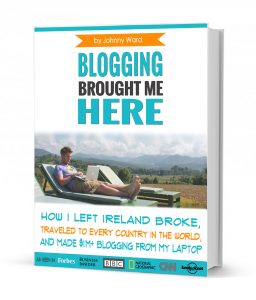 As you know, blogging changed my life. I left Ireland broke, with no plan, with just a one-way ticket to Thailand
and no money. Since then, I started a blog, then a digital media company, I've made
more than $1,500,000 USD, bought 4 properties and visited (almost) every country in the world. And I did it all from my laptop as I
travel the world and live my dream. I talk about how I did it, and how you can do it too, in my COMPLETELY FREE
Ebook, all 20,000
words or so. Just finish the process by putting in your email below and I'll mail it right out to you immediately. No spam ever too, I promise!
As you know, blogging changed my life. I left Ireland broke, with no plan, with just a one-way ticket to Thailand
and no money. Since then, I started a blog, then a digital media company, I've made
more than $1,500,000 USD, bought 4 properties and visited (almost) every country in the world. And I did it all from my laptop as I
travel the world and live my dream. I talk about how I did it, and how you can do it too, in my COMPLETELY FREE
Ebook, all 20,000
words or so. Just finish the process by putting in your email below and I'll mail it right out to you immediately. No spam ever too, I promise!