

Spring and Autumn in South Sardinia: The Mediterranean Family Trip You’re Probably Overpaying For
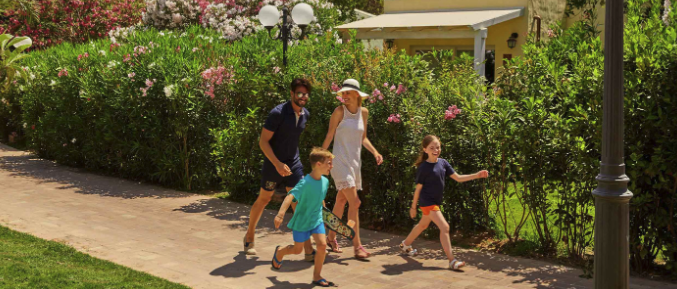
There is a strange convention in European family travel that says the summer holiday must happen in summer. Schools cooperate with this. Airlines exploit it. Resort pricing reflects it. And so, every July and August, the southern coast of Sardinia fills up with families who have paid roughly double what they would have paid six weeks earlier, for the privilege of sharing a beach at the very moment when demand is at its peak..
It is one of the more easily corrected mistakes in travel planning. Sardinia’s south coast — Chia, Pula, Villasimius, and the long stretch of white sand and shallow blue water that runs between them — is at its quiet best in late May, early June, and through September into mid-October. The weather is still warm. The sea is still swimmable. And the best Sardinia family resort options on the island reserve their most generous family offers and rates for precisely these weeks, when their grounds and pools and kids’ programmes are still running in full.
For families willing to step slightly outside the school-holiday script — and a growing number of Northern European families are doing exactly that — the shoulder season delivers something close to the platonic ideal of a Mediterranean family holiday at a price that makes it repeatable.
Why the weather isn’t the trade-off people imagine
The cliché is that off-season means cold pools and grey skies. In southern Sardinia, it doesn’t. The island sits at the same latitude as Naples, with a milder spring and a longer warm autumn than mainland Italy. May temperatures hover in the low-to-mid 20s Celsius, with sea temperatures around 19–21°C — cooler than August, but well within the range of what children will happily swim in for hours. September is, if anything, the secret peak: the sea has been baking all summer and the water is at its warmest, while the crowds have collapsed back to a fraction of their August density.
What changes most is the light and the pace. The harsh midday glare of peak summer softens into something gentler. The beaches that felt like festivals in August feel like beaches again. Local restaurants, no longer running at the edge of their capacity, slow down enough to actually cook. The island starts to feel like itself again rather than a destination performing for an audience.
The value math, briefly
This is the part travel writing usually fudges. The honest figures are these:
- Accommodation. Shoulder-season rates at the better resorts on the south coast typically run 30–50% lower than peak August prices. The same room, the same beach, the same restaurants — at materially different cost.
- Flights. Direct flights to Cagliari from most Northern European hubs drop sharply outside July and August. Families flying in late May or late September often pay half of peak-season fares.
- Special offers. The properties that depend on family business in summer compete hard for shoulder-season bookings. Free nights for children, complimentary half-board, longer-stay discounts, family-room upgrades — these appear in shoulder-season offers and disappear from June through August.
The cumulative effect, for a family of four staying a week, can be the difference between a comfortable holiday and an out-of-reach one. Or, more practically, the difference between one family holiday a year and two.
What families actually get for the money
The economic case for shoulder-season travel only matters if the experience holds up. In Sardinia, it does, and arguably improves. The full resort infrastructure remains in operation through May, June, September, and into October — pools, beaches, restaurants, kids’ clubs, teen programmes, sports facilities, the lot. What disappears is the pressure: shorter waits for the popular activities, more attentive staff, the chance to actually have a conversation with the people running the kids’ programme rather than collecting a child from a queue.
The wider island responds in the same way. Boat trips that take three days to book in August are available the next morning in May. The good restaurants in Cagliari have tables. The roads to the inland villages — Barumini, Sardara, the nuraghi heartland — empty out, and a half-day archaeological trip with restless teenagers stops being a logistical battle.
For families who already understand that the most expensive way to travel is rarely the best way, this is not a surprising observation. It is the same logic that has always favoured shoulder-season travel in Italy, applied to the one Italian destination where the school-holiday tax is largest.
The broader Mediterranean argument is one this site has made before — there’s more on the region in Discovering the Heart of the Mediterranean — and for region-by-region planning the official Sardegna Turismo site is the cleanest starting point.
The southern coast will still be there in July. It will also be there in late May, when it costs less, looks better, and finally feels like the place the brochures keep promising.
Remember, never travel without travel insurance! And never overpay for travel insurance!
I use HeyMondo. You get INSTANT quotes. Super cheap, they actually pay out, AND they cover almost everywhere, where most insurance companies don't (even places like Central African Republic etc!). You can sign-up here. PS You even get 5% off if you use MY LINK! You can even sign up if you're already overseas and traveling, pretty cool.
Also, if you want to start a blog...I CAN HELP YOU!
Also, if you want to start a blog, and start to change your life, I'd love to help you! Email me on johnny@onestep4ward.com. In the meantime, check out my super easy blog post on how to start a travel blog in under 30 minutes, here! And if you just want to get cracking, use BlueHost at a discount, through me.
Also, (if you're like me, and awful with tech-stuff) email me and my team can get a blog up and running for you, designed and everything, for $699 - email johnny@onestep4ward.com to get started.
Do you work remotely? Are you a digital nomad/blogger etc? You need to be insured too.
I use SafetyWing for my digital nomad insurance. It covers me while I live overseas. It's just $10 a week, and it's amazing! No upfront fees, you just pay week by week, and you can sign up just for a week if you want, then switch it off and on whenever. You can read my review here, and you can sign-up here!


 As you know, blogging changed my life. I left Ireland broke, with no plan, with just a one-way ticket to Thailand
and no money. Since then, I started a blog, then a digital media company, I've made
more than $1,500,000 USD, bought 4 properties and visited (almost) every country in the world. And I did it all from my laptop as I
travel the world and live my dream. I talk about how I did it, and how you can do it too, in my COMPLETELY FREE
Ebook, all 20,000
words or so. Just finish the process by putting in your email below and I'll mail it right out to you immediately. No spam ever too, I promise!
As you know, blogging changed my life. I left Ireland broke, with no plan, with just a one-way ticket to Thailand
and no money. Since then, I started a blog, then a digital media company, I've made
more than $1,500,000 USD, bought 4 properties and visited (almost) every country in the world. And I did it all from my laptop as I
travel the world and live my dream. I talk about how I did it, and how you can do it too, in my COMPLETELY FREE
Ebook, all 20,000
words or so. Just finish the process by putting in your email below and I'll mail it right out to you immediately. No spam ever too, I promise!