

How to Ask for What You Want Using the ‘Ben Franklin Effect’
Asking for a favour can be difficult. We often worry about being a burden, appearing weak, or facing rejection. But what if asking for help, done correctly, could actually strengthen your relationships and make people like you more? This is the central paradox of a 200-year-old psychological principle known as the “Ben Franklin Effect.”
It’s a counterintuitive strategy that turns conventional networking advice on its head. Instead of just offering to help others, you strategically ask for their help. This article explores the psychology behind this powerful effect and provides a practical guide on how to use it to build rapport, influence, and stronger professional alliances.
Table of contents
What Is the Ben Franklin Effect (And Why Does It Work)?
The effect gets its name from an anecdote told by Benjamin Franklin himself. While serving in the Pennsylvania legislature, he faced a political rival who strongly opposed him. Franklin didn’t try to win him over with flattery; instead, he asked to borrow a rare and valuable book from his rival’s personal library.
The rival, surprised, agreed. Franklin returned the book a week later with a simple thank-you note. The next time they met, the rival approached Franklin and spoke to him for the first time. They went on to become not only political allies but also lifelong friends.
This phenomenon is a classic example of cognitive dissonance. Our minds crave consistency; we need our attitudes and our actions to be in alignment.
- The Dissonance: “I don’t like this person, but I just did them a favour.”
- The Resolution: To resolve this conflict, the mind subconsciously adjusts the attitude: “I must actually like this person; otherwise, why would I have helped them?”
This principle of cognitive dissonance is a cornerstone of modern business and user engagement. Industries from software to online entertainment study user psychology to build loyalty. For instance, platforms like fortunica casino online might use small, successive engagement requests, like tutorials or feedback surveys, to build a user’s affinity for their site. The underlying principle is the same: our actions shape our attitudes, often more than our attitudes shape our actions.
How to Use the Effect (Without Being Manipulative)
Now that we understand the psychology, how do we apply it ethically and effectively? It’s crucial to distinguish between using this effect to build genuine rapport and simple manipulation. The goal is to open the door to a positive relationship, not just to get free help.
This distinction lies entirely in the execution.
Start Small and Be Specific
The key to Franklin’s success was the nature of his request. It was small, specific, and non-threatening. He didn’t ask for a huge political favour; he asked to borrow a book. This made it easy for his rival to say “yes” without feeling imposed upon.
Start with small “asks”:
- Asking to borrow a book or a business-related magazine.
- Asking for a 5-minute opinion on an idea you’re developing.
- Asking for a simple recommendation, like their favourite business podcast.
These low-stakes requests give the other person an easy way to invest in you.
Make Your Request Genuine
Your request must be authentic. People can spot a purely transactional or insincere motive. You should ask for something you genuinely need and from someone whose expertise you truly respect.
Show that you have done your research and are not just randomly asking for help. A good request sounds like, “I’ve seen your work on [Project X], and I really admire how you handled [Specific Part]. I’d be grateful for your brief opinion on an approach I’m considering.”
This shows you value their unique insight, making them feel respected, not used.
Express Sincere Gratitude (But Don’t Overdo It)
After the favour is granted, a simple, sincere “thank you” is essential. However, and this is critical, do not immediately offer to repay the favour or say, “I owe you one.”
Why? Because offering immediate repayment turns the interaction into a simple transaction. This cancels the cognitive dissonance. You want them to sit with the fact that they chose to help you, allowing their mind to conclude that they did it because they like you.
Common Pitfalls: When the Effect Backfires
The Ben Franklin Effect is a powerful tool, but it’s not foolproof. A poorly handled request can damage a relationship rather than build it.
Be mindful of these common errors that prevent the effect from working.
- Asking for too much, too soon: Asking a near-stranger to review your entire business plan is too big. This creates pressure, not rapport.
- Asking the wrong person: Don’t ask an incredibly busy executive for a favour that wastes their time. The request should be something they can fulfil easily.
- Making the request impersonal: A mass email asking for help will be ignored. Your request must be personal and specific to the individual.
- Forgetting to say thank you: This seems obvious, but failing to show gratitude makes you seem entitled and rude, destroying any goodwill.
- Becoming a “Taker”: This effect is not a license to constantly ask for favours. It’s an icebreaker. If you only take, you’ll quickly be seen as a leech.
Avoiding these mistakes ensures your request is perceived as an opportunity for the other person to be generous, not as a burden.
From Asking for Favours to Building Alliances
This strategy is not about a single favour. It’s about using a small “ask” as the first step in building a long-term professional alliance. The initial favour creates a psychological foundation of goodwill.
The table below illustrates the difference between a simple, dead-end transaction and a relational request that builds a bridge.
| Feature | Transactional Request (Avoid) | Relational Request (Use) |
| The Goal | To get a resource or service. | To start a dialogue and build rapport. |
| The Tone | Urgent, demanding, or desperate. | Respectful, appreciative, and specific. |
| The Follow-up | “I owe you one.” (Closes the loop) | “Thank you so much, this was very helpful.” (Leaves the loop open) |
| The Outcome | A favour is (perhaps grudgingly) done. | A positive feeling and a new social script are created. |
By focusing on relational requests, you leverage the Ben Franklin Effect to its full potential, turning a simple interaction into a meaningful connection.
Remember, never travel without travel insurance! And never overpay for travel insurance!
I use HeyMondo. You get INSTANT quotes. Super cheap, they actually pay out, AND they cover almost everywhere, where most insurance companies don't (even places like Central African Republic etc!). You can sign-up here. PS You even get 5% off if you use MY LINK! You can even sign up if you're already overseas and traveling, pretty cool.
Also, if you want to start a blog...I CAN HELP YOU!
Also, if you want to start a blog, and start to change your life, I'd love to help you! Email me on johnny@onestep4ward.com. In the meantime, check out my super easy blog post on how to start a travel blog in under 30 minutes, here! And if you just want to get cracking, use BlueHost at a discount, through me.
Also, (if you're like me, and awful with tech-stuff) email me and my team can get a blog up and running for you, designed and everything, for $699 - email johnny@onestep4ward.com to get started.
Do you work remotely? Are you a digital nomad/blogger etc? You need to be insured too.
I use SafetyWing for my digital nomad insurance. It covers me while I live overseas. It's just $10 a week, and it's amazing! No upfront fees, you just pay week by week, and you can sign up just for a week if you want, then switch it off and on whenever. You can read my review here, and you can sign-up here!









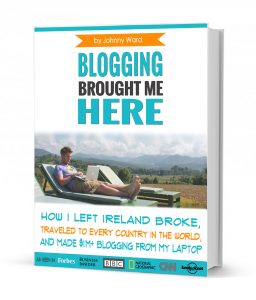 As you know, blogging changed my life. I left Ireland broke, with no plan, with just a one-way ticket to Thailand
and no money. Since then, I started a blog, then a digital media company, I've made
more than $1,500,000 USD, bought 4 properties and visited (almost) every country in the world. And I did it all from my laptop as I
travel the world and live my dream. I talk about how I did it, and how you can do it too, in my COMPLETELY FREE
Ebook, all 20,000
words or so. Just finish the process by putting in your email below and I'll mail it right out to you immediately. No spam ever too, I promise!
As you know, blogging changed my life. I left Ireland broke, with no plan, with just a one-way ticket to Thailand
and no money. Since then, I started a blog, then a digital media company, I've made
more than $1,500,000 USD, bought 4 properties and visited (almost) every country in the world. And I did it all from my laptop as I
travel the world and live my dream. I talk about how I did it, and how you can do it too, in my COMPLETELY FREE
Ebook, all 20,000
words or so. Just finish the process by putting in your email below and I'll mail it right out to you immediately. No spam ever too, I promise!