

Travel Blogger Media Kit Copy With Examples for New Creators
You have a few useful travel posts, photographs you are proud of and a hotel you would love to work with. Then someone asks for your media kit. Suddenly, your small audience feels smaller.
Start with what you can prove. A media kit introduces your work, explains who it serves and sets out what a partner could commission. Clear copy helps a hotel manager decide whether your approach suits the property, even before you have a long list of clients.
The examples here use an imaginary creator, Maya, whose niche is affordable European city breaks. All figures and project details are illustrative; replace them with your own evidence.
Table of contents
- Travel Blogger Media Kit Copy With Examples for New Creators
- Give your niche a clear sentence
- Write a bio with useful detail
- Describe your audience without inflated claims
- Replace vague promises with specific copy
- Make the collaboration offer easy to picture
- Define the deliverables before the trip
- Use sample projects when you have no sponsors
- End with an invitation someone can answer
Give your niche a clear sentence
“I love travel” could describe almost anyone. Tell potential partners which trips you cover and whose questions you answer.
“I create practical guides to European city breaks for UK travellers who want to explore without a car.”
That sentence gives a hotel near a railway station a reason to pay attention. It also helps unsuitable partners recognise the mismatch early.
If your site is still an idea, One Step 4Ward’s guide to how to start a travel blog covers the groundwork. Your kit should point towards published work that supports the niche you claim.
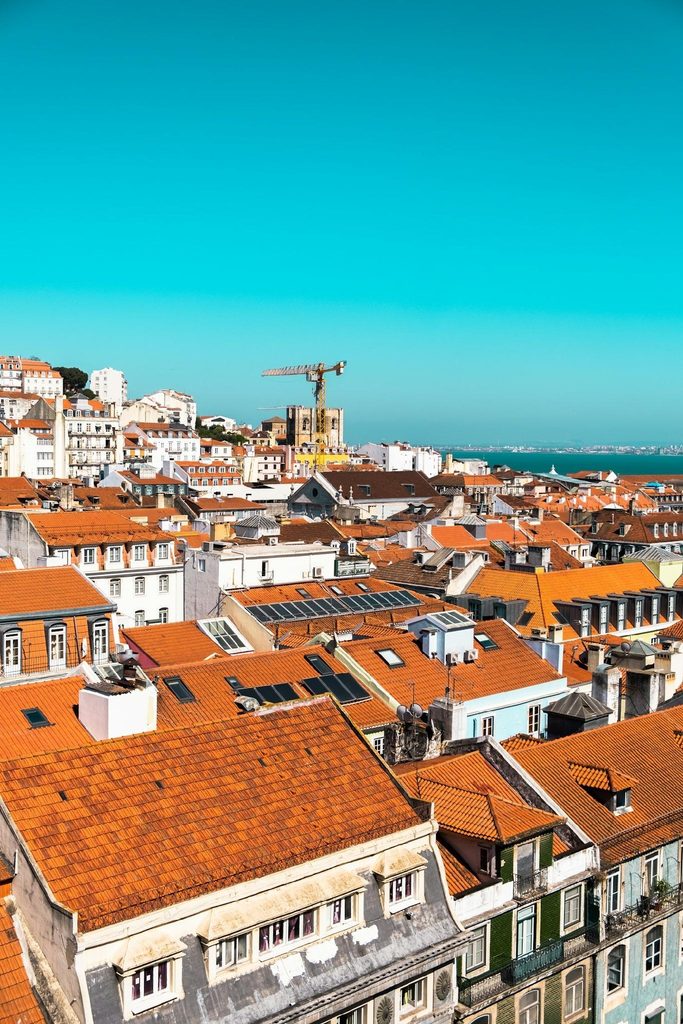
Choose portfolio photographs that support your travel niche.
Write a bio with useful detail
Your bio needs a name, a focus and a reason to trust your perspective. Keep the childhood travel story for your About page.
“I’m Maya, a Manchester-based travel blogger behind Weekend by Rail. I publish affordable European itineraries with station transfers, neighbourhood notes and costs from trips I have taken. My guides help readers plan short breaks around a full-time job.”
Before you approach hotels or tourism boards, give those sentences a careful edit. The AI assistant getsolved.ai can help review grammar and refine awkward phrasing in your media kit. Use its suggestions selectively so the result still sounds like you. Check every claim against your records, and never accept an impressive detail that the tool adds without evidence.
Read the bio aloud afterwards. Would you introduce yourself that way over coffee? If not, simplify it.
Describe your audience without inflated claims
A small, relevant audience gives you something concrete to discuss. The important distinction is between people you hope to attract and people your analytics show you already reach.
Example audience overview:
“In August 2026, Weekend by Rail recorded 1,240 website users in GA4. My Instagram account had 860 followers on 31 August. Of the followers covered by Instagram’s country data, 62% were based in the UK.”
These measures describe different things. Website users are not page views, and followers are not the number of people who saw a post. Keep platform labels and dates attached to each figure. Do not combine audiences across channels into a supposed unique total.
If you include an engagement rate, state the calculation and period. Avoid a percentage you cannot explain when a partner asks.
When analytics are too limited to support a useful audience profile, say so. You could write: “This blog launched in July; audience data is still limited. My current portfolio includes three detailed rail itineraries and twelve original destination photographs.” Then link to those pieces. This gives the reader evidence of your output while your reach develops. Keep a private record of post dates and results so future updates are straightforward. After a few months, you can replace the launch note with a dated summary that reflects normal activity, rather than the single post that happened to take off.
Replace vague promises with specific copy
You do not need grand claims to sound professional. Show the reader what you mean.
| Vague claim | More useful alternative |
|---|---|
| “I create amazing travel content.” | “My guides explain rail routes, daily costs and realistic weekend itineraries.” |
| “My audience loves my posts.” | “My Porto carousel received 74 saves in its first 30 days.” |
| “I offer exposure for your hotel.” | “I can produce a room tour and a neighbourhood guide for prospective guests.” |
| “I guarantee results.” | “I provide a report with reach, saves and available link-click data.” |
Use the example figures only as a model. A verifiable modest result makes a stronger starting point than a spectacular number borrowed from someone else.
Make the collaboration offer easy to picture
“Open to collaborations” leaves the partner to invent your role. Suggest a project with a subject, an audience and a practical benefit.
“For independent hotels near major railway stations, I offer weekend guides that show car-free travellers how to reach the property and explore nearby. A project could combine a first-person stay feature, original photographs and a short room-tour video.”
Notice that this offer describes work you can deliver. It does not promise reservations or pretend to know the hotel’s commercial priorities. Ask about those priorities in your pitch, then adjust the scope.
Keep content production and publication distinct. A hotel may want photographs for its own channels, a feature on your blog, or both. Your kit should make that choice visible.
Define the deliverables before the trip
Give each proposed package enough detail for a sensible discussion. For example:
- One original blog feature of approximately 800 words, published on your website.
- One vertical video of 30–45 seconds, published on your Instagram account.
- Ten edited photographs, supplied as JPEG files.
- Delivery within 14 days after departure, with publication dates agreed beforehand.
Add a short scope note:
“The quote will specify fees, travel expenses, one agreed revision round and photo usage permissions. Paid advertising, exclusivity and additional edits require separate agreement.”
Do not assume a complimentary stay covers every cost or grants unlimited use of your work. Clarify the exchange before you accept it. You can state “Quotes depend on scope and usage” if a fixed rate would be premature.
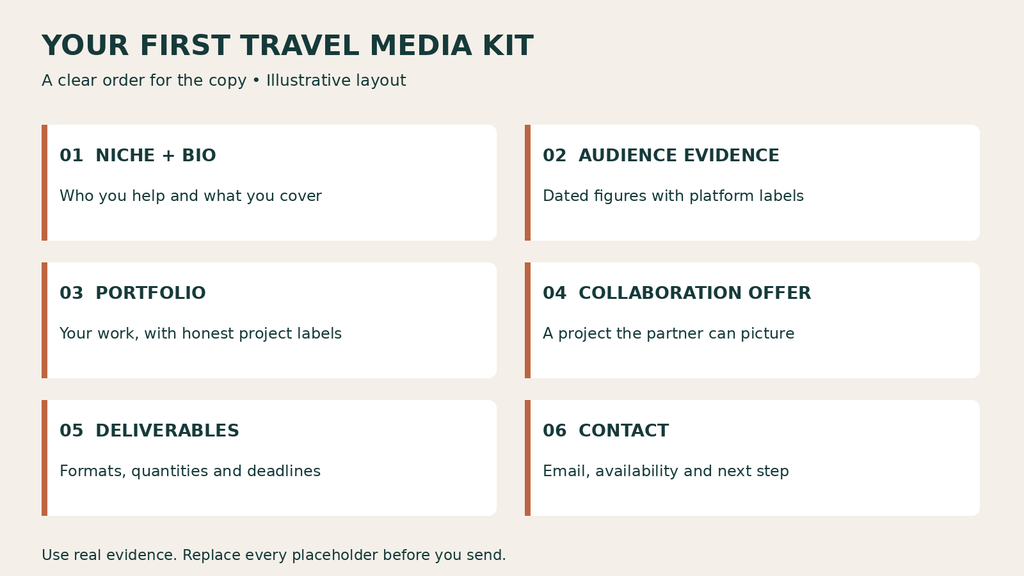
A simple structure keeps the essential information easy to find. Source: original layout illustration created for this article; all content is illustrative.
Use sample projects when you have no sponsors
Your own trips can supply portfolio material. Select a destination guide, a short video and a photo series that demonstrate the work you want to sell. A local weekend is enough if the material is useful and well presented.
Label the circumstances plainly:
“Independent portfolio project: a two-day Porto itinerary, produced from a self-funded trip. No commercial relationship with the featured businesses.”
For a project you have not completed, use “Uncommissioned concept” and explain what is proposed. Keep concepts separate from finished work.
Do not place hotel logos under “Previous partners” merely because you stayed there. Likewise, a friendly reader comment is not a client testimonial. Honest labels let a potential partner judge your skills without a misleading impression of experience.
End with an invitation someone can answer
Give the reader one practical next step:
“Have a property or destination that suits a weekend by rail? Email [your email] with the location, preferred dates, campaign objective and approximate budget. I’ll reply with availability and a suggested scope.”
Before you send the kit, replace every placeholder, test the portfolio links and check the file on your phone. Add an update date beside your statistics.
Start with a concise document you can maintain. After each completed project, replace a sample with real work and the results you can substantiate. Your first kit only needs to make your current value clear enough to begin a useful conversation.
Remember, never travel without travel insurance! And never overpay for travel insurance!
I use HeyMondo. You get INSTANT quotes. Super cheap, they actually pay out, AND they cover almost everywhere, where most insurance companies don't (even places like Central African Republic etc!). You can sign-up here. PS You even get 5% off if you use MY LINK! You can even sign up if you're already overseas and traveling, pretty cool.
Also, if you want to start a blog...I CAN HELP YOU!
Also, if you want to start a blog, and start to change your life, I'd love to help you! Email me on johnny@onestep4ward.com. In the meantime, check out my super easy blog post on how to start a travel blog in under 30 minutes, here! And if you just want to get cracking, use BlueHost at a discount, through me.
Also, (if you're like me, and awful with tech-stuff) email me and my team can get a blog up and running for you, designed and everything, for $699 - email johnny@onestep4ward.com to get started.
Do you work remotely? Are you a digital nomad/blogger etc? You need to be insured too.
I use SafetyWing for my digital nomad insurance. It covers me while I live overseas. It's just $10 a week, and it's amazing! No upfront fees, you just pay week by week, and you can sign up just for a week if you want, then switch it off and on whenever. You can read my review here, and you can sign-up here!



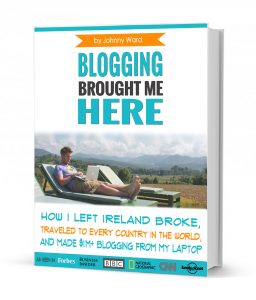 As you know, blogging changed my life. I left Ireland broke, with no plan, with just a one-way ticket to Thailand
and no money. Since then, I started a blog, then a digital media company, I've made
more than $1,500,000 USD, bought 4 properties and visited (almost) every country in the world. And I did it all from my laptop as I
travel the world and live my dream. I talk about how I did it, and how you can do it too, in my COMPLETELY FREE
Ebook, all 20,000
words or so. Just finish the process by putting in your email below and I'll mail it right out to you immediately. No spam ever too, I promise!
As you know, blogging changed my life. I left Ireland broke, with no plan, with just a one-way ticket to Thailand
and no money. Since then, I started a blog, then a digital media company, I've made
more than $1,500,000 USD, bought 4 properties and visited (almost) every country in the world. And I did it all from my laptop as I
travel the world and live my dream. I talk about how I did it, and how you can do it too, in my COMPLETELY FREE
Ebook, all 20,000
words or so. Just finish the process by putting in your email below and I'll mail it right out to you immediately. No spam ever too, I promise!