

Travel Safety Tips: A Guide to Digital Safety on the Road
Taking your laptop, picking up your passport, and going to the airport has a certain excitement about it. Yet before you book your next flight, it’s a good idea to consider travel safety, since a stolen laptop or a blocked bank account can turn your holiday dream into a nightmare very quickly. Whenever you earn a living online by traveling between countries, it is just as important to protect both your income and your data as it is to find a good Wi-Fi connection.
This guide shows you practical, everyday steps to stay safe as you build a location-independent income from anywhere in the world.
Table of contents
- Travel Safety Tips: A Guide to Digital Safety on the Road
- Why Travel Safety Looks Different for Digital Nomads
- Start With the Basics: Physical Safety
- Backup Important Travel Documents
- Protecting Devices While Traveling
- Secure Banking While Abroad – And Why Access Gets Tricky
- Remote Work Internet Reliability
- Don’t Skip Travel Insurance Essentials
- Know the Digital Nomad Visa Requirements
- Bringing It All Together
Why Travel Safety Looks Different for Digital Nomads
Ordinary tourists are concerned about pickpockets and losing their luggage, and you are too, with an additional concern: making sure your remote work continues smoothly, that you can access your banking, and that your devices remain secure. Travel safety for digital nomads means combining traditional common sense with up-to-date habits.
In recent years, the number of people who work without being tied to a specific location has reached tens of millions all over the world. With so many people depending on their phones and laptops as their only office, proper security measures matter more than most people think.
Start With the Basics: Physical Safety
Before diving into passwords and VPNs, let’s cover the travel safety fundamentals:
- Before you book a trip, check your destination’s safety reputation rather than doing so after you arrive.
- Store copies of your passport, visa, and ID away from the originals.
- Share details of your planned activities with a trusted friend or family member.
- It’s best not to show off expensive equipment in public, particularly in busy transit areas.
- Choose a place to stay with reviews that mention secure entry and working locks.
Safe accommodation booking practices include not just checking the star rating. Look for verified hosts, read recent reviews (not just the top ones), and make sure the listing has a functioning lock, secure Wi-Fi, and a real address before you pay a deposit.
Backup Important Travel Documents
It’s stressful when you lose your physical passport. If you don’t have a digital copy, the situation can turn into a logistical nightmare that can take days out of your trip. That is why, before you leave home:
- Scan your passport, visa, and insurance papers.
- Save copies in an encrypted cloud storage service and on a disconnected drive.
- Copy the email to your own inbox so that you can access it easily.
- Store a printed copy in a different bag from your main documents.
A small travel safety habit reduces a great deal of stress when an item goes missing.
Protecting Devices While Traveling
Since your laptop is, in effect, your office, treat it as such. A few habits make a big difference:
- Use a password manager. Do not reuse weak passwords.
- Turn on two-factor authentication for your email, banking, and cloud accounts.
- Encrypt your hard drive. If someone steals your laptop, they won’t get your files.
- Avoid public USB charging ports; carry your own charger and cable.
- Make sure that your software and antivirus programs are up to date even if you are busy.
Public Wi-Fi in cafes and airports is convenient, but it is also one of the most vulnerable places for someone to intercept your data. Using a reliable VPN provides an extra level of online security when you connect to networks that you don’t fully trust.
Secure Banking While Abroad – And Why Access Gets Tricky
This surprises many nomads: banks and payment services often flag or block logins from foreign IP addresses. Even if you have taken all the necessary precautions (e.g., using a strong password and having two-factor authentication enabled), you can still be locked out just because you’ve logged in from a different country.
This happens because banks use location-based fraud detection, and a login from a different continent can look suspicious to their systems, even if all you’re doing is checking invoices from a beach town. Many remote workers use a private proxy server, which enables them to direct a connection through a steady and reliable IP address rather than the local network. With this setup, your bank sees a familiar connection pattern, and your normal activities – such as using banking apps, freelance platforms, and streaming subscriptions – continue to work as they do at home.
A few tips for currency and payment safety abroad:
- Inform your bank before you travel to avoid unexpected account freezes.
- As a precaution, have two payment methods from different providers.
- It is better to use ATMs located in banks than standalone street machines.
- Check your account activity weekly, not just at the end of the month.
Remote Work Internet Reliability
Unreliable internet doesn’t just make things less convenient. It can cost you clients and make you miss deadlines. Before you move into a new place:
- Look for coworking spaces or cafés that have verified fast connections.
- Take a mobile hotspot device or a local SIM as a backup.
- Check your video call quality before an important meeting, not during it.
- Consider a backup internet connection if you need to stay online for work.
To stay connected across time zones, arrange your schedule around your clients’ availability rather than your own energy levels. Using a shared calendar with built-in time zone conversions can prevent many missed calls.
Don’t Skip Travel Insurance Essentials
Health emergencies, flight cancellations, and lost luggage are more common than most travelers plan for. The following are the essential travel insurance points that you should check before purchasing a policy:
- Insurance for medical emergencies and for evacuation.
- Coverage for electronics that have been stolen or damaged.
- Trip cancellation and delay coverage.
- Coverage for remote work as the reason for your travel.
Since some standard tourist policies don’t cover claims involving work equipment, read the fine print carefully.
Know the Digital Nomad Visa Requirements
More countries have introduced official digital nomad visa rules tailored to remote workers. These visas generally provide more stability than tourist visas. They usually require evidence of income, valid health insurance, and a clean background check. Apply early to avoid last-minute visa runs later, and to help with banking and securing accommodation, since you’ll have resident-worker status rather than temporary visitor status.
Bringing It All Together
Travel safety can never be reduced to a single checklist you finish and then ignore. It’s a habit you keep adjusting whenever you go to a different country, upgrade your equipment, or change banks. Start with the essentials – backing up your documents, protecting your device, and having a reliable way to access your accounts. Then expand as your travel habits change.
What’s worked for you so far? Every nomad picks up their own tricks along the way, and sharing them helps the whole community travel a little smarter.
Remember, never travel without travel insurance! And never overpay for travel insurance!
I use HeyMondo. You get INSTANT quotes. Super cheap, they actually pay out, AND they cover almost everywhere, where most insurance companies don't (even places like Central African Republic etc!). You can sign-up here. PS You even get 5% off if you use MY LINK! You can even sign up if you're already overseas and traveling, pretty cool.
Also, if you want to start a blog...I CAN HELP YOU!
Also, if you want to start a blog, and start to change your life, I'd love to help you! Email me on johnny@onestep4ward.com. In the meantime, check out my super easy blog post on how to start a travel blog in under 30 minutes, here! And if you just want to get cracking, use BlueHost at a discount, through me.
Also, (if you're like me, and awful with tech-stuff) email me and my team can get a blog up and running for you, designed and everything, for $699 - email johnny@onestep4ward.com to get started.
Do you work remotely? Are you a digital nomad/blogger etc? You need to be insured too.
I use SafetyWing for my digital nomad insurance. It covers me while I live overseas. It's just $10 a week, and it's amazing! No upfront fees, you just pay week by week, and you can sign up just for a week if you want, then switch it off and on whenever. You can read my review here, and you can sign-up here!






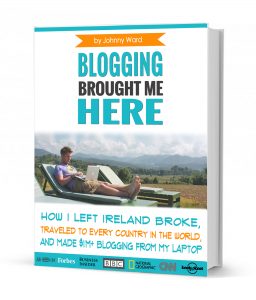 As you know, blogging changed my life. I left Ireland broke, with no plan, with just a one-way ticket to Thailand
and no money. Since then, I started a blog, then a digital media company, I've made
more than $1,500,000 USD, bought 4 properties and visited (almost) every country in the world. And I did it all from my laptop as I
travel the world and live my dream. I talk about how I did it, and how you can do it too, in my COMPLETELY FREE
Ebook, all 20,000
words or so. Just finish the process by putting in your email below and I'll mail it right out to you immediately. No spam ever too, I promise!