

What It’s Really Like Having a Baby While Living Abroad
Having a baby is one of the biggest life shifts you can experience. Doing it while living abroad adds another layer entirely. It is exciting, overwhelming, occasionally chaotic, and often far more rewarding than you expect. The idea of raising a child between cultures sounds romantic, and in many ways it is. But the reality is more complex, and worth understanding properly before you find yourself navigating hospitals, paperwork, and sleepless nights in a country that is not your own.
Table of contents
The Emotional Reality of Pregnancy Abroad
Pregnancy already comes with a mix of excitement and anxiety. When you are overseas, that emotional load is amplified. You are removed from your default support network. No popping around to your mum’s house. No easy familiarity with the healthcare system. No instinctive understanding of how things “normally” work.
Instead, everything becomes a conscious effort. You research hospitals. You ask in expat groups. You compare private versus public care. You learn new medical vocabulary, sometimes in another language. Even something as simple as booking a scan can feel like a small mission.
At the same time, there is something grounding about it. You become more self-reliant. You and your partner, if you have one, become a tighter unit. Decisions are made together, without outside noise. That clarity can be powerful.
And then there is the perspective shift. You realise quickly that there is no single “correct” way to approach pregnancy or birth. Different countries do things differently, and many of those approaches are just as valid, sometimes even better.
Navigating Healthcare Systems That Aren’t Yours
This is where things get practical, fast. Healthcare abroad can range from world-class private hospitals to under-resourced public systems depending on where you are. Even within the same country, the experience can vary dramatically.
If you are in a place like Thailand, for example, private hospitals can feel like five-star hotels. In parts of Europe, public healthcare may be excellent but bureaucratic. In more remote locations, access may be limited and require travel.
One of the biggest challenges is trust. Back home, you would likely have a GP you know, or at least a system you understand. Abroad, you are building that trust from scratch. That is why many expats seek additional guidance online, particularly from professionals who understand both local and international perspectives.
For example, working with a Lactation consultant UK can provide continuity and reassurance if you are more familiar with UK-based standards of care. Similarly, those from Ireland may feel more comfortable consulting a Lactation consultant Ireland who understands the nuances of Irish maternity expectations. Having access to that kind of support, even remotely, bridges the gap between home and your current reality.
The Logistics No One Talks About
There is a long list of practical details that rarely get mentioned when people talk about having a baby abroad.
First, paperwork. Birth certificates, passports, visas, residency status. Depending on your nationality and the country you are in, this can range from straightforward to a bureaucratic maze. Timing matters too. Some countries require registration within days, others allow more flexibility.
Second, insurance. If you are relying on travel insurance or international health cover, you need to know exactly what is included. Many policies have strict rules around pregnancy, especially after a certain number of weeks.
Third, language barriers. Even if you speak the local language at a conversational level, medical discussions are different. You want to be 100 percent clear on procedures, risks, and options. Many expats opt for hospitals with English-speaking staff for this reason, even if it comes at a higher cost.
Fourth, support during recovery. After birth, you are not just dealing with a newborn. You are recovering physically and mentally. In your home country, that support might come from family dropping by, helping with meals, or simply being present. Abroad, you need to actively create that support system, whether through friends, hired help, or online communities.
The Upside: A Unique Start to Life
Despite the challenges, there is a reason so many people choose to stay abroad and raise their kids internationally. The upside is huge.
From day one, your child is exposed to a broader world. Different languages, different foods, different ways of living. That kind of early exposure shapes how they see everything. It normalises diversity and builds adaptability without effort.
For you, there is also a sense of pride in figuring it all out. You navigated a foreign healthcare system. You built a support network from scratch. You handled the unknown and came out stronger.
There is also often a slower pace to life in many parts of the world compared to major Western cities. That can translate into more present parenting. More time outdoors. Less pressure to follow rigid routines.
And then there is the community aspect. Expat communities, especially those with young families, tend to bond quickly. Everyone is in a similar situation, away from home, figuring things out. That shared experience creates strong connections.
So, Is It Worth It?
The honest answer is that it depends on your personality and your situation. If you value stability, predictability, and being close to family, having a baby abroad will feel challenging. If you are comfortable with uncertainty and open to different ways of doing things, it can be one of the most rewarding experiences of your life.
It is not easier. It is not harder. It is just different.
What matters most is preparation. Understand the healthcare system. Line up support where you can. Accept that things will not always go to plan. And recognise that there is no perfect setup, whether you are at home or abroad.
Having a baby is a leap into the unknown no matter where you are. Doing it overseas just makes that leap a little bigger. But for many, that is exactly what makes it worth taking.
Remember, never travel without travel insurance! And never overpay for travel insurance!
I use HeyMondo. You get INSTANT quotes. Super cheap, they actually pay out, AND they cover almost everywhere, where most insurance companies don't (even places like Central African Republic etc!). You can sign-up here. PS You even get 5% off if you use MY LINK! You can even sign up if you're already overseas and traveling, pretty cool.
Also, if you want to start a blog...I CAN HELP YOU!
Also, if you want to start a blog, and start to change your life, I'd love to help you! Email me on johnny@onestep4ward.com. In the meantime, check out my super easy blog post on how to start a travel blog in under 30 minutes, here! And if you just want to get cracking, use BlueHost at a discount, through me.
Also, (if you're like me, and awful with tech-stuff) email me and my team can get a blog up and running for you, designed and everything, for $699 - email johnny@onestep4ward.com to get started.
Do you work remotely? Are you a digital nomad/blogger etc? You need to be insured too.
I use SafetyWing for my digital nomad insurance. It covers me while I live overseas. It's just $10 a week, and it's amazing! No upfront fees, you just pay week by week, and you can sign up just for a week if you want, then switch it off and on whenever. You can read my review here, and you can sign-up here!





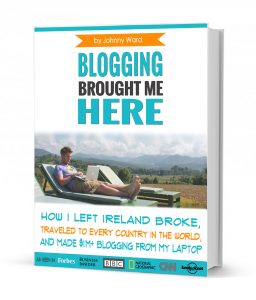 As you know, blogging changed my life. I left Ireland broke, with no plan, with just a one-way ticket to Thailand
and no money. Since then, I started a blog, then a digital media company, I've made
more than $1,500,000 USD, bought 4 properties and visited (almost) every country in the world. And I did it all from my laptop as I
travel the world and live my dream. I talk about how I did it, and how you can do it too, in my COMPLETELY FREE
Ebook, all 20,000
words or so. Just finish the process by putting in your email below and I'll mail it right out to you immediately. No spam ever too, I promise!
As you know, blogging changed my life. I left Ireland broke, with no plan, with just a one-way ticket to Thailand
and no money. Since then, I started a blog, then a digital media company, I've made
more than $1,500,000 USD, bought 4 properties and visited (almost) every country in the world. And I did it all from my laptop as I
travel the world and live my dream. I talk about how I did it, and how you can do it too, in my COMPLETELY FREE
Ebook, all 20,000
words or so. Just finish the process by putting in your email below and I'll mail it right out to you immediately. No spam ever too, I promise!