

The Science Behind Bite-Sized Learning: What Research Shows
Short lessons are not just a convenient option for people with busy schedules. They represent a scientifically validated approach to how the human brain actually processes and retains new information. Traditional long-format lectures often overload learners, reducing comprehension and making knowledge harder to retrieve later. Bite-sized learning science has consistently demonstrated that shorter, focused sessions produce stronger retention outcomes than extended study blocks.
Platforms like SmartyMe are built on exactly these research-backed principles, helping learners absorb material more efficiently. The evidence is not new; cognitive psychologists have studied this for decades, and the findings point in one clear direction: shorter, more frequent learning works better for the vast majority of people.
Table of contents
How Our Brain Processes Information
The brain does not absorb new information the way a hard drive stores files. Instead, it filters, organizes, and connects incoming data through a series of cognitive stages before anything moves into long-term memory. Each of these stages has real capacity limits, and pushing past them reduces how much a person actually retains. Understanding this process is the first step toward building study habits that work with the brain rather than against it.
The Limits of Working Memory
Working memory is the cognitive system responsible for temporarily holding and manipulating information during active thinking. Psychologist George Miller’s foundational research, published in 1956, found that working memory can hold roughly 7 items at a time, give or take two. When a lecture or lesson exceeds this threshold, the brain begins dropping data before it can be encoded.
- Working memory capacity is limited to a small number of items at once
- Information overload causes comprehension to break down quickly
- Smaller content chunks stay within processing limits and encode more effectively
This is a key reason why long, dense lectures so often fail to produce lasting knowledge. Bite-sized lessons are sized to fit within what working memory can handle at a single time, making each session more productive from start to finish.
Attention Span and Focus
Sustained attention is another biological constraint that shapes how well we learn. Research from educational psychology indicates that most adults maintain peak focus for roughly 10 to 20 minutes before cognitive performance begins to decline. After that point, the brain starts filtering out input rather than processing it actively.
- Peak concentration typically holds for around 20 minutes in most adults
- Beyond that window, focus drops and retention weakens significantly
- Short lessons are structured to land within the brain’s natural focus window
Fitting a lesson inside this attention window means the learner stays engaged from start to finish, rather than mentally drifting halfway through an hour-long session. This is not a minor difference in learning quality; it is a structural one.
What Research Tells Us About Short Lessons
A substantial body of research across cognitive science, education, and behavioral psychology supports the effectiveness of shorter, more frequent learning sessions. These are not isolated findings from a single study but consistent patterns observed across different age groups, subjects, and learning environments. Short lessons research points to two core mechanisms that explain why brief, repeated exposure outperforms longer, infrequent study: the forgetting curve and the spaced learning effect.
The Forgetting Curve
Hermann Ebbinghaus, a 19th-century German psychologist, was among the first to measure memory loss systematically. His experiments showed that without any review, people forget roughly 70% of newly learned material within 24 hours. This pattern became known as the Ebbinghaus Forgetting Curve and remains one of the most cited findings in memory research today.
- Without review, most new information disappears within a single day
- Short, regular review sessions interrupt this forgetting process effectively
- Spaced repetition rebuilds memory traces before they fully decay
Each time a learner revisits material, the rate of forgetting slows down noticeably. Over multiple sessions, the knowledge becomes progressively more stable and easier to retrieve.
The Spaced Learning Effect
The spaced learning effect builds directly on what the forgetting curve reveals. Instead of concentrating study into one long block, distributing practice across multiple shorter sessions produces better long-term retention. Research consistently confirms that spaced practice outperforms massed practice across nearly every subject tested.
- Daily short sessions outperform infrequent long ones
- Rest periods between sessions allow the brain to consolidate information
- Study for 10–15 minutes daily rather than one long weekly block
The underlying mechanism is neurological. During breaks between study sessions, the brain strengthens the connections formed during learning. Skipping those rest intervals prevents this consolidation and reduces long-term retention.
Putting Science into Practice
The research is clear, and the practical takeaway is straightforward. Structure your study time around the brain’s natural limits rather than pushing through them. Learning science consistently shows that 15 minutes of focused daily practice produces better outcomes than a single 90-minute session once a week.
Here is a simple framework to apply these principles:
- Choose short formats over lengthy lectures
- Set a daily 15-minute study goal
- Begin each session with a quick review
- Keep a fixed daily schedule
- Stop before mental fatigue sets in
Regularity matters more than duration. A person who studies for 15 minutes every day will almost always outperform someone who studies for hours once a week. The brain responds to consistent, repeated exposure rather than occasional intensity.
Remember, never travel without travel insurance! And never overpay for travel insurance!
I use HeyMondo. You get INSTANT quotes. Super cheap, they actually pay out, AND they cover almost everywhere, where most insurance companies don't (even places like Central African Republic etc!). You can sign-up here. PS You even get 5% off if you use MY LINK! You can even sign up if you're already overseas and traveling, pretty cool.
Also, if you want to start a blog...I CAN HELP YOU!
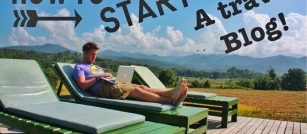
Also, if you want to start a blog, and start to change your life, I'd love to help you! Email me on johnny@onestep4ward.com. In the meantime, check out my super easy blog post on how to start a travel blog in under 30 minutes, here! And if you just want to get cracking, use BlueHost at a discount, through me.
Also, (if you're like me, and awful with tech-stuff) email me and my team can get a blog up and running for you, designed and everything, for $699 - email johnny@onestep4ward.com to get started.
Do you work remotely? Are you a digital nomad/blogger etc? You need to be insured too.
I use SafetyWing for my digital nomad insurance. It covers me while I live overseas. It's just $10 a week, and it's amazing! No upfront fees, you just pay week by week, and you can sign up just for a week if you want, then switch it off and on whenever. You can read my review here, and you can sign-up here!







 As you know, blogging changed my life. I left Ireland broke, with no plan, with just a one-way ticket to Thailand
and no money. Since then, I started a blog, then a digital media company, I've made
more than $1,500,000 USD, bought 4 properties and visited (almost) every country in the world. And I did it all from my laptop as I
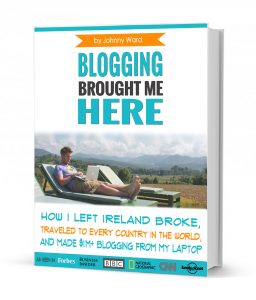
travel the world and live my dream. I talk about how I did it, and how you can do it too, in my COMPLETELY FREE
Ebook, all 20,000
words or so. Just finish the process by putting in your email below and I'll mail it right out to you immediately. No spam ever too, I promise!
As you know, blogging changed my life. I left Ireland broke, with no plan, with just a one-way ticket to Thailand
and no money. Since then, I started a blog, then a digital media company, I've made
more than $1,500,000 USD, bought 4 properties and visited (almost) every country in the world. And I did it all from my laptop as I
travel the world and live my dream. I talk about how I did it, and how you can do it too, in my COMPLETELY FREE
Ebook, all 20,000
words or so. Just finish the process by putting in your email below and I'll mail it right out to you immediately. No spam ever too, I promise!