

How to Turn ‘Stuck at Home’ Into a Six-Figure Financial Launchpad
Being home more than usual does not have to mean falling behind financially. For millions of people, a shift in routine — whether by choice or circumstance — has quietly become one of the most powerful catalysts for building real, lasting wealth. The question is not whether the opportunity exists. It is whether you are ready to take it seriously.
Table of contents
- How to Turn ‘Stuck at Home’ Into a Six-Figure Financial Launchpad
- The Mindset Shift That Changes Everything
- Step 1: Run a Ruthless Audit of Your Current Finances
- Step 2: Build Multiple Streams of Income From Home
- Step 3: Invest Consistently — Even When the Amounts Feel Small
- Step 4: Use Your Home as a Financial Asset
- Step 5: Protect the Wealth You Are Building
- The Bottom Line
The Mindset Shift That Changes Everything
Most people treat time at home as downtime. That is the first mistake. Every hour you are not commuting, not buying lunch out, and not spending money on convenience is an hour that belongs entirely to you. The financial implications of that are enormous — but only if you decide to act on them deliberately.
Think of it this way: a person who eliminates a $15-a-day spending habit and redirects that money into an investment account is not just saving $450 a month. They are building a habit, a system, and over time, a meaningful asset. Small redirections compound. That is not motivational fluff — that is arithmetic.
The foundation of a six-figure financial launchpad is not a windfall. It is consistency applied to a clear plan.
Step 1: Run a Ruthless Audit of Your Current Finances
Before you can build anything, you need to know exactly where you stand. Pull together your bank statements from the last three months. Look at every line item. You will almost certainly find subscriptions you forgot about, recurring fees that crept up, and spending patterns that no longer reflect your priorities.
Categorize everything
Separate your spending into three buckets: essentials, nice-to-haves, and pure waste. Essentials are non-negotiable. Nice-to-haves deserve scrutiny. Pure waste gets cut immediately. Most households discover they can free up $300 to $800 a month through this exercise alone — without making any dramatic lifestyle sacrifices.
“The average American household spends over $1,400 a year on subscriptions and recurring charges — many of which go unused for months at a time.” — Consumer Financial Protection Bureau
Once you have a clear picture, redirect every freed-up dollar with intention. This is not about deprivation. It is about alignment — making your spending reflect what you actually want your financial future to look like.
Step 2: Build Multiple Streams of Income From Home
A single income source is a single point of failure. The households that build real wealth consistently have more than one revenue stream. Being at home gives you the time and environment to build those streams — often from scratch and with very little upfront investment.
Freelancing and consulting
If you have professional skills — writing, design, accounting, marketing, coding, project management — someone out there will pay for them on a contract basis. Platforms like Upwork and Toptal connect skilled individuals with companies that need project-based help. Many freelancers earn their first $1,000 in additional income within 30 days of starting.
Creating digital products
Templates, online courses, e-books, and digital tools can be created once and sold repeatedly. This is one of the few income models where your time investment front-loads and then scales without you. A well-crafted course on a niche topic can generate passive income for years.
Monetizing what you already know
Tutoring, coaching, and consulting via video call require almost no setup. If you are proficient in a subject — a language, a software tool, a musical instrument, a fitness discipline — you already have a product. You just have not packaged it yet.
Quick Start
List your top 3 skills. Search what people pay for each on freelance platforms.
Think Long-Term
Digital products scale. Trading time for money does not. Build both early on.
Track Everything
Any income over $600 from freelancing is taxable. Keep records from day one.
Step 3: Invest Consistently — Even When the Amounts Feel Small
You do not need thousands of dollars to start investing. You need a decision and a date. Setting up automatic contributions to a brokerage or retirement account — even $50 or $100 a month — builds the discipline long before the dollar amounts become significant.
Focus on low-cost index funds first. They are diversified by design, require no active management, and historically outperform most actively managed funds over the long run. The U.S. Securities and Exchange Commission’s investor education portal is a reliable starting point if you are new to the basics of how stock market investing works.
Time in the market beats timing the market. Every month you delay is a month of compounding you will never get back. Start now, increase contributions as your income grows, and resist the urge to react to short-term market swings.
Step 4: Use Your Home as a Financial Asset
If you own your home, you are sitting on an asset that most renters simply do not have access to. And beyond appreciation in value, there are practical ways to put that asset to work for you right now.
Rent out what you are not using
A spare room, a parking space, a garage, or even storage space can be monetized. Short-term rental platforms have made this easier than ever. Even generating an extra $400 to $600 a month from unused square footage adds up to $5,000–$7,000 a year — money you can funnel directly into investments or debt payoff.
Tap into your home equity strategically
Homeowners who have built up significant equity over the years have a financing option that often goes underutilized. A home equity loan allows you to borrow against the value you have already built in your property — typically at interest rates far lower than personal loans or credit cards — and use those funds to consolidate high-interest debt, fund a home improvement that raises your property value, or invest in an income-generating venture. The key is using this tool purposefully, not as a way to fund lifestyle spending. Accessed wisely, home equity is one of the most cost-effective forms of capital available to everyday homeowners.
Step 5: Protect the Wealth You Are Building
Building income and assets is only half the equation. Protecting what you build is the other half — and most people neglect it until it is too late.
At minimum, you need an emergency fund covering three to six months of essential expenses. Without it, one unexpected event wipes out months of progress. Beyond that, review your insurance coverage. Life, disability, and liability insurance are not exciting topics, but the absence of them can be financially catastrophic.
Consider setting up a simple will and beneficiary designations on your accounts. These things take an afternoon to sort out and protect everything you are working toward. Wealth preservation is not complicated. It is mostly just doing the things that feel boring before they become urgent.
The Bottom Line
A six-figure financial outcome is not reserved for people with high salaries, inherited wealth, or exceptional luck. It is available to anyone who decides to use the time and resources they already have more deliberately. The strategies outlined here are not shortcuts. They are compounding habits — each one reinforcing the next over months and years.
The most important move is the first one. Audit your finances this week. Open an investment account if you do not have one. Identify one skill you can monetize. Look honestly at the assets you already own. None of these steps are complicated. But taken together, consistently, they are exactly how ordinary households build extraordinary financial outcomes.
Being stuck at home was never the problem. What you do with the time is the only question that matters.
Remember, never travel without travel insurance! And never overpay for travel insurance!
I use HeyMondo. You get INSTANT quotes. Super cheap, they actually pay out, AND they cover almost everywhere, where most insurance companies don't (even places like Central African Republic etc!). You can sign-up here. PS You even get 5% off if you use MY LINK! You can even sign up if you're already overseas and traveling, pretty cool.
Also, if you want to start a blog...I CAN HELP YOU!
Also, if you want to start a blog, and start to change your life, I'd love to help you! Email me on johnny@onestep4ward.com. In the meantime, check out my super easy blog post on how to start a travel blog in under 30 minutes, here! And if you just want to get cracking, use BlueHost at a discount, through me.
Also, (if you're like me, and awful with tech-stuff) email me and my team can get a blog up and running for you, designed and everything, for $699 - email johnny@onestep4ward.com to get started.
Do you work remotely? Are you a digital nomad/blogger etc? You need to be insured too.
I use SafetyWing for my digital nomad insurance. It covers me while I live overseas. It's just $10 a week, and it's amazing! No upfront fees, you just pay week by week, and you can sign up just for a week if you want, then switch it off and on whenever. You can read my review here, and you can sign-up here!









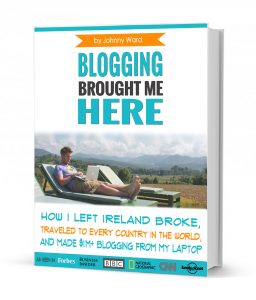 As you know, blogging changed my life. I left Ireland broke, with no plan, with just a one-way ticket to Thailand
and no money. Since then, I started a blog, then a digital media company, I've made
more than $1,500,000 USD, bought 4 properties and visited (almost) every country in the world. And I did it all from my laptop as I
travel the world and live my dream. I talk about how I did it, and how you can do it too, in my COMPLETELY FREE
Ebook, all 20,000
words or so. Just finish the process by putting in your email below and I'll mail it right out to you immediately. No spam ever too, I promise!
As you know, blogging changed my life. I left Ireland broke, with no plan, with just a one-way ticket to Thailand
and no money. Since then, I started a blog, then a digital media company, I've made
more than $1,500,000 USD, bought 4 properties and visited (almost) every country in the world. And I did it all from my laptop as I
travel the world and live my dream. I talk about how I did it, and how you can do it too, in my COMPLETELY FREE
Ebook, all 20,000
words or so. Just finish the process by putting in your email below and I'll mail it right out to you immediately. No spam ever too, I promise!