

Staying with the Skeleton Tribe in Papua New Guinea
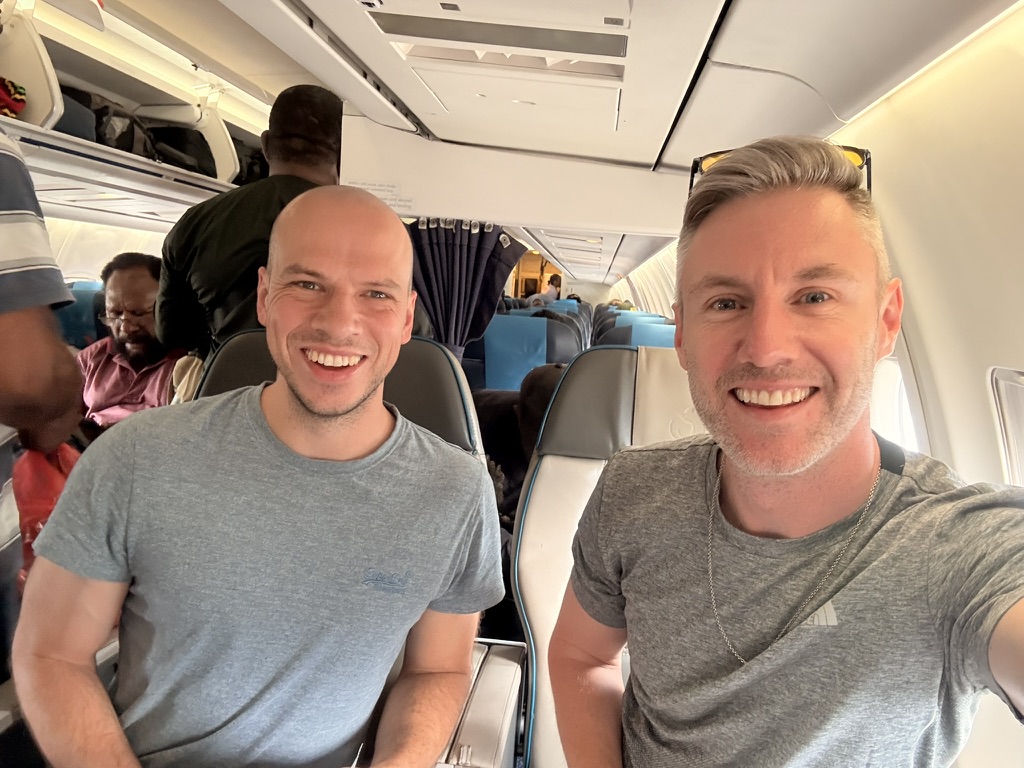
During my journey to every country in the world, I ended up in Papua New Guinea completely unprepared. I went there with no plan, no fixer, just me and my best buddy, Anthony Middleton.
We landed in Port Moresby, quickly discovered that it’s supposed to be the second most dangerous city in the world after Mogadishu, Somalia. We immediately took the next airplane out of there, up north to this place called Madang in the north of Papua New Guinea, where we stayed with some tribes and had a wild week or so. And the entire thing was scary, rushed, expensive, and a big eye-opener.
I had no idea Papua New Guinea was so sketchy. And to this day I would say it’s right up there as one of the most dangerous countries in the world. Kind of like that movie Pitch Black with Vin Diesel, that when the sun goes down, all these monsters come out, and the same with Papua New Guinea: when the sun goes down, the rascals, as they call them, come out and basically do what they want with the women and take what they want from the men. Not a place to be without prior organisation, I promise.
All that being said, Papua New Guinea is also one of the most epic countries on the planet that you can visit. Deep jungle, amazing flora and fauna, an affiliation with Australia, which is obviously how you fly in and out from there, and most importantly, or certainly from a travel perspective, they have the wildest tribes still functioning to this day. So much so, in fact, that they say the only cannibals left on the planet are untouched tribes deep in the jungle of the island of Papua (on the indonesian side). Not a place where you go as a tourist, but just as a point to say that they still have this kind of stuff.
I wanted to SEE this tribes in real life. So I put together a trip.
Table of contents
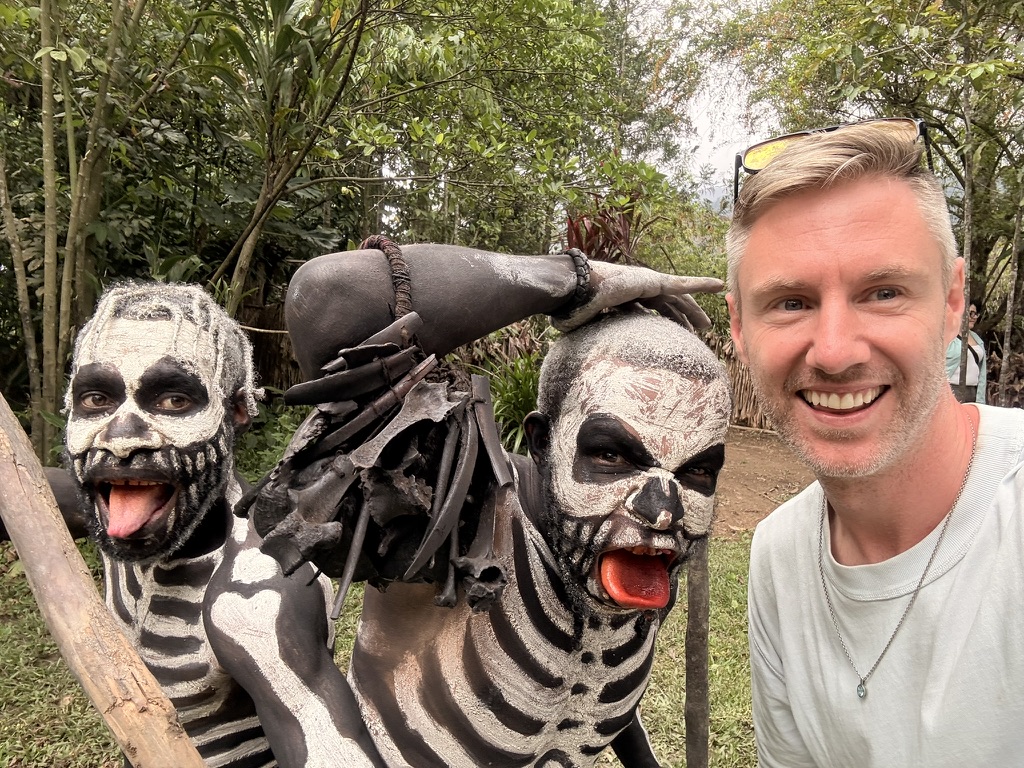
Table of contents
Why Not Mount Hagen Festival?
Because of my last experience where I hadn’t set anything up, it was time to go back and try to explore these tribes properly. You may have seen some of these amazing tribes on TV or on social media over the years, because they simply look so, so cool, like true travel experiences.
However, the way that 99.9% of people ever see these tribes is through this festival at Mount Hagen, where all the tribes from the highlands of Papua New Guinea all gather near an airport, where they’re basically in a sports field, all dressed up showcasing their tribes to hordes of foreign tourists with huge cameras.
Human Zoos
Now for me, I’m not sure if you guys have ever been to Kenya or Tanzania, but again they’re the kind of Africa-lite versions of Africa, and you go to climb Kilimanjaro, or you go party in Zanzibar, or you go on safari, of course. And as part of that often they bring you to the so-called Maasai tribe.
And while the Maasai are indeed a very cool tribe and living some very cool lives, the version that we as tourists get to see with the Maasai feels very, very much like a human zoo. Personally for me, I’m based in northern Thailand in Chiang Mai, and we have something similar here with the long-neck tribes, where these ethnic minorities are essentially incentivized to maintain their tribal dress because tourists like it. And as I said, perhaps for you, but certainly for me, I hate that human zoo vibe, and Mount Hagen is quite literally the definition of a human zoo.
Sure they look cool, but it is not an authentic Papua New Guinean experience, that is for sure. So I always wanted to see the tribes, especially the famous skeleton tribe. But I kind of promised myself that if I was ever to make the journey to see these epic tribes in Papua New Guinea, I would categorically avoid the Mount Hagen festival because of the whole human zoo stuff, and I would try to delve a little deeper and visit the villages that the tribes come from. And so my Papua New Guinea trip began to take shape.
Logistics in PNG
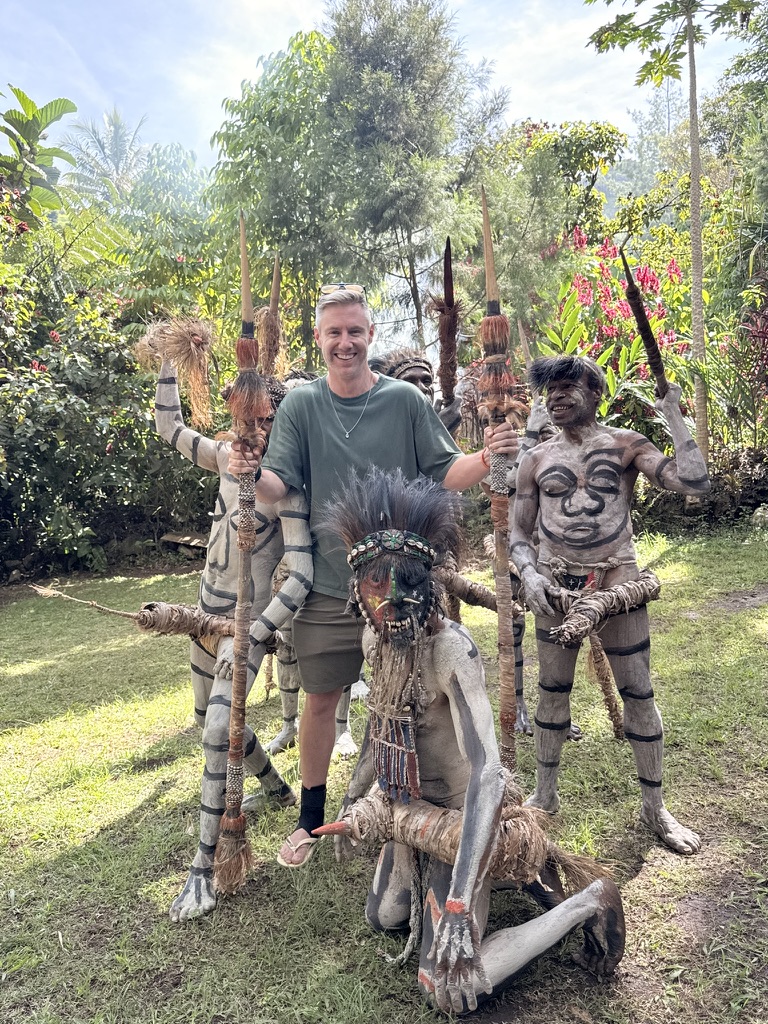
Organizing trips to Papua New Guinea is hard, expensive and scary. But I was desperate to go and see the skeleton tribes and a few other tribes that I’ve seen online through my travel friends over the years. So I contacted a lady that I know, Florence, who’s trustworthy, if a little slow to respond. And over the course of about six months or so, I put together a really cool itinerary where I would try to go to three or four different villages, pay the money to the elders and get to both stay in their villages and access the tribes directly. Of course, they don’t wear their normal getup every single day. They wear it for auspicious occasions, for celebrations, for birthdays and all the rest. And so I put the trip together, and the itinerary looked something like this.
My PNG itinerary:
Day 1 – Port Moresby
Arrive back in Port Moresby and stay at the Hilton. Dinner and drinks in the city.
Day 2 – Port Moresby to Goroka & Asaro
Fly from Port Moresby to Goroka and drive around 90 minutes into the Highlands. Visit Gurupoka and Gimesave villages to experience the Mokomoko Dance and Burning Heads. Overnight at Eco Lodge Asaro.
Day 3 – Asaro Mudmen & Mount Gurupoka
Walk to Mount Gurupoka to meet the famous Asaro Mudmen and experience their ceremony. Visit the sacrifice cave and see traditional dances, including the Mokomoko.
Day 4 – Skeleton Tribe & Remote Villages
Travel deeper into the Highlands to visit the Skeleton Tribe in their village. Also meet the Insect Hunters, Nurku Dust Shakers and Spirit Bird/Birdmen, including the eerie mud-covered Spirit Birds who remain almost completely motionless. Overnight at Skeleton Eco Lodge.
Day 5 – Mount Hagen
Travel towards Mount Hagen. Visit the Kuk Early Agricultural Site, a UNESCO World Heritage Site, explore traditional gardens, experience a local singsing, and have a traditional mumu feast. Overnight at Mount Ararat Hotel.
Day 6 – Back to Port Moresby
Take the morning flight back to Port Moresby. Visit the National Museum, Parliament House, APEC House and Ela Beach. Overnight at the Crown Hotel.
Day 7 – Papua New Guinea to New Zealand
Finish the Papua New Guinea trip and fly from Port Moresby to Auckland. And then I went onto visit Niue and Cook Islands to finish my weird 216/216 ‘countries’.
Thankfully I also know enough weirdo that meant I wouldn’t be doing this alone. So together, 15 of us ventured deep into the Papua New Guinea highlands.
The Papua New Guinea Tribes
This was the whole reason I came back to Papua New Guinea. I wanted to skip the big tourist festival at Mount Hagen and actually get out into the villages and see some of these tribes properly. These were the main ones I managed to experience:
The Skeleton Tribe
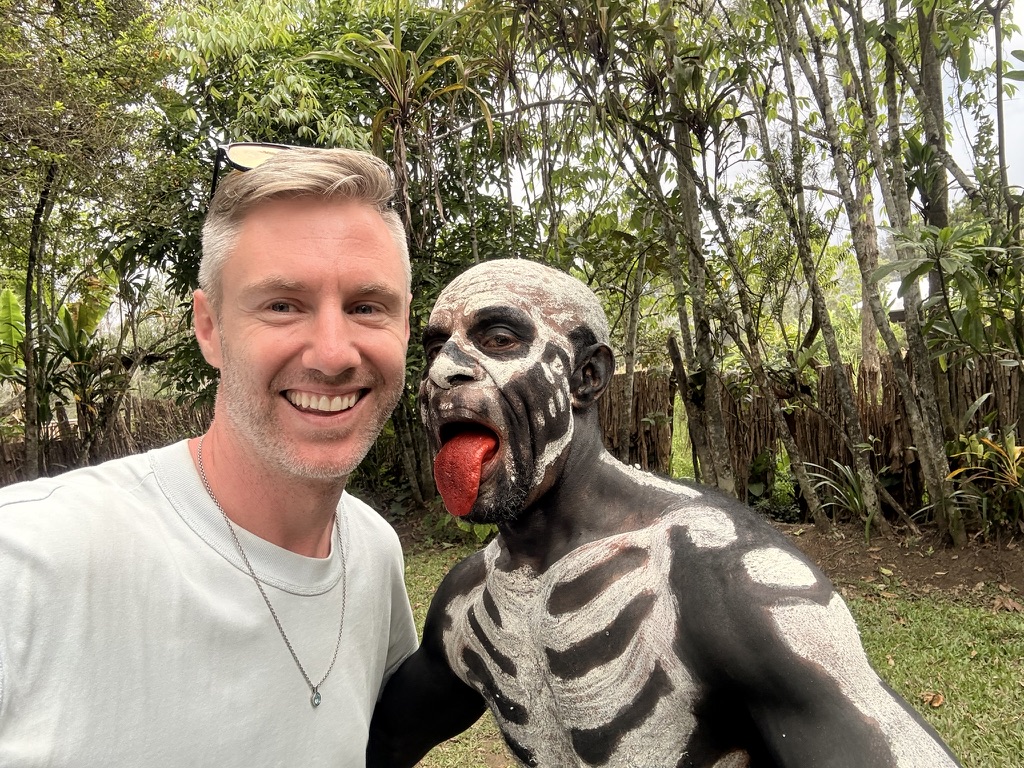
The big one for me. These guys paint their entire bodies black and then cover themselves in white markings to look like human skeletons. Absolutely mental to see them walking through the jungle like this, and one of the main reasons I came back to PNG.
The Asaro Mudmen
Probably the most famous tribe in Papua New Guinea. The Asaro Mudmen cover themselves in mud and wear these huge, creepy clay masks. We actually hiked up Mount Gurupoka to experience their ceremony rather than seeing them perform at a tourist festival.
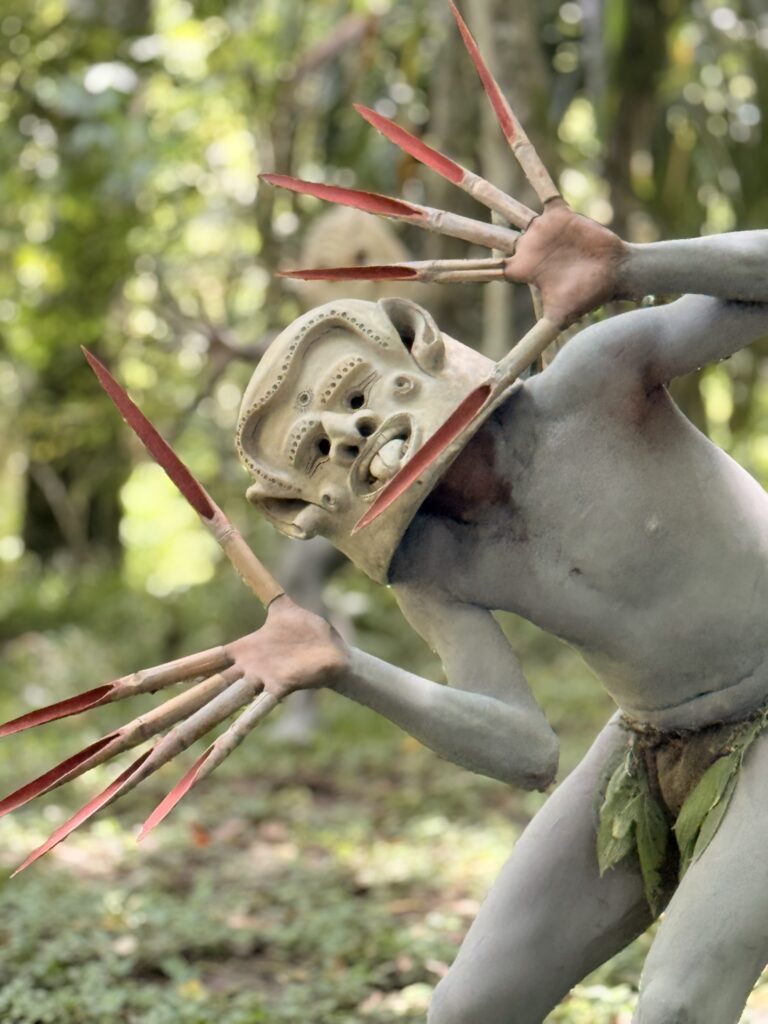
The Spirit Birds / Birdmen
One of the eeriest experiences of the trip. Completely covered in mud, with these strange bird-like masks, they sit almost completely motionless beside the water. Genuinely looks like something from another planet.
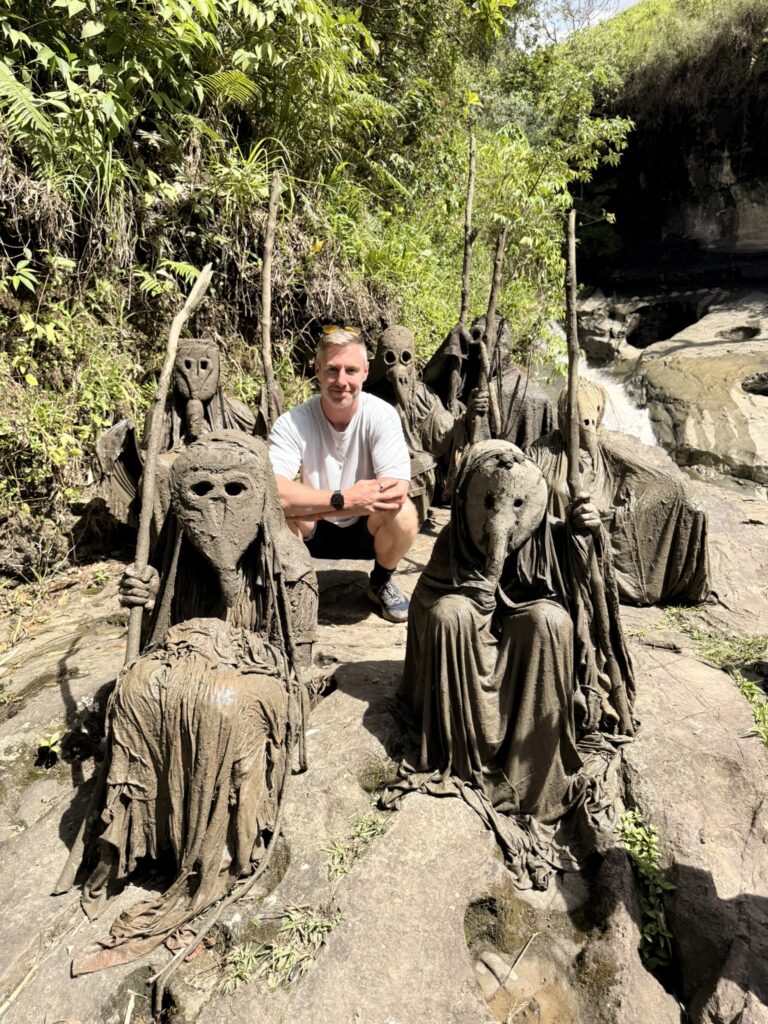
The Burning Heads
Another wild one. Huge masks and headpieces designed to look like they’re burning, with an intense traditional performance in the village. Exactly the sort of crazy PNG tribal experience I’d travelled all this way for.
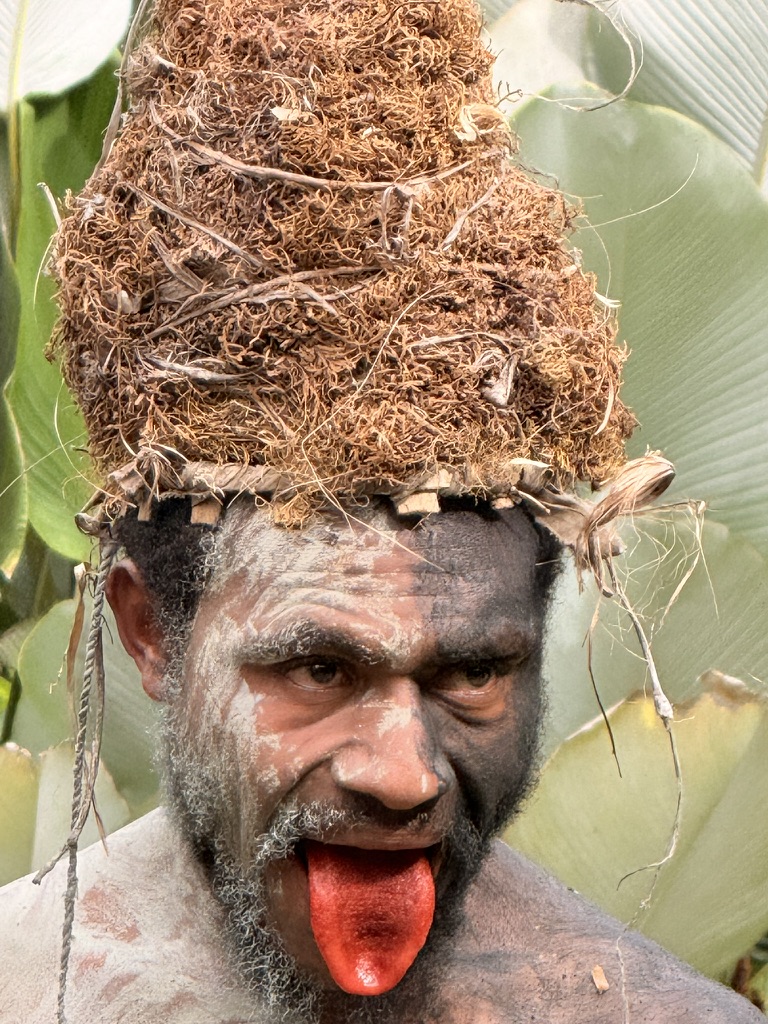
The Arunuma Dancers
We met the Arunuma dancers around Gimesave village. Traditional costumes, dancing and singing, but experienced out in the Highlands rather than surrounded by hundreds of tourists at Mount Hagen.
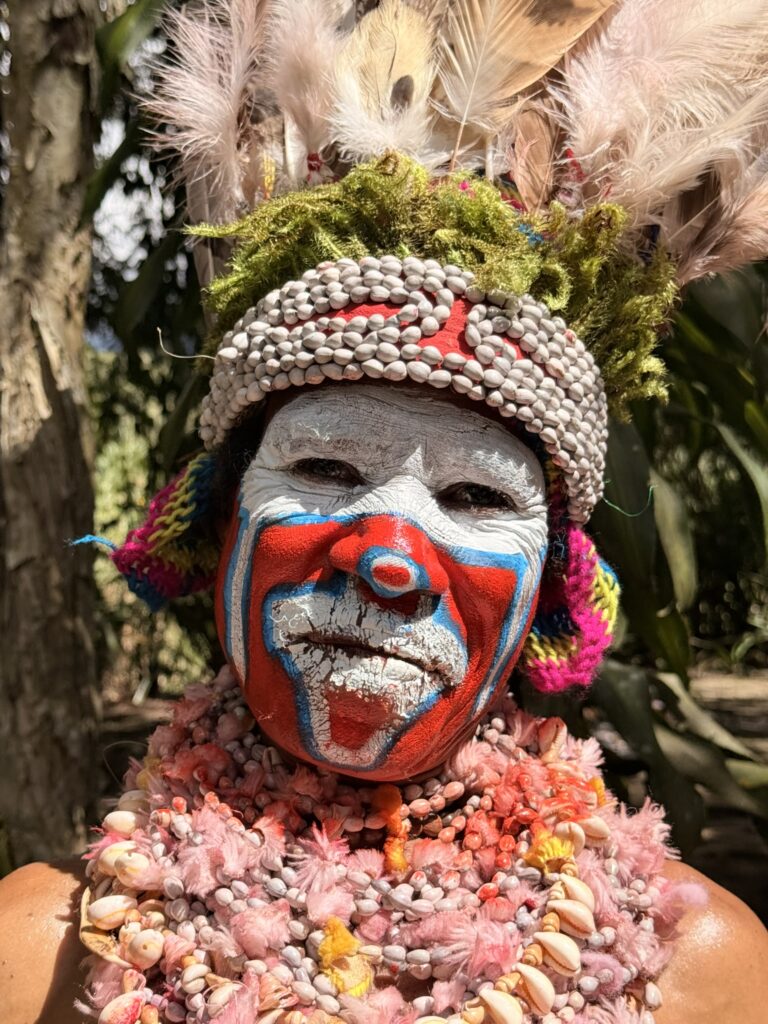
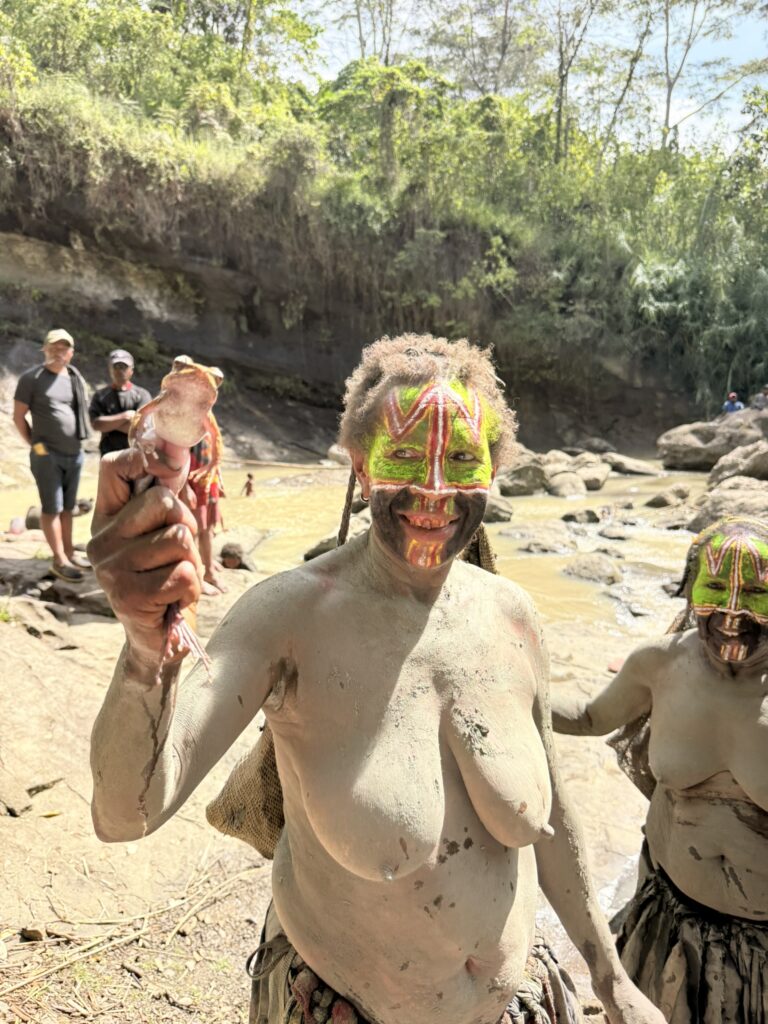
The Insect Hunters
Another of the smaller tribal experiences we encountered while travelling through the Highlands. Their costumes and traditions are inspired by insects and hunting, making them completely different again from the other groups we’d seen.
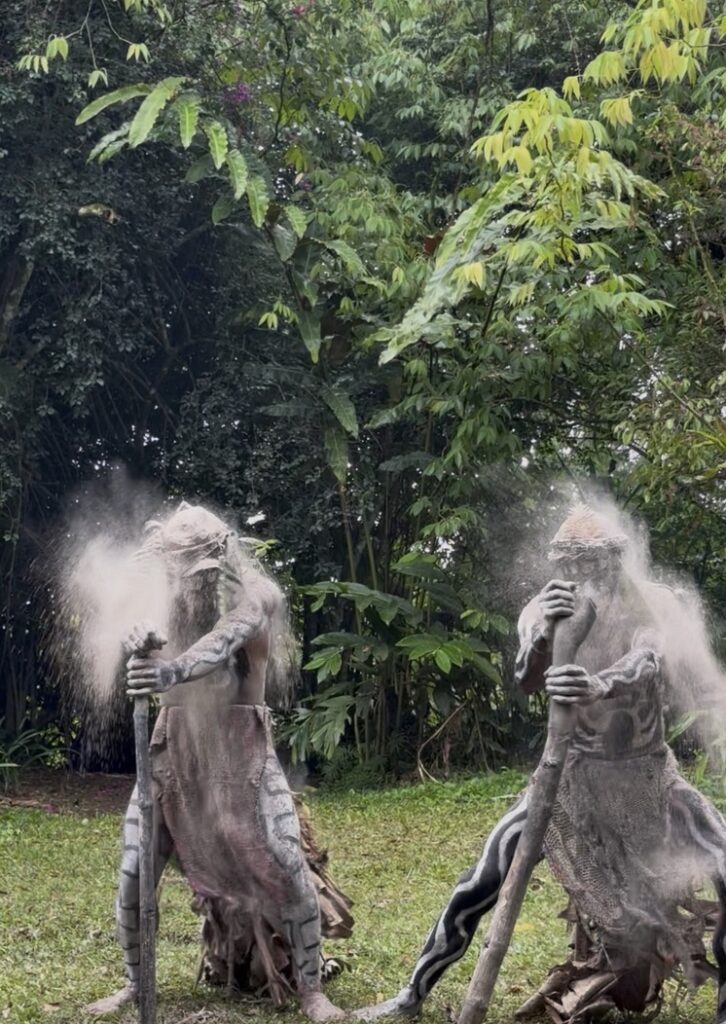
The Nurku Dust Shakers
One of the more unusual groups we encountered. The Dust Shakers use dust as part of their traditional performance, creating another properly surreal scene out in the villages.
The Mokomoko Tribe
We also got to see the Mokomoko perform during our time around Mount Gurupoka. Another traditional Highlands performance and another reminder of just how insanely culturally diverse Papua New Guinea is. In total, across the week, I had organised to see nearly 10 different tribes.
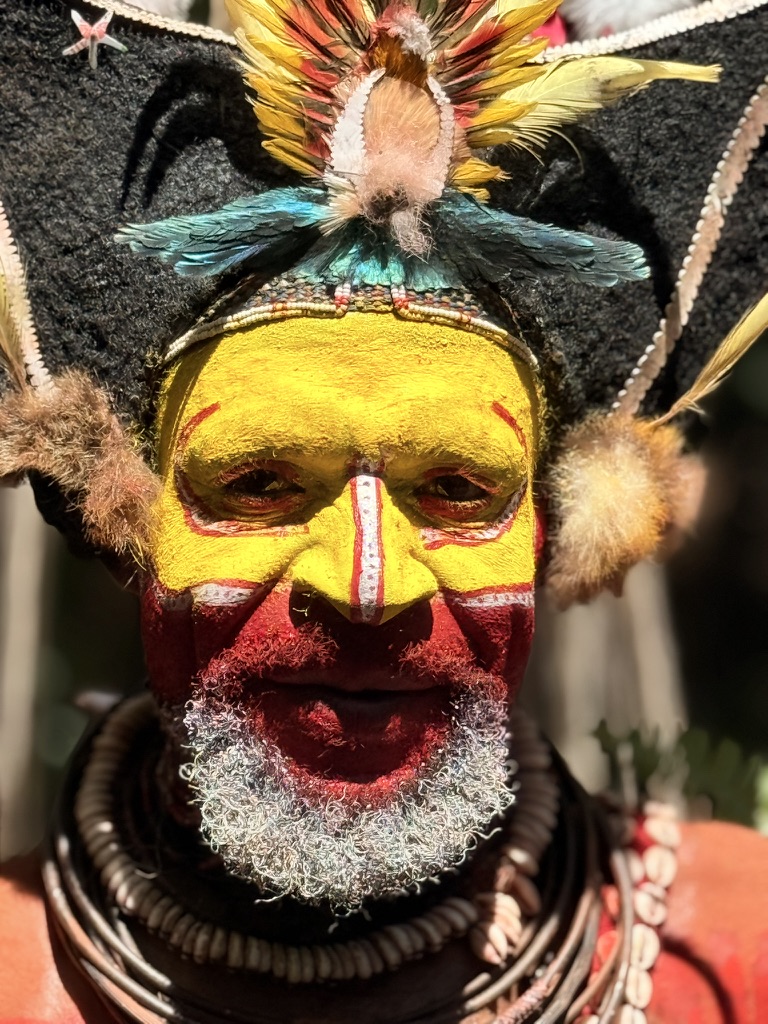
Huli Wigmen
This one was getting dangerously close to Human Zoo stuff to be honest. The Wigmen KNOW they look cool, and they’re kinda the face of PNG tourism. Cool to see, but not exactly an authentic experience.
Journeying Deep into the Papua New Guinea Highlands
To access the tribes of Papua New Guinea, first you have to escape Port Moresby and fly into the Highlands. That sounds straightforward. It is not.
Papua New Guinea is bloody enormous, the road network is limited, and many places simply are not connected by road. Domestic flights are essential, but delays and cancellations happen all the time. Even the British Government’s travel advice specifically warns about it. If you are planning a trip here, build in at least a couple of spare days. Otherwise one cancelled flight can turn your carefully planned adventure into a very expensive pile of shit.
We were flying from Port Moresby to Goroka, where all 15 of us would begin the real trip. Getting everyone and everything onto that flight was stressful as hell, but eventually we took off, landed safely and found ourselves surrounded by the green mountains of the Papua New Guinea Highlands.
We had made it. Somehow.
Coming Face to Face with the Skeleton Tribe
My dream, finally! Travelling this deep into Papua New Guinea is expensive. Really expensive. You can’t simply appear in a remote village with a camera and ask everyone to dress up for you. You need trusted local contacts, permission from the elders, accommodation, transport, food and people willing to host you. You also pay the communities (a fortune!) for their time and for the cultural performances they arrange. That money goes through the village elders and helps make the whole thing possible, including keeping everyone safe while you are there – it kinda feels a lot of the payment is for this to be honest!
We did this with several different communities, but the entire trip revolved around one experience for me: meeting the Skeleton Tribe. I had deliberately scheduled them for our second day. If a flight was cancelled or something else went wrong, we still had a window to move things around. There was no f*cking way I was travelling all the way back to Papua New Guinea and missing the main reason I had returned.
As we entered the village, we could already hear a commotion somewhere ahead of us. I was like a kid waiting for Christmas morning. Most foreign visitors see the Skeleton Tribe at the Mt Hagen festival, surrounded by old white people and enormous camera lenses. Very few actually travel to their village.
I asked one of the elders how many tourists normally came. He told me they had another visitor arriving the following month, then two more tourists coming about three months later. That was it. This was not some place processing three busloads of tourists every afternoon. And then finally the Skeleton Men appeared.
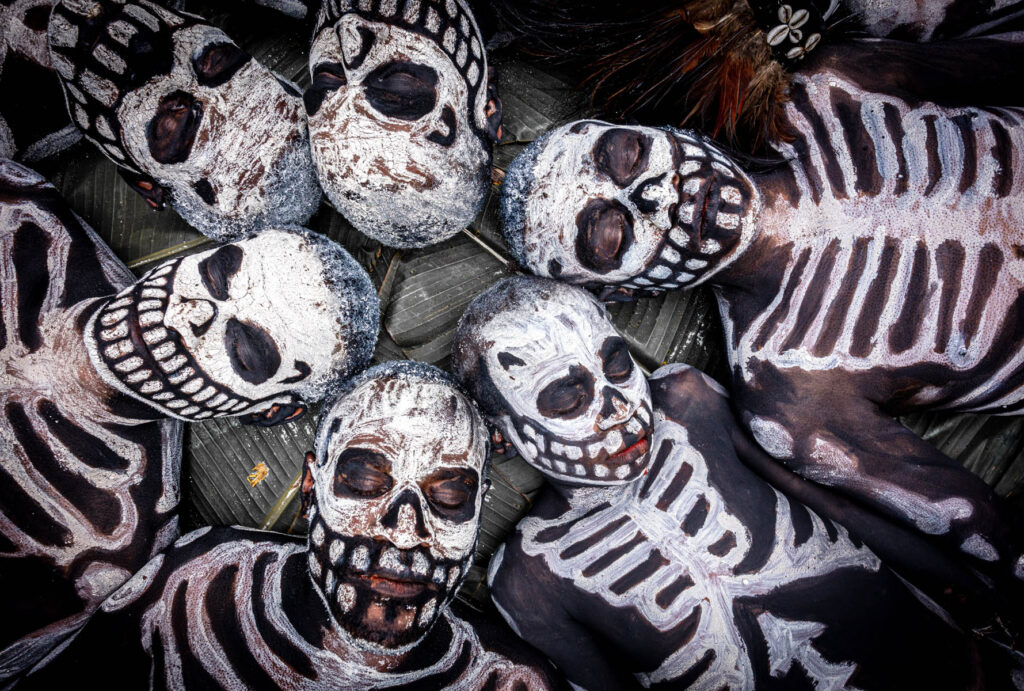
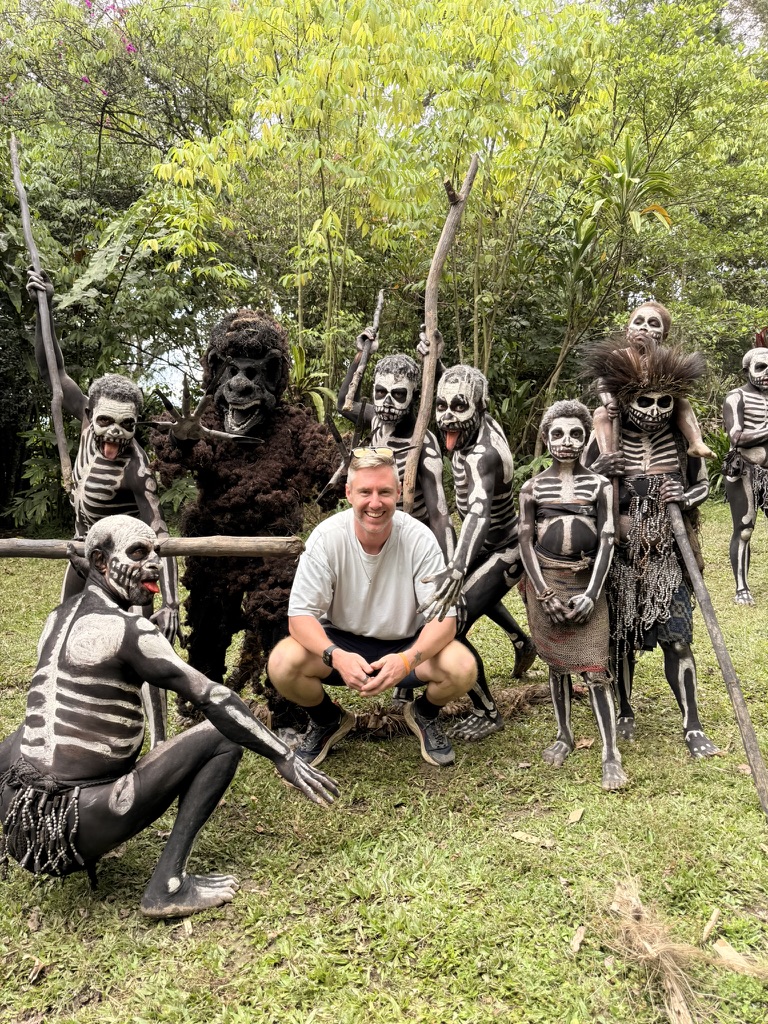
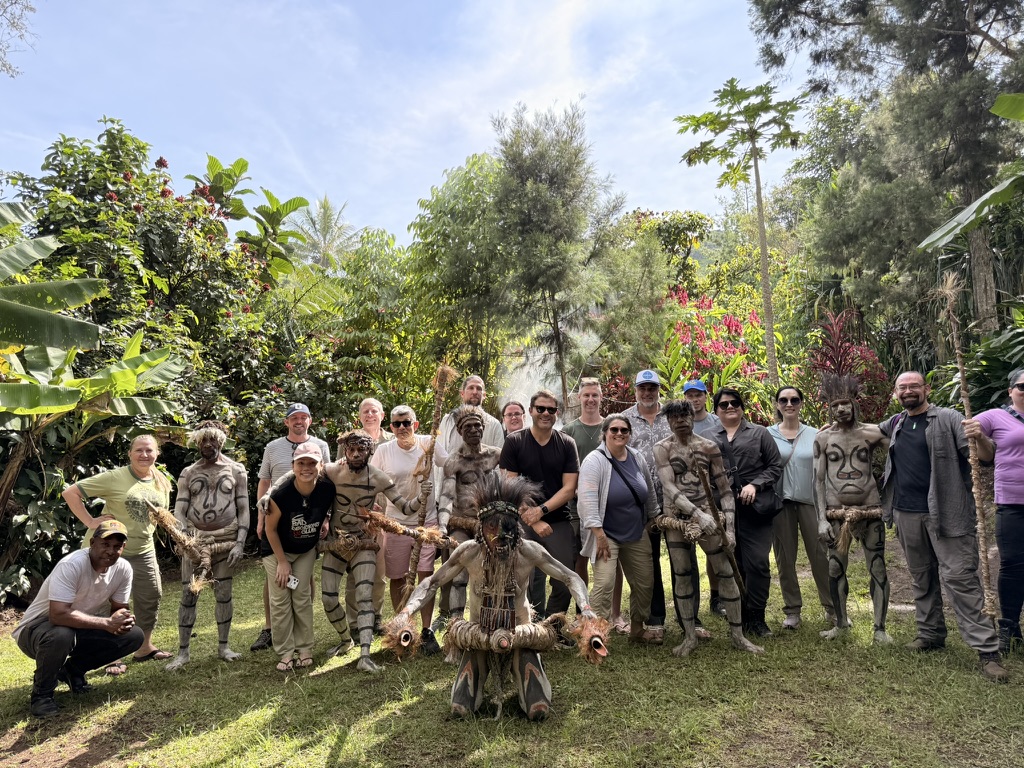
Their bodies were painted completely black, with white bones covering them from head to toe. They looked incredible. They performed their story, explained the monster behind the tradition and then let us walk among them and take photographs.
I had imagined that moment for years. Suddenly I was standing inside their village, surrounded by human skeletons emerging from the jungle. Absolute bucket-list stuff.
What the Skeleton Body Paint Actually Means
The skeleton paint is not just some cool costume invented for Instagram. It represents an old local story about a monster living inside a mountain cave. Different versions of oral traditions can vary. The version told to us involved a monster taking a child. The community’s published account describes hunters disappearing in the mountains before warriors discovered a cave filled with human bones and a monster hiding inside.
The warriors covered their bodies in black and white clay, painting themselves to resemble skeletons. The idea was to confuse the monster into believing they were already dead. They waited until it fell asleep and then escaped back to their village.
So the paint is not really a celebration of death. It remembers the people who used intelligence and deception to survive the monster.
There is another interesting detail too. According to the community’s account, the tradition itself is said to be around 200 years old, but the highly detailed anatomical painting seen today developed much more recently. Earlier generations used broader white markings. During the 1970s, the design became more elaborate, eventually producing the astonishing skeletons we see today.
Staying Overnight at the Skeleton Eco Lodge
We stayed at the Skeleton Eco Lodge, which was actually semi-nice. That is the most accurate review I can give it haha!
It was comfortable enough that you were not suffering, but still remote enough that every insect in Papua New Guinea appeared to have squatters’ rights inside your room. Of course I can tolerate rough accommodation. I have travelled to every country in the world, so I have slept in some absolute sh*tholes. But I hate spiders. HATE THEM. Completely irrational, completely pathetic, do not care.
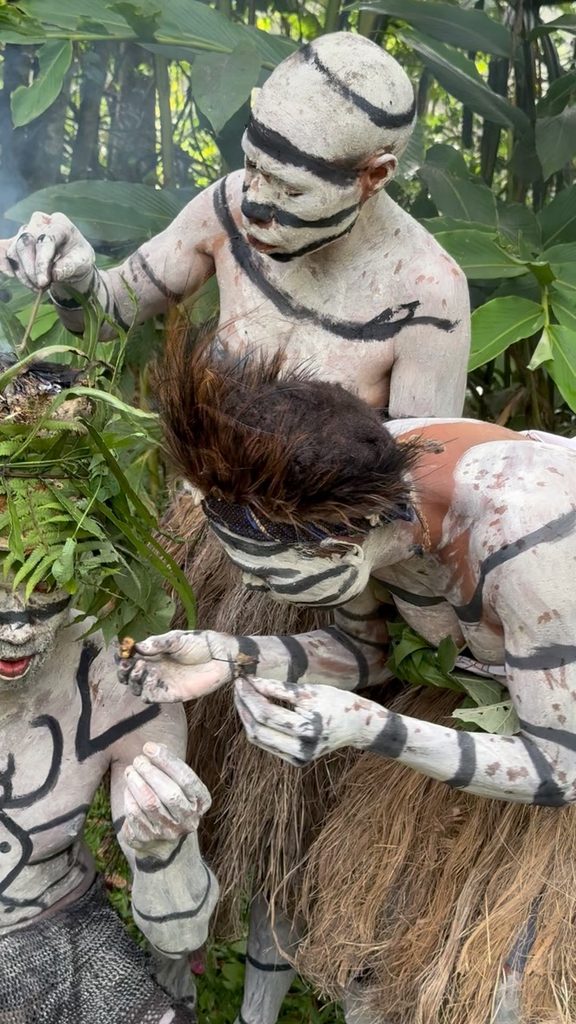
This was made considerably worse by the fact that earlier that day we had met the Insect Hunters. We had watched them handling and eating spiders that looked about the size of my hand. This confirmed two deeply unpleasant facts. First, spiders that size existed. Second, they existed somewhere close enough to walk into my room.
Every shadow became a spider. Every noise became a spider. Every innocent leaf outside the window was obviously a spider preparing an attack.
The lodge was comfortable. The hospitality was lovely. The location was incredible. I still spent half the night inspecting the walls like a terrified lunatic. The whiskey helped though.
You can see the spider if you zoom in here….
The Most Surreal Moment of the Entire Trip
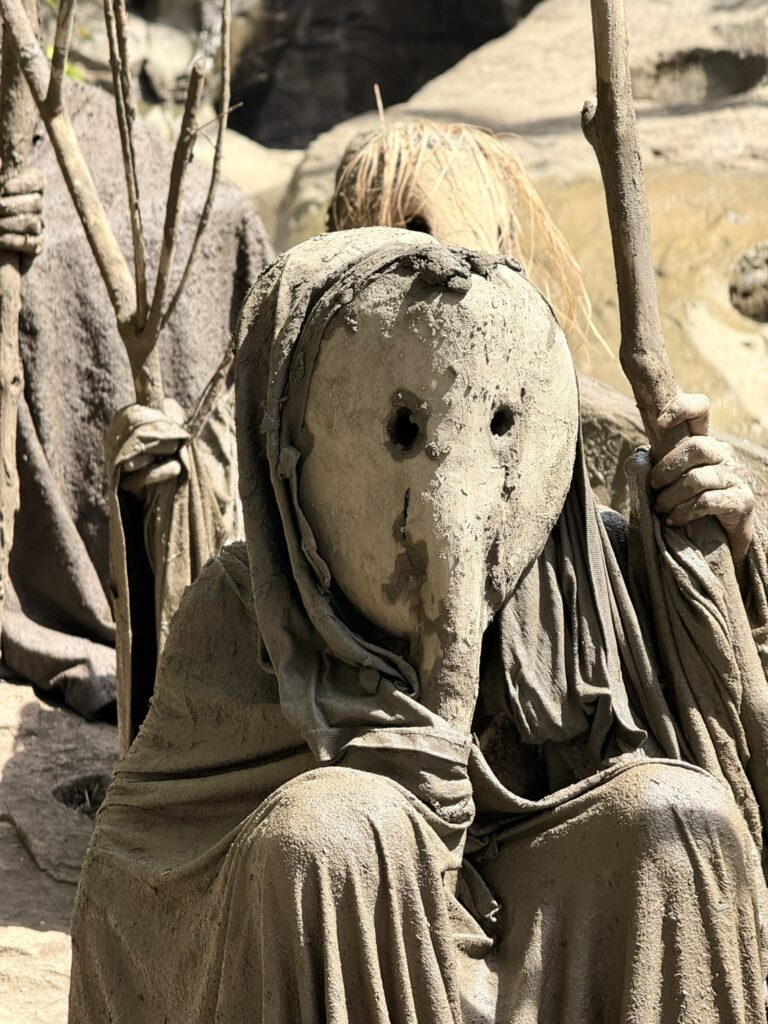
The Skeleton Tribe had been the main reason I organised the trip, but the most surreal moment came from a group I had barely even heard of. We walked down towards a river to meet the Spirit Birds, sometimes called the Birdmen. I had seen them somewhere on the itinerary months earlier, but I had completely forgotten they were coming. Then somebody screamed for us to look up.
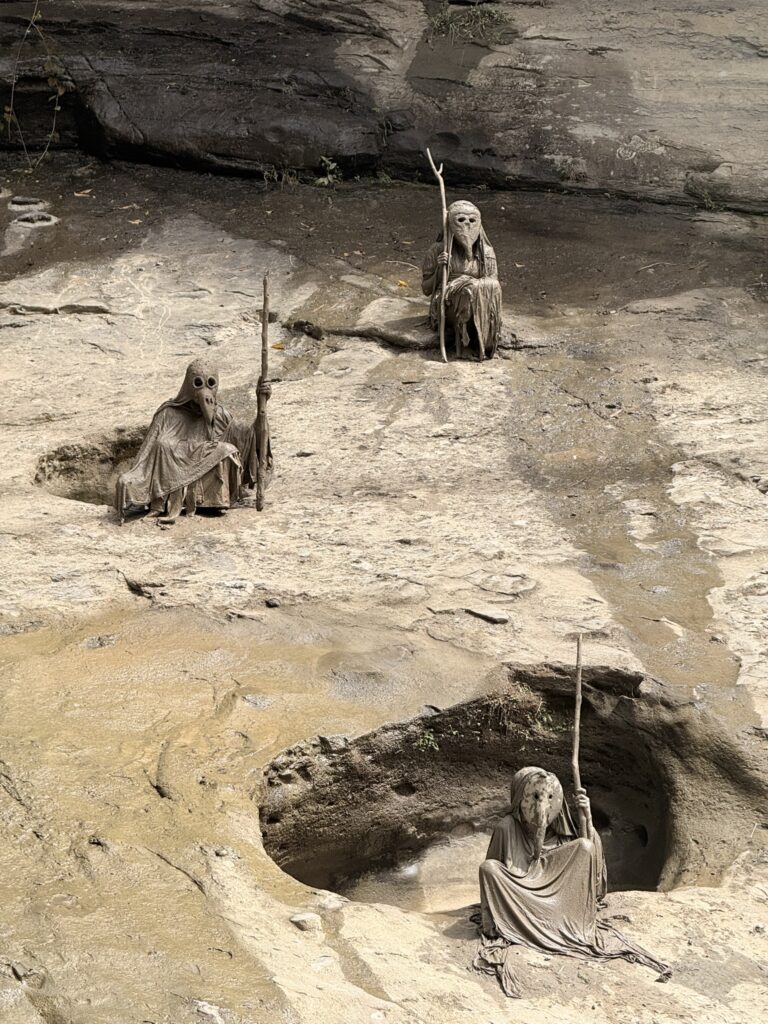
We all looked up and saw these strange mud-covered figures sitting beside the water. They had long, bird-like masks and were completely motionless. At first, I thought they were statues. They did not speak. They barely moved. They just sat there watching us.
It felt like we had stumbled into a scene from another planet. No introduction, no big stage and no bloke with a microphone explaining what we were supposed to be looking at. Just these eerie creatures waiting silently beside a remote river in the Highlands. I had arrived obsessed with the Skeleton Tribe, but the Spirit Birds might actually have been the coolest thing we saw on the entire trip.
An Authentic Encounter or a Performance for Tourists?
Let us be honest. These guys do not wake up every morning, paint themselves as skeletons and sit down to eat breakfast like that.
The paint, masks, costumes and dances are normally used for ceremonies, celebrations and other important occasions. On this trip, they also dressed and performed because we had arranged the visit with the elders and paid the community for their time.
Does that make it fake? I do not think so.
A cultural performance does not automatically become inauthentic because visitors are watching. Does Irish dancing in Dublin for tourists count as fake? We’re not doing that every night before we have dinner are we?!
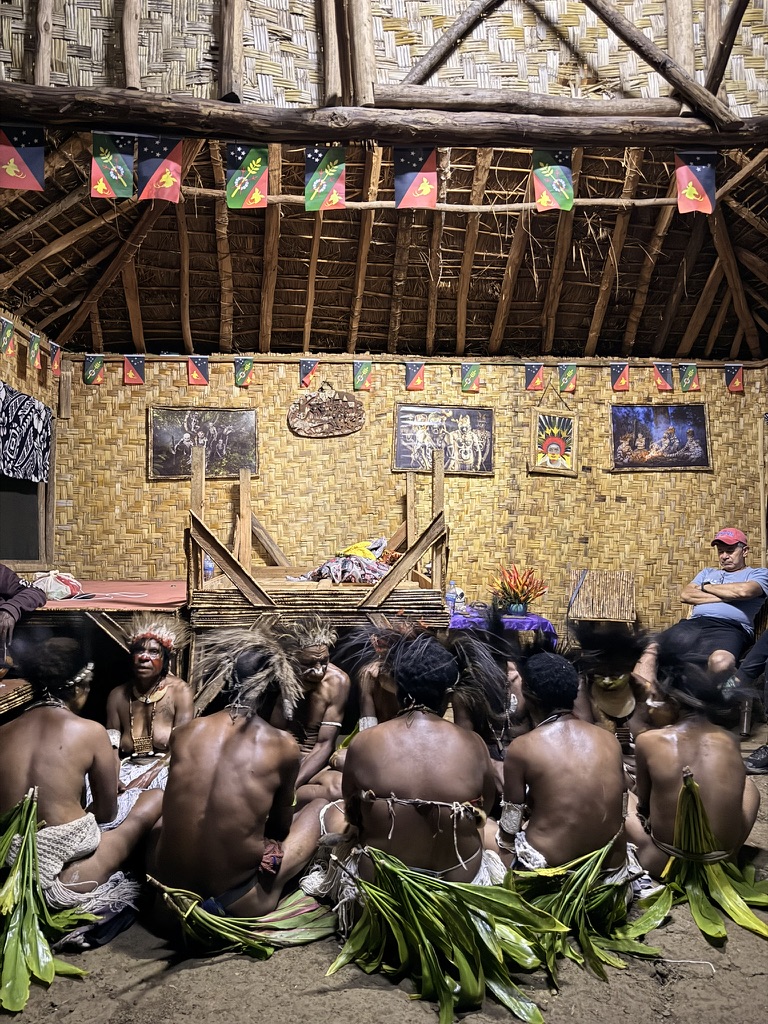
We were inside their villages, hosted by the community and listening to the stories directly from the people who carry those traditions. The performances were arranged for us, but the culture behind them was theirs.
For me, that is entirely different from seeing everyone gathered inside a sports field at Mount Hagen while hundreds of tourists fight for the same photograph. I understand that those festivals have cultural value, but as a visitor, the atmosphere can feel like a human zoo.
Reaching the villages was much harder and much more expensive, but it also felt far more personal. Was it completely untouched by tourism? Of course not. Nothing involving a group of 15 foreigners and several thousand dollars could honestly be described that way. But was it as authentic as a visitor could reasonably experience in 2026? I think so. I would do it the same way again.
Is Papua New Guinea Really That Dangerous?
Yes.
There is no point sanitising this. Papua New Guinea can be extremely dangerous, particularly in Port Moresby, Lae, Mount Hagen and parts of the Highlands. Basically the coolest parts.
Serious crime includes armed robbery, carjacking, kidnapping and endless sexual assault. Tribal fighting can begin suddenly, sometimes involving guns and machetes. Police response can be slow, state resources are limited, and many organisations use private security. If you live there as a foreigner, you’re on a compound with armed security. Simple as that.
Walking around after dark is a terrible idea. Travelling without reliable local contacts is a terrible idea. Arriving with no plan, as I did on my first trip, is an absolutely terrible idea.
Can I prove that Papua New Guinea is literally the most dangerous country in the world? No. Most of those global rankings are bullshit because they measure different things and use unreliable data. But I can say that, from my own experience travelling to every country in the world, PNG is right up there among the most dangerous places I have visited. Top 5 without doubt.
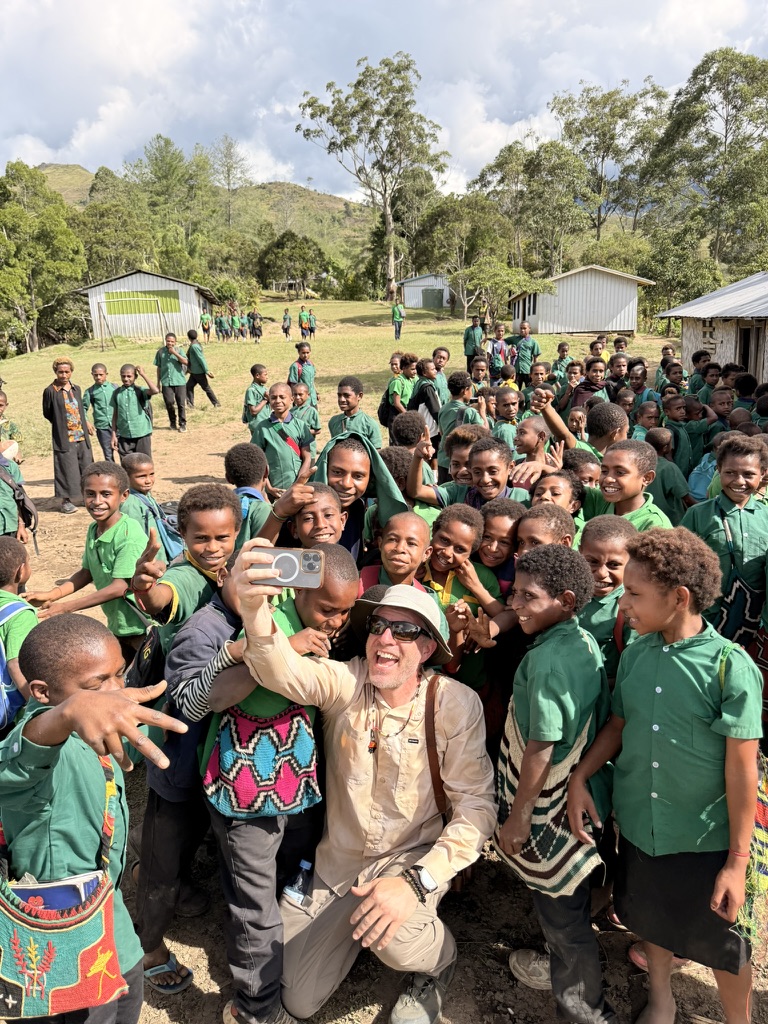
That does not mean everyone in Papua New Guinea is dangerous. We met generous, funny and welcoming people throughout the trip. But friendly people do not magically remove the wider security risks.
Do not travel at night. Do not wander around Port Moresby. Do not depend on public transport. Use trusted local contacts, private vehicles and reputable accommodation. This is not the country for spontaneous backpacking and hoping everything works out. The stories I heard the first time I was there, and now this time, makes your skin crawl. It’S wild.
Of course most people are cool, but let’s say in other countries that’s 99.9% of people. Here it’s more like 95%, for example. So it’s constantly sketchy af.
How to Organise Your Own Papua New Guinea Tribal Tour
Honestly, organising this trip independently would be very difficult. For me too, it took almost a year.
You need somebody with genuine relationships inside the communities. You need the village elders to approve your visit, agree on the payments, organise accommodation and bring together the people involved in each performance. Then you need vehicles, drivers, internal flights and enough flexibility to survive the inevitable delays. And you need to match each village to each village as you move.
If you are travelling alone, the sensible option is to join a specialist small-group tour. The fixed costs are simply too high to carry by yourself. You also want a company or organiser that has worked with the same communities before, not some random person who found an elder’s phone number on Facebook last Tuesday.
Build at least two spare days into the itinerary. Arrange private transport. Avoid road travel after dark. Stay somewhere secure in Port Moresby. Make sure your insurance includes emergency medical evacuation because serious treatment may require flying to Australia.
If your budget cannot stretch to a village-based trip, the Mount Hagen festival is the easier and cheaper way to see many of these groups in one place. It is not my preferred experience, but logistically it makes far more sense for most travellers.
What Would I Do Differently Next Time?
Honestly, very little.
I have thought about running this trip again next year, and I would keep almost the entire Highlands itinerary exactly the same. It worked. We saw nearly ten different cultural groups, stayed inside the communities and experienced the Skeleton Tribe in their own village. That was the whole bloody point.
The only thing I would change would be adding another section at the end to explore New Ireland, New Britain and Bougainville.
Why? Because I’m a massive travel nerd, so let me bore you for a sec:
- New Ireland would bring beaches, remote islands, diving around Kavieng, the Boluminski Highway and its extraordinary Malagan cultural traditions.
- New Britain would add Rabaul, active volcanoes, Japanese tunnels, World War II wrecks and the Baining Fire Dance. The islands were given their English names by European explorers, with William Dampier naming New Britain in 1700 and Philip Carteret naming New Ireland in 1767. They are colonial names, not evidence of some lost group of Irish lads getting spectacularly confused in the Pacific.
- Then there is Bougainville, which might eventually become the world’s newest independent country. It has rainforests, volcanic mountains, reefs, World War II history and a powerful identity of its own. In 2019, 97.7 percent of voters backed independence. As of 28 August 2026, the referendum result has finally been tabled in Papua New Guinea’s Parliament, but Bougainville is not independent yet. The final parliamentary decision is now expected in October. That political process is still unfolding.
Adding those islands would turn an amazing Highlands trip into a much bigger exploration of Papua New Guinea. More expensive, more complicated and probably more stressful. So naturally, I really want to do it haha!
Was Visiting the Skeleton Tribe Worth It?
One hundred percent.
After travelling to every country in the world, it would be easy to become jaded. I have done a lot of cool shit. I have seen extraordinary places, met fascinating people and experienced things that once felt completely impossible.
So finding something that can still make me feel like a kid at Christmas is a blessing.
Standing inside that village and watching the Skeleton Men emerge from the jungle was one of those moments. I had spent months planning it, thousands organising it and far too many hours worrying that a cancelled flight or some random disaster would ruin everything. But it worked.
The whole trip was a huge success. I got to share it with my friends, experience cultures I had wanted to see for years and feel that rare sense that I was not merely passing through life. I was properly fucking living it. That is exactly why I still travel.
If you’re keen for next year, let me know. It’s tough to organise, and I need at least 6 people to just break even on the thing. So let’s see 🙂
Remember, never travel without travel insurance! And never overpay for travel insurance!
I use HeyMondo. You get INSTANT quotes. Super cheap, they actually pay out, AND they cover almost everywhere, where most insurance companies don't (even places like Central African Republic etc!). You can sign-up here. PS You even get 5% off if you use MY LINK! You can even sign up if you're already overseas and traveling, pretty cool.
Also, if you want to start a blog...I CAN HELP YOU!
Also, if you want to start a blog, and start to change your life, I'd love to help you! Email me on johnny@onestep4ward.com. In the meantime, check out my super easy blog post on how to start a travel blog in under 30 minutes, here! And if you just want to get cracking, use BlueHost at a discount, through me.
Also, (if you're like me, and awful with tech-stuff) email me and my team can get a blog up and running for you, designed and everything, for $699 - email johnny@onestep4ward.com to get started.
Do you work remotely? Are you a digital nomad/blogger etc? You need to be insured too.
I use SafetyWing for my digital nomad insurance. It covers me while I live overseas. It's just $10 a week, and it's amazing! No upfront fees, you just pay week by week, and you can sign up just for a week if you want, then switch it off and on whenever. You can read my review here, and you can sign-up here!


 As you know, blogging changed my life. I left Ireland broke, with no plan, with just a one-way ticket to Thailand
and no money. Since then, I started a blog, then a digital media company, I've made
more than $1,500,000 USD, bought 4 properties and visited (almost) every country in the world. And I did it all from my laptop as I
travel the world and live my dream. I talk about how I did it, and how you can do it too, in my COMPLETELY FREE
Ebook, all 20,000
words or so. Just finish the process by putting in your email below and I'll mail it right out to you immediately. No spam ever too, I promise!
As you know, blogging changed my life. I left Ireland broke, with no plan, with just a one-way ticket to Thailand
and no money. Since then, I started a blog, then a digital media company, I've made
more than $1,500,000 USD, bought 4 properties and visited (almost) every country in the world. And I did it all from my laptop as I
travel the world and live my dream. I talk about how I did it, and how you can do it too, in my COMPLETELY FREE
Ebook, all 20,000
words or so. Just finish the process by putting in your email below and I'll mail it right out to you immediately. No spam ever too, I promise!