

The Condition, Not The Number: How To Keep Track Of Offers Worth Using

Image by Ines Arrighi
Work abroad for a year and your wallet fills up with offers that belong to other people’s countries. A supermarket card from the city you left in March. A clothing code that expired while you were on a bus. A trial that renewed onto a card you replaced two moves ago. None of it is written down anywhere, which is the real problem.
The headline number on any of these is the advertisement. The condition underneath it is the offer. A code that excludes the only thing you wanted is worth nothing, and a member price you cannot claim because the scheme will not accept your address is worth less than nothing, because you already spent the attention.
Every sector hides its condition somewhere different, and the hiding place is the thing worth learning. What follows works through four kinds of offer, from a shelf price to the credit a casino sign-up promotion hands a new account, and ends with what a usable record of them actually holds.
Table of contents
- The Condition, Not The Number: How To Keep Track Of Offers Worth Using
- Two Prices On The Same Shelf
- The Code, The Basket And The Price It Gets Measured Against
- The Fees That Arrive After The Price
- The Offers That Charge You For Forgetting
- Deposit Matches, Free Credit, Spins And Money Back
- What The Record Has To Hold
Two Prices On The Same Shelf
Long-term travelers work the grocery aisle out early. One Step 4Ward’s own advice on eating cheaply on the road points at the supermarket late in the day, when the reduced stickers go on and the bakery shelf gets cleared.
Chains have since added a second price that has nothing to do with the clock. The Competition and Markets Authority reviewed around 50,000 loyalty priced products at Tesco, Sainsbury’s, Waitrose, Co-op and Morrisons in 2024, and found 92% carried a genuine saving against the usual price in the same store, worth 17% to 25% on average.
Shoppers did not believe it. Of those surveyed, 55% thought the non-member price had been pushed up to make the promotion look better, and the review found very little evidence of that happening. The condition in this sector was never the price. It is membership.
The same review found room for improvement on access, and floated offline sign-up in store or by telephone for shoppers without a smartphone. The cheaper price and the ability to reach it are two separate things, which makes access the thing to record.
Which? reported in 2025 that some retailers were shutting millions of shoppers out of loyalty prices through the rules on who may hold a card at all. A grocery offer you cannot join is not an offer, and it should never reach your list.
The Code, The Basket And The Price It Gets Measured Against
Clothing promotions move the condition somewhere else. The percentage is usually real. The question is which number it was measured against, and which lines the code quietly refuses.
Which? tracked more than 66,000 prices across 208 products at seven retailers for six months either side of Black Friday 2022, and 98% were available at the same price or cheaper at another point in that year. Almost half, 45%, were cheaper outright at some other time.
A discount states a relationship between two numbers and shows you only one of them. The other one sits in the retailer’s own pricing history, which you cannot see from the checkout page.
So the entry worth keeping is not the percentage. It is the end date, the excluded brands, the minimum spend, and whether the code stacks with the sale rail. Those four facts survive the week. The number on the banner does not.
The Fees That Arrive After The Price
A third kind of condition is the one the seller never states until the last screen. The Competition and Markets Authority put the principle in a single line on 18 November 2025: the first price a customer sees should be the price they pay.
Booking fees are where that breaks. On 19 August 2026 the regulator questioned Trainline over train booking fees of £0.59 to £2.79 and a £1.50 charge on coach tickets, RED Driving School over booking and digital fees above £7, and Virgin Atlantic over resort fees and local taxes left out of holiday package prices.
Charges like those are mandatory, which means the headline was never the total. A saving measured against a price nobody was ever able to pay is not a saving, and a promotion sitting on top of it inherits the same gap. Record the total you were quoted at the final screen, not the one that pulled you in.
The Offers That Charge You For Forgetting
Trials reverse the shape of the whole thing. The benefit lands first and the cost arrives later, so the condition is no longer a basket or a card. It is a date, and it belongs to you rather than to the seller.
The Restore Online Shoppers’ Confidence Act makes a US seller spell out the material terms before it takes billing information, get an express yes to them, and leave a simple way to stop the charges. Sellers clear that bar every day and still bill you, because clearing it only means the renewal date was stated somewhere you clicked through.
Which leaves the cancel-by date doing the work. Put it in the record on the day you sign up, set the reminder several days early, and note which card it bills, because the charge usually outlives the card you meant to cancel it on.
Deposit Matches, Free Credit, Spins And Money Back
Casino sign-up offers arrive in a small number of recognizable shapes. The shape tells you two things at once: what the customer has to do to trigger it, and what the terms fasten onto once it lands.
A deposit match is the common one. The operator matches a percentage of a first deposit up to a ceiling and issues the matched amount as bonus credit, which sits in the account as a balance separate from the cash. Funding the account is the whole trigger, so the customer’s part is over in a minute.
The work happens afterwards, in the play-through, a multiple of the credit that has to be wagered before the balance turns into money that can leave. Game weighting decides how fast that counter moves and it is rarely uniform. Slots usually count in full, blackjack or roulette a fraction of each bet or nothing at all.
Purely as an illustration, and not a quote from any operator’s page, a 100% match on a $50 deposit issues $50 of credit, and at a 15x requirement that credit carries $750 of wagering before a withdrawal is possible. A cap on bet size while the credit is live is common too, and a single bet over the cap can void what the credit has earned.
No-deposit credit reverses the entry condition. Nothing is funded. The account gets registered and identity-checked, and a small credit appears for that alone. Amounts here are the smallest of the four and the terms the tightest, since the operator is paying for a registration rather than for a deposit.
The field that decides this one is the withdrawal cap, a ceiling on how much of anything won with the credit can ever be taken out, and it never appears in the headline. Expiry gets measured in days rather than weeks, and the list of games the credit will play on is usually short.
Bonus spins are denominated in spins on named games at a fixed stake per spin rather than in currency, which is why two offers both advertising 200 spins can be worth very different amounts. The stake per spin and the named titles define the whole thing.
Release is often staggered, twenty or fifty a day across a week, and each tranche carries its own expiry date. The other question is what the winnings turn into, since some offers pay them as cash and others convert them into more bonus credit with a play-through of its own.
A refund-style offer runs backwards. Nothing is claimed at the start. The operator measures net losses across a defined opening window, often a first session or the first 24 hours, and returns a share of them up to a ceiling.
The terms decide whether that money comes back withdrawable or as credit with conditions attached, where the ceiling sits, and when the window opens, since it usually starts at the first deposit rather than at registration.
PlayUSA sets out what each online casino sign up bonus type contains and which restrictions hold the money before a withdrawal clears.
What separates the four is the demand each one makes. One wants a deposit, one wants only a verified identity, one pays out in spins on games the operator picked, and one wants nothing at all until the losses have already been counted. Two offers advertising the same figure can sit in different shapes, and the figure will not tell you which.
What The Record Has To Hold
Set the four side by side and the pattern is easy to see. The headline number is the least stable thing on the page, and in every sector the condition is what decides whether the offer reaches you.
| Offer | What the headline number means | The condition that decides it | Where the terms have to appear |
| Tesco Clubcard Prices | A second, member-only shelf price | Holding a card the scheme will issue you | Shelf label and scheme terms |
| Black Friday Discount Code | A cut against an unshown earlier price | Excluded lines, minimum spend, end date | The code’s own terms page |
| Subscription Free Trial | A period billed at zero | A cancel-by date you have to act on | Before billing details are taken |
| Online Casino Sign-Up Offer | Credit issued against a deposit | Play-through, by type of game | The offer’s own terms page, before you opt in |
So the record is four fields per line, and none of them is the number: the condition, the date it dies, where the terms are published, and what it excludes. Written that way, a list of thirty offers takes two minutes to read and tells you immediately which three are still alive.
Terms also get rewritten more often than offers get launched, and the rewrite rarely comes with an announcement. Short notices of those rewrites land on an X account run by the same publisher, which beats rereading a terms page you saved in March and assuming it still says what it said.
One last filter, and it is the one that keeps the record honest. An offer only saves money against spending you had already decided on. If the condition requires new spending, or a new account, or money moved somewhere you would not otherwise have moved it, the offer is not a discount. It is a price, and it belongs off the list.
That filter bites hardest on the gambling line, where the credit is the operator’s marketing cost rather than anyone’s saving, and where play is for adults only. If the spending there has stopped feeling like a choice, the National Problem Gambling Helpline, 1-800-MY-RESET, runs free and confidential around the clock.
Remember, never travel without travel insurance! And never overpay for travel insurance!
I use HeyMondo. You get INSTANT quotes. Super cheap, they actually pay out, AND they cover almost everywhere, where most insurance companies don't (even places like Central African Republic etc!). You can sign-up here. PS You even get 5% off if you use MY LINK! You can even sign up if you're already overseas and traveling, pretty cool.
Also, if you want to start a blog...I CAN HELP YOU!
Also, if you want to start a blog, and start to change your life, I'd love to help you! Email me on johnny@onestep4ward.com. In the meantime, check out my super easy blog post on how to start a travel blog in under 30 minutes, here! And if you just want to get cracking, use BlueHost at a discount, through me.
Also, (if you're like me, and awful with tech-stuff) email me and my team can get a blog up and running for you, designed and everything, for $699 - email johnny@onestep4ward.com to get started.
Do you work remotely? Are you a digital nomad/blogger etc? You need to be insured too.
I use SafetyWing for my digital nomad insurance. It covers me while I live overseas. It's just $10 a week, and it's amazing! No upfront fees, you just pay week by week, and you can sign up just for a week if you want, then switch it off and on whenever. You can read my review here, and you can sign-up here!









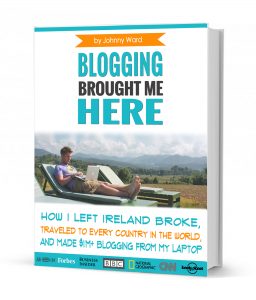 As you know, blogging changed my life. I left Ireland broke, with no plan, with just a one-way ticket to Thailand
and no money. Since then, I started a blog, then a digital media company, I've made
more than $1,500,000 USD, bought 4 properties and visited (almost) every country in the world. And I did it all from my laptop as I
travel the world and live my dream. I talk about how I did it, and how you can do it too, in my COMPLETELY FREE
Ebook, all 20,000
words or so. Just finish the process by putting in your email below and I'll mail it right out to you immediately. No spam ever too, I promise!