

Why More Men Are Looking for Serious Relationships Abroad
A friend of mine deleted four dating apps in one afternoon last March. No breakup, no drama. He just sat down, did the math on the previous fourteen months — something like 900 swipes, 40-odd matches, six actual dates, zero second dates — and decided the machine was broken. Two months later he was texting a woman in Kraków he’d met through a completely different kind of platform, and by August he’d flown there twice.
He’s not an outlier anymore. Guys who want marriage and kids, guys who are done treating dating as a hobby, are widening the map. Which is a big part of why search interest around foreign women looking for American men keeps climbing among men in their thirties and forties who already gave the domestic route an honest run. Not out of bitterness. Out of arithmetic.
Table of contents
The App Fatigue Nobody Wants to Admit
Here’s the thing about swipe platforms: they make money when you stay. A match that turns into a marriage is a churned customer. Nobody at those companies is twirling a mustache about it, but the incentive structure sits right there in plain sight, and after a few years of paying nineteen bucks a month for boosts, most men start to feel it.
The numbers are grim in a specific way. Match-to-conversation rates for the average male profile hover somewhere in the single digits. Conversation-to-date is worse. And the paid tiers keep stacking — see who liked you, jump the queue, undo that swipe you regret. You’re buying lottery tickets in a lottery that profits from your losing.
Then there’s the choice thing. When a woman opens an app in Chicago and sees 4,000 profiles within ten miles, nobody in that stack is irreplaceable. Same goes the other direction, honestly. Abundance kills patience. Why work through a rough second date when there’s a fresh deck waiting?
Men notice this eventually. Some of them stop playing.
What “Serious” Starts to Mean After 30
Ask a 24-year-old what he wants in a partner and you’ll get a list about vibes. Ask a 36-year-old and the list gets short and brutal: does she want kids, does she want them soon, can she talk about money without flinching, will she still be here in a bad year.
That shift catches guys off guard. You spend a decade optimizing for attraction and then wake up optimizing for stability, and the two searches don’t overlap as much as you’d hope. The woman who’s fun on a Friday is not automatically the woman who’ll sit with your mother in a hospital waiting room.
The Timeline Problem
Biology doesn’t negotiate, and neither does energy. A man who wants to be a present father — coaching the team, not just funding it — starts running numbers backward from age 55. Two kids, three years apart, means the first one arrives by 38 if he’s lucky. Dating with an eighteen-month runway feels different from dating with an open one. Suddenly “let’s see where this goes” reads as a red flag rather than a green one.
Overseas, in plenty of places, the assumption runs the other way. Dating carries a stated purpose from the start. You’re not decoding anything.
Where Men Are Actually Looking
Three regions come up constantly, each with real tradeoffs:
Central and Eastern Europe — Ukraine, Poland, Czechia and neighboring countries. Cultural distance from American life is small, education levels run high, and English is common among women under 35. Flights are long and pricey. Visa processes vary a lot by country.
Latin America — Colombia, Brazil, Mexico. Six-hour flights from most of the US, warm family cultures, cheaper to visit repeatedly. Language is the wall. If you’re not willing to grind Spanish or Portuguese for a year, you’ll spend your marriage talking at 60% depth.
Southeast Asia — the Philippines especially, plus Vietnam and Thailand. English fluency in the Philippines is genuinely high. Distance is punishing, though, and the cost-of-living gap between countries is wide enough that motive-checking matters more here than anywhere else.
None of these are shopping catalogs, and men who approach them that way get exactly what they deserve. What they are is different dating markets with different norms about commitment.
The Culture Gap Cuts Both Ways
This is where most articles go soft, so let me be blunt. Marrying across cultures means you’re the foreigner in half the conversations for the rest of your life.
Her family will be involved. Not “we visit at Christmas” involved — involved. In much of Latin America and Southeast Asia, adult children stay financially braided with parents and siblings, and money that flows home isn’t a betrayal of your household budget, it’s a normal obligation she assumed long before you showed up. Sort that out early, in numbers, out loud.
Communication style shifts too. Direct American conflict — “I’m annoyed, here’s why” — reads as aggression in cultures where disagreement travels sideways through hints and third parties. You’ll misread her, repeatedly, and she’ll misread you. That’s not a compatibility failure. It’s just Tuesday for the first two years.
And English fluency on a video call is not English fluency during a fight at 11 p.m. Big difference.
Visas, Money, and the Unsexy Logistics
Two main paths into the US. The K-1 fiancé visa, where she enters and you marry within 90 days, then adjust status. Or the CR-1 spousal visa, where you marry abroad first and she enters with a green card already granted.
K-1 moves faster on paper and slower in practice, since adjustment of status tacks another chunk of time onto the back end. CR-1 takes longer up front but she arrives able to work immediately, which matters more than most guys expect.
Income requirements catch people off guard. K-1 sponsorship runs against 100% of the federal poverty guideline for your household size; the CR-1 affidavit of support requires 125%. Not wealth. Just documented, boring stability.
What the Paperwork Actually Costs
Ballpark, as of this writing — verify current figures with USCIS and the State Department before budgeting, because they’ve moved twice in recent years:
- Fiancé petition filing: roughly $675
- Consular processing and visa fees: several hundred more
- Medical exam at an approved clinic: $200–$500 depending on country
- Adjustment of status after arrival: over $1,400
- Flights, hotels, and two or three trips before anything is filed: $4,000–$8,000 realistically
Total damage lands somewhere north of $8,000 for most couples once travel is counted. Timelines run 12 to 20 months. Anyone promising a bride by Christmas is selling something.
The Scam Problem, Stated Plainly
Certain sites make money per message translated. Read that sentence again. If a platform charges by the letter, every woman on it has a financial reason to write slowly and forever, and some of those “women” are a room of employees in a call center.
Filters that work:
- Video call within the first week. Live, unscheduled, face visible. A refusal is your answer.
- Reverse image search on every photo. Takes four minutes.
- Any money request, in any amount, for any reason. Sick mother, stolen phone, customs fee on a gift she’s sending you. It’s always a story. It’s never true.
- Vagueness about her city, job, or family. Real people overshare about work.
The men who get burned aren’t stupid. They’re lonely and hopeful, and those two feelings together will talk you past evidence you’d never ignore in a business deal.
How the Guys Who Make It Work Do It
They visit early. Not after eight months of texting — after six weeks. Cheaper to lose a plane ticket than a year.
They visit twice before filing anything, and the second trip runs long enough to get boring. Boring is the test. Anybody can be charming across four days.
They learn the language badly and out loud. Fifty words, terrible accent, zero shame. Her parents will forgive the grammar and remember that you tried.
They meet the family and read the room. Who defers to whom, where the money sits, what’s expected of a son-in-law.
They plan on two years and treat anything faster as luck.
Remember, never travel without travel insurance! And never overpay for travel insurance!
I use HeyMondo. You get INSTANT quotes. Super cheap, they actually pay out, AND they cover almost everywhere, where most insurance companies don't (even places like Central African Republic etc!). You can sign-up here. PS You even get 5% off if you use MY LINK! You can even sign up if you're already overseas and traveling, pretty cool.
Also, if you want to start a blog...I CAN HELP YOU!
Also, if you want to start a blog, and start to change your life, I'd love to help you! Email me on johnny@onestep4ward.com. In the meantime, check out my super easy blog post on how to start a travel blog in under 30 minutes, here! And if you just want to get cracking, use BlueHost at a discount, through me.
Also, (if you're like me, and awful with tech-stuff) email me and my team can get a blog up and running for you, designed and everything, for $699 - email johnny@onestep4ward.com to get started.
Do you work remotely? Are you a digital nomad/blogger etc? You need to be insured too.
I use SafetyWing for my digital nomad insurance. It covers me while I live overseas. It's just $10 a week, and it's amazing! No upfront fees, you just pay week by week, and you can sign up just for a week if you want, then switch it off and on whenever. You can read my review here, and you can sign-up here!








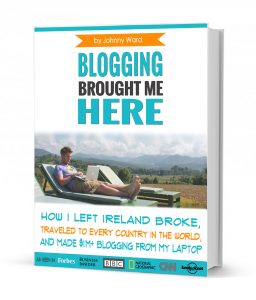 As you know, blogging changed my life. I left Ireland broke, with no plan, with just a one-way ticket to Thailand
and no money. Since then, I started a blog, then a digital media company, I've made
more than $1,500,000 USD, bought 4 properties and visited (almost) every country in the world. And I did it all from my laptop as I
travel the world and live my dream. I talk about how I did it, and how you can do it too, in my COMPLETELY FREE
Ebook, all 20,000
words or so. Just finish the process by putting in your email below and I'll mail it right out to you immediately. No spam ever too, I promise!
As you know, blogging changed my life. I left Ireland broke, with no plan, with just a one-way ticket to Thailand
and no money. Since then, I started a blog, then a digital media company, I've made
more than $1,500,000 USD, bought 4 properties and visited (almost) every country in the world. And I did it all from my laptop as I
travel the world and live my dream. I talk about how I did it, and how you can do it too, in my COMPLETELY FREE
Ebook, all 20,000
words or so. Just finish the process by putting in your email below and I'll mail it right out to you immediately. No spam ever too, I promise!